The Solana price stands at $120.36 on Tuesday midday, which is €106.86. Against the previous day almost nothing has moved, 0.09 percent lower. The interesting number of the day is therefore n
The Solana price stands at $120.36 on Tuesday midday, which is €106.86. Against the previous day almost nothing has moved, 0.09 percent lower. The interesting number of the day is therefore not the price itself but what sits beneath it: the 20-day moving average runs at $117.32, less than three percent below the current level. Above it, the high of the past 90 days waits at $122.08. Solana has been wedged between those two marks for days, while in the background the largest rebuild the network has ever had is under way, and nobody is saying when it arrives.
This article puts both together: where the price really stands, which three levels bound it, what the Alpenglow consensus switch means for holders in Germany, and which deadlines you need to know before you react to a move.
Solana price on October 6: $120.36, €106.86 and a daily range of 2.1 percent
The day's range ran from $118.97 to $121.51. That is 2.13 percent between low and high, an unusually tight day for Solana. Trading volume over 24 hours came to roughly $2.48 billion, market capitalisation to $70.8 billion. That puts Solana seventh among the largest crypto assets by market value. There are 588,385,318 SOL in circulation.
Depending on the period you pick, the same price tells three different stories. Over the week there is a gain of 0.77 percent, which is effectively a flat line. Over 30 days it is up 12.87 percent, with the price coming from $106.49. Over one year, by contrast, it is down 48.25 percent. And from the all-time high of $293.31, set on January 19, 2025, the price is still 58.96 percent away.
Anyone calculating in euros gets a slightly different figure, because the euro-dollar rate moves alongside. We worked through this gap between the euro view and the dollar view in a separate piece on October 5. For your tax return only the euro value counts, not the dollar price in the app.
In brief: Market capitalisation is the price multiplied by the number of coins in circulation. That figure says what all existing SOL would currently be worth together, not how much money has flowed into the network.
The three Solana price levels above and below: $122.08, $117.32 and $106.50
Levels are not an oracle. They are prices at which a striking amount was traded in the past, and therefore places where supply and demand tend to meet. Three of them are cleanly measurable on Solana right now.
$122.08 on the upside. That is the highest daily close of the past 90 days. The price has run at this zone several times in recent days and has stayed below it every time. A daily close above it would be the first signal that the sideways phase is ending.
$117.32 on the downside. That is the average of the past 20 daily closes. This line has run below the price since the middle of September and has caught it more than once. A break of this line would end the short-term uptrend.
$106.50 as the second step. That is the average of the past 50 daily closes and at the same time almost exactly the level of 30 days ago. If the price falls back there, the entire monthly gain would be handed back.
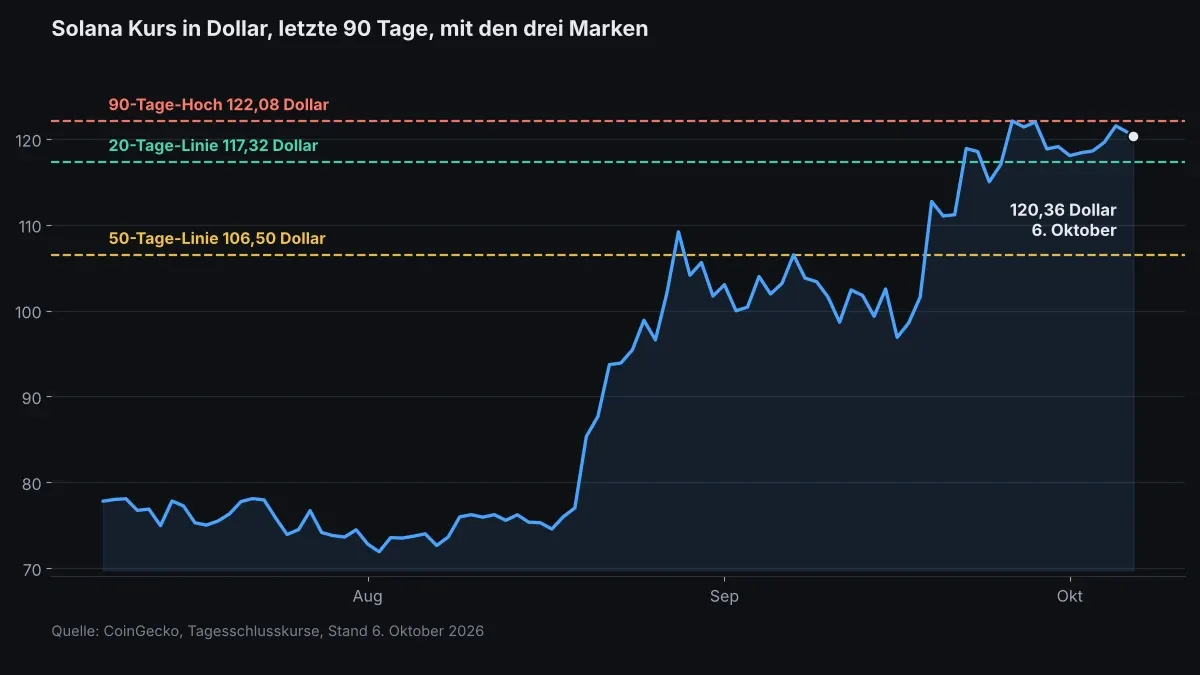
The price is wedged between the 90-day high and the 20-day line, a good three percent of room to the downside.
For context on the downside: the low of the past 90 days was $71.89, and the 200-day moving average runs at $86.27. Both are far away. The medium-term uptrend is therefore intact, even if the price is making no headway at the moment. How far the range on Solana can spread out in an October historically is something we recalculated in our review of previous years.
Will the $117.32 level hold? The honest answer is that nobody knows in advance. What you can do with it is another matter. You now know three concrete prices at which you can decide beforehand what you will do, instead of deciding in the moment of the move. That is exactly what levels are for.
Alpenglow: what the consensus switch changes technically
Alpenglow is the name for the largest intervention in the heart of Solana since launch. It sits in client version Agave 4.3, and the project's overview page lists it under Network Upgrades with the status "In Development" and the window October 2026.
In brief: Consensus is the procedure by which all computers in a network agree on which transactions are valid and in what order they stand. Replacing the consensus means replacing the foundation everything else rests on.
Two building blocks are being swapped out. Votor takes over the role of TowerBFT, the voting logic used so far. Rotor replaces Turbine, through which new blocks are distributed across the network. The intended result is stated on the project page: around 150 milliseconds to final confirmation of a transaction, instead of 12.8 seconds today.

The lever is set but not locked in: Alpenglow is fully developed and still not active.
For operators the cost calculation changes markedly. So far a validator pays ongoing fees for its voting transactions, up to about one SOL per day according to the analysis by infrastructure provider Helius. Alpenglow replaces these individual votes with a bundled certificate procedure, and the running fee falls away. Helius therefore puts the minimum stake at which running your own validator pays off at around 450 SOL in future, instead of roughly 4,850 SOL today. That is the analysis's figure, not a commitment from the project.
Alpenglow without a fixed date: September 28 passed with no switch
At the end of September it circulated on social networks that Alpenglow would go to mainnet on September 28. The developer team Anza explicitly contradicted this, and the switch did not take place that day. In early October the mainnet is still running under the old procedure.
The project still names only the October 2026 window and no date. For you as a holder that is less irritating than it sounds, but it has one practical consequence: a date that can arrive any day cannot be planned around. Anyone making their reaction depend on noticing the switch beforehand is planning on information that may only be available afterwards.
The sober reading: Alpenglow is an improvement in the technology, not an event that has to move a price mechanically. Experience with network switches points in both directions, and anyone translating the switch into a particular price today is working with a number that does not exist.
Frankendancer ends: your validator and the client question
In brief: A client is the software a validator runs to take part in the network. Several independent clients are considered a security advantage, because a bug in one of them then does not paralyse the whole network.
Alongside the standard client Agave, Frankendancer has been running since 2024, an interim solution from Jump Crypto. This client combines the fast networking part of the Firedancer client with the consensus logic of Agave. That consensus logic is precisely what Alpenglow replaces. Jump Crypto has therefore announced that it will discontinue support for Frankendancer with the activation and concentrate its efforts on the full Firedancer client.
If you have delegated SOL, this affects you indirectly. Your delegation sits with a specific validator, and that operator has to carry out the change. In your wallet's explorer you can see which validator your delegation goes to, how high its commission is and how reliably it has worked recently. That is a detail worth looking at once before a network switch, and before the switch runs rather than after. Anyone staking their SOL through a provider instead of delegating themselves will find the details on commission and payout rhythm at the respective service; our overview of staking platforms sets the terms side by side.
Epoch 1050 is 71 percent through: how long deactivating a delegation takes
Here lies the deadline that matters most in everyday use and that the fewest people know. Solana counts in epochs. One epoch covers 432,000 slots. The network currently stands in epoch 1050 at slot 307,080, so roughly 124,920 slots are still open. At the current roughly 400 milliseconds per slot, that corresponds to just under 14 hours.
The point of it: anyone who deactivates a delegation is not free immediately. The deactivation takes effect at the end of the current epoch, and only after that can the balance be withdrawn and sold. Between your click and the moment you can actually trade there is therefore half a day to a full day on average, depending on when in the epoch you decide.
If you take your levels from the second section seriously, a clear consequence follows: a staked holding is not a tradable holding. Anyone who wants to sell at $117 but only starts deactivating at $117 sells at a different price. Network inflation in the current epoch stands at 3.62 percent a year according to the network query, and that yield is the price you receive for the reduced mobility. Whether the trade is worth it to you depends on whether you were going to leave the holding untouched anyway.
Solana staking taxes in Germany: the €256 threshold and section 22 no. 3 of the Income Tax Act
For tax purposes, price gains and staking income in Germany run through two different sections, and many people confuse the two.

Two sections, two thresholds: income from staking and the gain from a sale are treated separately.
With passive staking, the ongoing staking rewards generally count as income from services under section 22 no. 3 of the German Income Tax Act. A threshold of €256 per calendar year applies to it. Threshold means: stay below it and the amount is tax free. Exceed it by even one euro and the entire amount is taxable, not just the part above the line. That is the difference from an allowance, where only the portion above it counts.
What counts is the euro value at the moment of receipt, meaning the day the reward is credited to your account. On Solana that happens epoch by epoch, so several times a week. These many small inflows are the reason why keeping records by hand gets confusing fast with staking; tax and portfolio tools read the inflows automatically and convert them into euros at the rate of the respective day.
The holding period stays at twelve months: the German finance ministry letter of March 6, 2025
Section 23 of the Income Tax Act applies to the sale of the SOL themselves. If you sell within twelve months of buying, the gain is taxable, with a threshold of €1,000 a year for all private disposal transactions together. After twelve months have passed, the gain is tax free regardless of its size.
For a long time it was disputed whether this period extends to ten years if the coins are staked in the meantime. The Federal Ministry of Finance has rejected that. In the letter of March 6, 2025, which replaces the version of May 10, 2022, it expressly remains at twelve months even if the crypto assets were used for staking or lending in the interim.
In practice that means staking does not extend your holding period. It does create a second stream of income that has to be recorded on an ongoing basis, and the rewards received this way start their own holding period from the day they arrive. The letter also stresses the duties to cooperate and keep records: anyone declaring income has to be able to document it.
This section is no substitute for tax advice. With larger holdings, where there is proximity to a commercial activity, or with staking through foreign providers, a visit to a specialist is worthwhile.
Buying and holding Solana: costs, custody and the route through an exchange
If you want to add to a position or get in for the first time after this article, three items decide your result more than any price forecast does.
First, total costs. The advertised trading fee is the wrong number to go by. What decides your result is the sum of fee, spread and deposit costs. The spread is the gap between the buying and selling price and appears in no fee table. In a tight market like Solana it is small, but with small amounts it still carries weight. Which providers in Germany let you trade on which terms is set out in our exchange comparison.
Second, custody. If the SOL sit on the exchange, the keys belong to the provider. For small amounts that is defensible; for a holding you want to keep for years, your own wallet is the cleaner solution. Anyone holding and delegating themselves also keeps the free choice of validator from the section above.
Third, record keeping. Every purchase needs a date, a quantity and a euro equivalent, otherwise the twelve-month period cannot be documented later. At the moment you buy, that is a matter of seconds; two years later it is a matter of hours.
Solana price and Alpenglow: how to proceed now
- Write down the three levels. $122.08 on the upside, $117.32 as the first step down, $106.50 as the second. Decide beforehand what happens at which daily close. If you want to change provider while you are at it, compare the total costs first in the exchange comparison.
- Look at your delegation. Which validator, which commission, which client. And build the just-under-14 hours to the end of the epoch into your plan before you set a level as a selling point. The providers' terms are in the staking overview.
- Check your €256. Add up what has reached you in staking rewards this year, in euros at the rate of each day of receipt. If you are close to the threshold, it is a decision before the end of the year and only a declaration afterwards. A tax tool takes the adding up off your hands.
(As of October 6, 2026. This article is not investment advice. Prices and fee structures change; check the terms with the provider before you buy.)