A blockchain API is the layer between a product and the chains it reads or trades on. In 2026 that layer does more than fetch a price. It decodes wallets across dozens of networks, streams or
A blockchain API is the layer between a product and the chains it reads or trades on. In 2026 that layer does more than fetch a price. It decodes wallets across dozens of networks, streams order books, and answers AI agents that never open a dashboard.
Demand has grown on both sides. According to a16z crypto’s State of Crypto 2025 report, blockchains now process more than 3,400 transactions per second. About 181 million addresses were active onchain each month. On the builder side, 1 in 3 crypto developers already work on multiple chains, per the Electric Capital 2024 Developer Report. One vendor per chain no longer scales.
This review ranks 12 blockchain APIs for developers across five layers: enriched data, node access, explorers and indexing, DeFi and oracle data, and execution. It builds on our developer deep dive on crypto APIs and extends it to the infrastructure layers that piece left out. Prices and limits were checked in October 2026.
What Changed for Blockchain APIs in 2026
Three shifts shaped this review. AI agents became API consumers. Developers spread across more chains. And trusting a single data source became a design flaw rather than a convenience.
Agents first. Per Postman’s 2025 State of the API Report, 24.3% of developers already design APIs with AI agents in mind. Only 10% use the Model Context Protocol (MCP) regularly. “APIs are no longer just powering applications, they’re powering AI agents,” says Abhinav Asthana, co-founder and CEO of Postman. Eight of the 12 APIs below now ship an MCP server, the standard that lets an agent reach a service as a tool. Six of those serve chain data; Codex’s serves its docs and Chainstack’s manages nodes.
Chains second. The Ethereum Foundation, citing Electric Capital data, counted 16,181 new developers joining Ethereum between January and September 2025. In the Solidity Developer Survey 2025, 52% of respondents deploy to Ethereum mainnet, 40% to Base and 35% to Arbitrum. A blockchain API that stops at one chain now stops short of most teams.
Trust third. Two execution clients, Geth and Nethermind, ran 79% of Ethereum nodes in the October 2025 snapshot on ethereum.org’s client diversity page. The same concentration risk applies to data vendors. “A market structure dominated by a few RPC providers is one that will face strong pressure to deplatform or censor users,” wrote Vitalik Buterin, co-founder of Ethereum, on Ethereum Research in May 2025.
Editor: embed this post with the X (Twitter) embed block using https://x.com/VitalikButerin/status/2012231445809435134. The quote below is the fallback text only.
“2026 is the year that we take back lost ground in terms of self-sovereignty and trustlessness. Helios: actually verify the data you’re receiving from RPCs instead of blindly trusting it.” Vitalik Buterin on X, January 16, 2026: https://x.com/VitalikButerin/status/2012231445809435134
The practical rule for 2026: run one primary provider per layer, and know which second provider you would switch to. The 12 APIs below are organized so that the second choice is always visible.
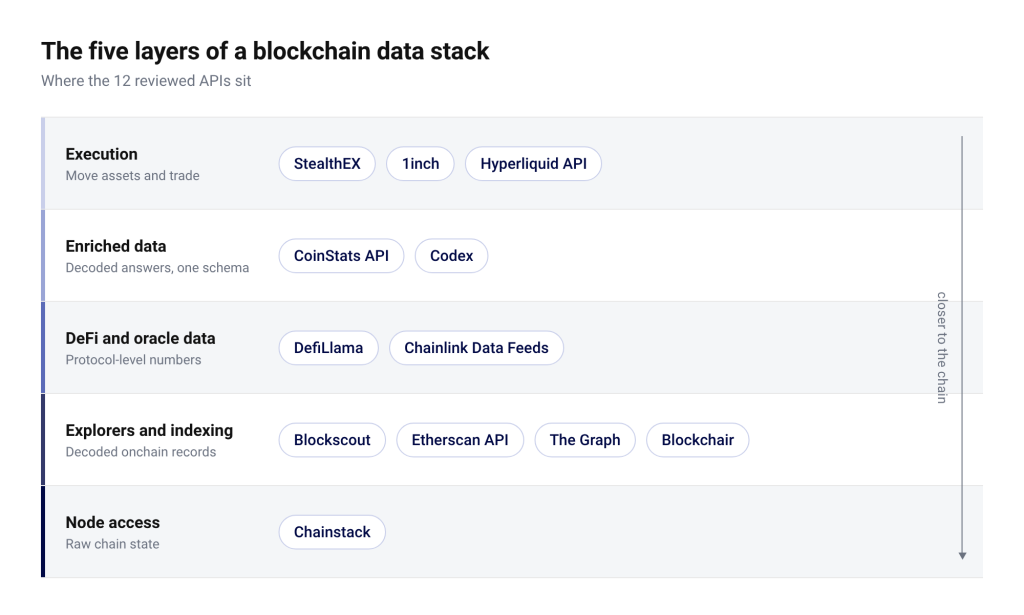
The five layers of a blockchain data stack and where the 12 APIs sit
How This Review Was Scored
Each API was scored 1 to 5 on six criteria: coverage, depth, delivery, AI readiness, free tier, and price after the free tier. Coverage counts chains and assets. Depth measures how much of its own job the API finishes without extra code, such as decoded DeFi positions or a complete order flow.
Delivery covers protocols and streaming: REST, GraphQL, WebSocket, gRPC and SDKs. AI readiness checks for an MCP server, agent tooling and pay-per-call billing. Free tier weighs the published allowance and whether a key is required. Price after free uses the cheapest published monthly plan.
Scores reward fit for a job, not company size. Every figure comes from provider documentation, pricing pages and published partner profiles, checked in October 2026. Where a figure is not published, the review says so instead of guessing.
At a Glance
Primary focus
Coverage
Wallet/Onchain data
MCP / AI support
Free tier
CoinStats API
Market, wallet, DeFi, portfolio, token risk
120+ chains, 100,000+ coins, 200+ exchanges
Balances, transactions, DeFi positions per wallet
MCP Server, x402 pay-per-request
20,000 credits/mo, 2 req/s
Chainstack
Managed RPC nodes
70+ chains
Raw chain state, archive, traces
MCP for node ops only
3M request units/mo, 25 req/s
StealthEX
Non-custodial swaps
2,000+ assets
None (execution only)
No MCP; REST for bots
Free integration, 600 req/min
Codex
Real-time token and prediction-market data
80+ networks, 107M+ tokens
Token balances, holders, DEX data
MCP server, agent skills, MPP pay-per-request
10,000 req/mo after $1 activation
Blockscout
Open-source explorer API
100+ EVM chains
Balances, logs, traces, verified contracts
MCP server (16 tools), agent skills
100,000 credits/day, 5 req/s
Etherscan API
Explorer data standard
60+ EVM chains
Balances, transfers, logs, ABI
MCP (21 tools), keyless MCP, CLI
100,000 calls/day, 3 req/s
The Graph
Decentralized indexing
60+ networks (Token API: 10)
Subgraph entities, token balances and transfers
Two MCP servers
100,000 queries/mo
DefiLlama
DeFi aggregates
500+ chains, 7,000+ protocols
None (protocol level)
MCP on paid plan
Open API, no key
Hyperliquid API
Onchain perp and spot exchange
One venue (HyperCore, HyperEVM)
Positions, fills, order books
No official MCP
No key, no fee
1inch Swap API
DEX routing and intents
17 EVM chains plus Solana
Balances, portfolio, history
MCP server, x402 pay-per-call
100,000 calls/mo, 60 req/min
Chainlink Data Feeds
Oracle reference prices
Dozens of networks
None (price and reserve data)
None
Onchain reads, gas only
Blockchair
Explorer API for UTXO chains
Under 20 chains via API
Addresses, outputs, xpubs
None
1,000 calls/day trial
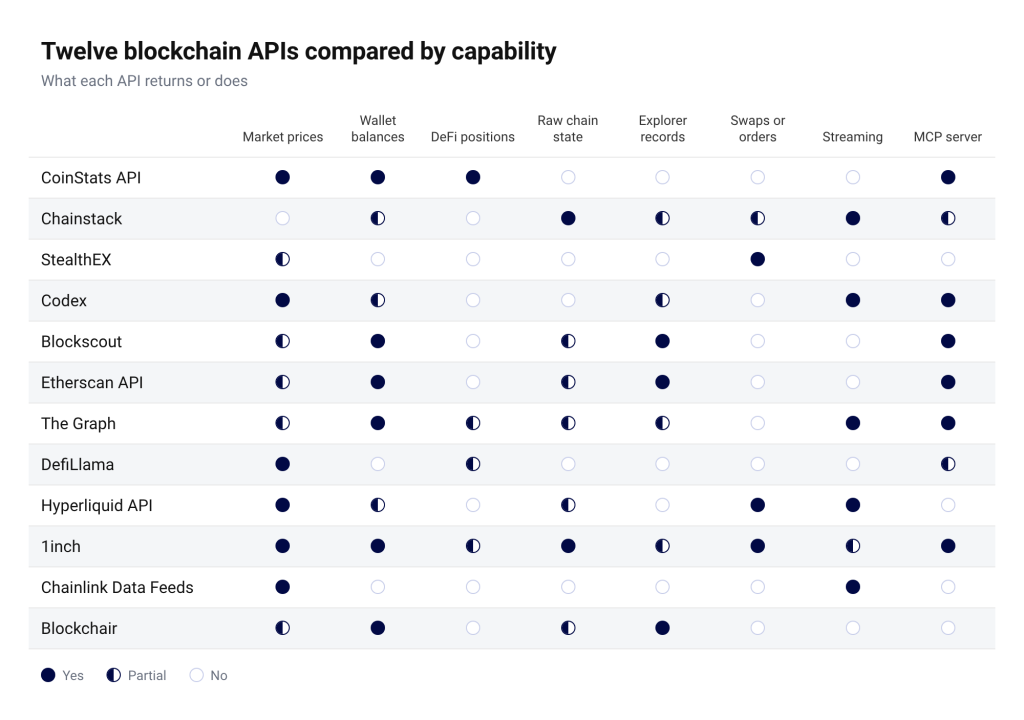
Twelve blockchain APIs compared by capability
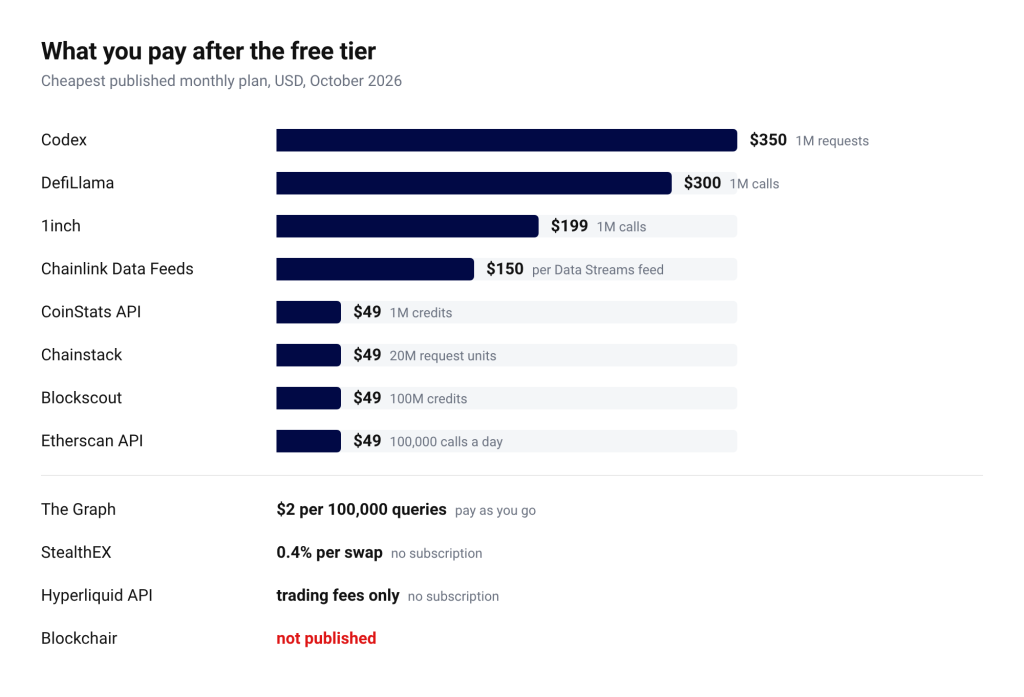
What each blockchain API costs after the free tier
Choosing the Right API (or Combination)
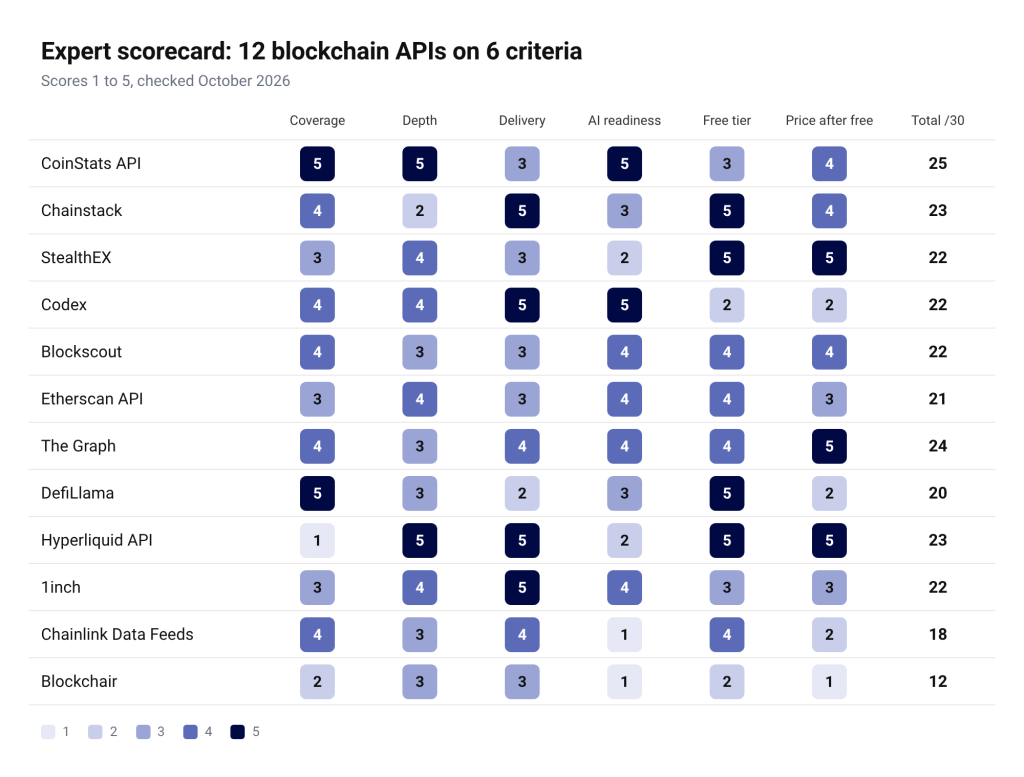
Expert scorecard: 12 blockchain APIs scored on six criteria
Start from the job, not the brand. A product that shows users what they own needs decoded data: balances, DeFi positions, prices and risk flags in one schema. CoinStats API finishes that job with one key, and it is the default starting point for most crypto products. Codex is the second data pick when sub-second token and prediction-market feeds matter more than DeFi positions.
A product that needs raw chain state, archive history or its own transaction submission needs a node layer. Chainstack covers 70+ chains with metered billing and Solana streaming. Blockscout and Etherscan API sit one layer up and return explorer-shaped data with verified contracts. The Graph fits when the data model is yours to define.
A product that moves assets needs execution. StealthEX embeds cross-chain instant swaps without custody or routine KYC. 1inch routes onchain DEX swaps and cross-chain intents, and Hyperliquid API is the venue for perp and spot order flow. The Chainstack and GetBlock swap-exchange comparisons, linked in the StealthEX and 1inch sections below, cover the venues behind those APIs.
DeFi dashboards and oracle consumers are special cases. DefiLlama answers protocol-level questions for free, and Chainlink Data Feeds answer price questions inside a contract. Blockchair is the Bitcoin-first pick when SQL-style queries and bulk dumps matter more than chain breadth.
Chain coverage sets the shortlist before any feature does. Ethereum still draws the most new developers, and the chains your users hold on decide which APIs qualify. Weight coverage by your own user base, not by the longest chain list.
Editor: embed this post with the X (Twitter) embed block using https://x.com/ethereumfndn/status/1978492951874687020. The quote below is the fallback text only.
“New data confirms: Ethereum is the #1 ecosystem for new developers in 2025.” Ethereum Foundation on X, October 15, 2025: https://x.com/ethereumfndn/status/1978492951874687020
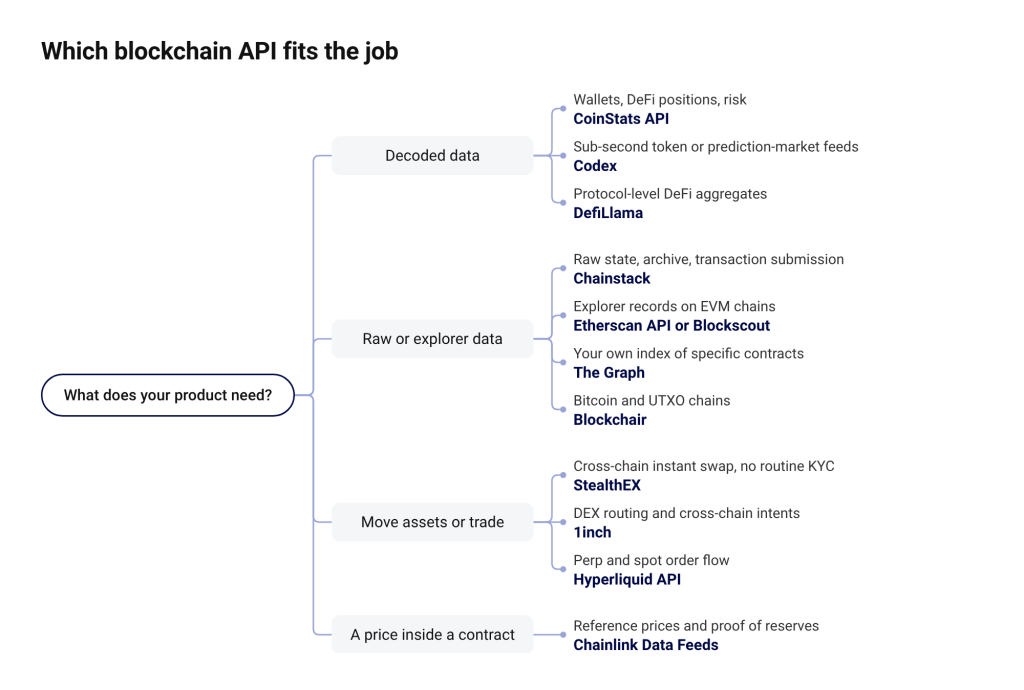
Decision tree: which blockchain API fits your build
Most production stacks combine two or three of these. A portfolio app pairs CoinStats API with Chainstack for transaction submission. A trading bot pairs Codex for data with Hyperliquid API or 1inch for execution. A wallet pairs CoinStats API for balances with StealthEX for swaps.
Start with one provider per layer. Add a second when a limit bites: a rate cap, a missing chain or a price jump at the next tier. Per the Stack Overflow 2026 Developer Survey, 48% of developers trust AI output when they can easily verify it. Treat blockchain data the same way, and keep a second source for anything that moves money.
1. CoinStats API
CoinStats crypto API is the best fit for most crypto products because one key covers market data, wallet balances, DeFi positions, portfolio analytics and token security. It tracks 100,000+ coins, 200+ exchanges, 120+ blockchains and 10,000+ DeFi protocols. Wallet reads span 70+ EVM chains, Solana and Bitcoin, with xpub, ypub and zpub support for HD wallets.
Depth is the differentiator. CoinStats API is the only API in this review that resolves DeFi positions per wallet across 10,000+ protocols. Staking, lending and LP tokens arrive as positions for any address, not as opaque contract balances. Token Risks screens honeypots, hidden fees, mint and burn controls and blacklists before a token reaches a tracker.
For agents, MCP Server exposes the same wallet, DeFi and portfolio data through 20+ tools. An x402 option lets an agent pay per request in USDC on Base with no account or key. The company’s own guide to the best blockchain APIs breaks the use cases down. Our review of multichain portfolio APIs covers the wallet side in detail.
Pricing is credit-based. The free tier gives 20,000 credits a month at 2 requests a second, with no card required. Starter is $49 a month for 1,000,000 credits at 30 requests a second, roughly $0.05 per 1,000 basic market calls. Standard is $199 a month for 5,000,000 credits.
Best for: any crypto product that needs market data, wallet balances, DeFi positions, portfolio analytics and token security from one key. That spans portfolio trackers, tax tools, trading bots and AI agents.
Limitations: wallet and DeFi calls cost 40 to 400 credits each, so a wallet-heavy app burns the free tier quickly. REST and MCP are the only interfaces; there is no WebSocket feed. All-network queries carry a 10x credit multiplier, so name the chain when you can.
2. Chainstack
Chainstack runs the node layer for teams that want raw chain state without operating infrastructure. Founded in 2018 and headquartered in Singapore, it offers managed RPC across 70+ chains, including Ethereum, Solana and Bitcoin, plus dedicated and self-hosted nodes for teams that need isolation. It handles 10B+ API calls a day across 10+ data centers. Access runs over JSON-RPC and WebSocket, with gRPC on Solana, TRON and Sui and GraphQL on Sui.
Global Nodes route each request to the nearest healthy region and fail over when a node lags by more than 40 blocks. On Solana, Yellowstone gRPC streams live data from validator memory, and Trader Nodes push Warp transactions through bloXroute at $0.15 each. Compliance is current: SOC 2 Type II in December 2025 and ISO 27001 in July 2026, with 99.99%+ uptime. Trust Wallet, Circle and TradingView appear on the homepage as customers.
“Our mission is to make blockchains boring. When your product runs on blockchain, you want uptime, control, and consistency, not operational drama,” says Eugene Aseev, co-founder and CTO of Chainstack.
Billing is metered in request units: a full-node call costs 1 unit and an archive call costs 2. The Developer plan is free with 3 million units a month at 25 requests a second, and it never expires. Growth is $49 a month for 20 million units at 250 requests a second, with archive data and the Debug and Trace API included.
Pro is $199, Business is $499, and Unlimited Nodes start at a flat $149 a month. Yellowstone streams start at $49 a month for two streams on Growth or above.
Best for: bots that read raw chain state, stream events and submit transactions, and multi-chain teams that want predictable request-unit billing, Ethereum archive and trace access, and a compliance-ready vendor.
Limitations: responses are raw chain state, so decoding and pricing are your job. The MCP server on every plan deploys and manages nodes and searches docs; it does not query chain data. Archive calls bill at double rate.
3. StealthEX
StealthEX adds non-custodial crypto-to-crypto swaps to any product through a v4 REST API. It covers 2,000+ assets, and end users swap without creating an account. Liquidity comes from Binance, KuCoin, Bybit, MEXC and other venues, and most swaps settle in 5 to 30 minutes.
Three rate modes cover most flows. Floating rates follow the market at execution, and fixed rates lock the receive amount. Reversed rates quote backward from a target payout, which suits payments.
There is no routine KYC; risk-based checks apply only to blacklisted wallets or flagged transactions. Developers get bearer-token authentication, a limit of 600 requests a minute, optional signed responses and an embeddable no-code widget. Chainstack’s comparison of the best crypto swap exchanges places StealthEX among eight venues, grouped by custody model.
Integration is free with no monthly commitment. A standard 0.4% fee is built into every quote, and partners can add their own markup on top. The swap step becomes a revenue line rather than a cost. Partner support runs 24/7.
Best for: wallets, trading bots, Telegram bots and payment flows that need to move assets, not just read prices. Also teams that want swap revenue without custody or a KYC stack.
Limitations: StealthEX is execution only, with no market data or analytics, so pair it with a data layer such as CoinStats API or Codex. Settlement takes minutes, not milliseconds, which rules out latency-sensitive arbitrage.
4. Codex
Codex is an enriched blockchain data API built on two pillars: tokens and prediction markets. One GraphQL API returns real-time token prices, OHLCV charts, holder analytics and wallet balances across 107M+ tokens and 80+ networks, with data freshness under 1 second. The second pillar returns prediction-market events, odds, trader analytics and order books across Polymarket and Kalshi in one schema.
Everything arrives enriched: USD prices, OHLCV candles, holder analytics, aggregated volume and token metadata, so there is no enrichment pipeline to build. Delivery runs over GraphQL with WebSocket subscriptions at 99.9% uptime, webhooks and a TypeScript SDK. For agents there are an MCP server, agent skills and keyless pay-per-request billing through MPP.
Codex powers TradingView, Coinbase, MoonPay, Uniswap, Pump.fun and hundreds more. For Solana-first builds, our Solana API providers guide covers the chain-specific options.
The free tier is 10,000 requests a month after a one-time $1 activation. Growth starts at $350 a month for 1 million requests with WebSockets and webhooks.
Best for: DEX terminals, trading bots and AI agents that need real-time token and prediction-market data at sub-second freshness.
Limitations: Codex is onchain and DEX data, not a full wallet stack. It is not a Bitcoin API, an execution API, a centralized-exchange balances API or a DeFi-position decoder for LP tokens and staking. For those jobs, pair it with a portfolio layer like CoinStats API.
5. Blockscout
Blockscout is the open-source explorer behind 1,000+ EVM networks, rollups and testnets. In July 2026 it moved all hosted explorer API traffic onto one PRO API across 100+ EVM chains. The API speaks Etherscan-compatible module-and-action calls, a REST v2 interface and GraphQL per explorer. Migrating from Etherscan usually means changing the base URL and the key.
Data covers balances, transactions, internal transactions, logs, token transfers, state changes, raw traces, token holders and contract verification through Sourcify. An MCP server exposes 16 tools, and agent skills for web3 development are published alongside it. Version 12, released on October 7, 2026, brought breaking API changes that hosted instances are still adopting.
Keys are required on every tier. The free tier gives 100,000 credits a day at 5 requests a second. A default call costs 20 credits, so that is roughly 5,000 calls a day. The $49 plan gives 100 million credits at 15 requests a second, the $199 plan gives 500 million at 30, and larger plans are custom.
Best for: teams that want Etherscan-style calls on rollups and L2s that Etherscan does not cover, with a self-host option and a larger free allowance.
Limitations: EVM only, with no Bitcoin or Solana. Credit costs vary by endpoint, from 20 to 50, so a trace-heavy app spends the free allowance faster than the call count suggests. The July 2026 switch to the PRO API retired the old per-explorer keys.
6. Etherscan API
Etherscan API is the explorer data standard for Ethereum, and since the V2 release one key covers 60+ EVM chains, selected by chain ID. The supported-chains list counts 61 networks, 50 of them on the free tier. Data includes native and token balances, normal and internal transactions, and ERC-20, ERC-721 and ERC-1155 transfers. Event logs, contract ABI and source, a gas oracle and ENS resolution round it out.
The AI tooling arrived in August 2026. An authenticated MCP server exposes 21 read-only tools, a keyless server exposes 16, and a CLI and agent skills shipped alongside. Etherscan received SOC 2 Type II certification in August 2026. Our Ethereum API providers guide places Etherscan next to the node providers it usually pairs with.
Editor: embed this post with the X (Twitter) embed block using https://x.com/etherscan/status/2094398654568448397. The quote below is the fallback text only.
“Etherscan API: Build with AI. The same data behind Etherscan, now built for your agents. Give your agents direct and structured access to reliable onchain data API behind Etherscan across 60+ EVM chains via MCP, CLI, and Skills.” Etherscan on X, August 31, 2026: https://x.com/etherscan/status/2094398654568448397
The free tier allows 3 calls a second and up to 100,000 calls a day on most chains. Since July 2026 it caps responses at 1,000 records per request. Lite is $49 a month for 5 calls a second and 100,000 calls a day across all chains. Standard is $199 for 10 calls a second, 200,000 calls a day and the PRO endpoints, such as historical balances and token holder lists.
Best for: production apps on Ethereum and the major L2s that need verified-contract data and the explorer API most libraries already support.
Limitations: BNB Chain, Base, OP Mainnet, Avalanche and Gnosis need a paid plan. PRO endpoints start at $199 a month. The chain list keeps shrinking: the Scroll, Moonbeam and opBNB APIs were deprecated during 2026, and Blast follows on October 31.
7. The Graph
The Graph is a decentralized indexing network with 1.27 trillion+ queries served and 75,000+ projects, per its homepage. Developers deploy subgraphs that index specific contracts into a GraphQL API, or stream raw blocks through Substreams. The Token API, in beta since March 2025, adds ready-made REST endpoints for balances, transfers, holders, DEX swaps and NFTs. It covers 10 mainnets, including Solana and Tron.
Subgraphs cover 60+ networks. Two MCP servers, one for subgraphs and one for the Token API, let agents query indexed data directly. Horizon, the network upgrade that went live in December 2025, opens the protocol to data services beyond subgraphs.
Subgraph queries are free up to 100,000 a month with an API key from Subgraph Studio. Beyond that, queries cost $2 per 100,000, payable by card or in GRT. The Token API free tier covers $25 of usage at 200 requests a minute, and Scale includes $50 at 500 a minute.
Best for: protocols and dashboards that need their own indexed view of specific contracts, with the cheapest per-query pricing in this review.
Limitations: you write and maintain the subgraph, or depend on someone else’s. The Token API covers only 10 networks and caps free responses at 10 items. GRT billing adds friction, although cards are accepted.
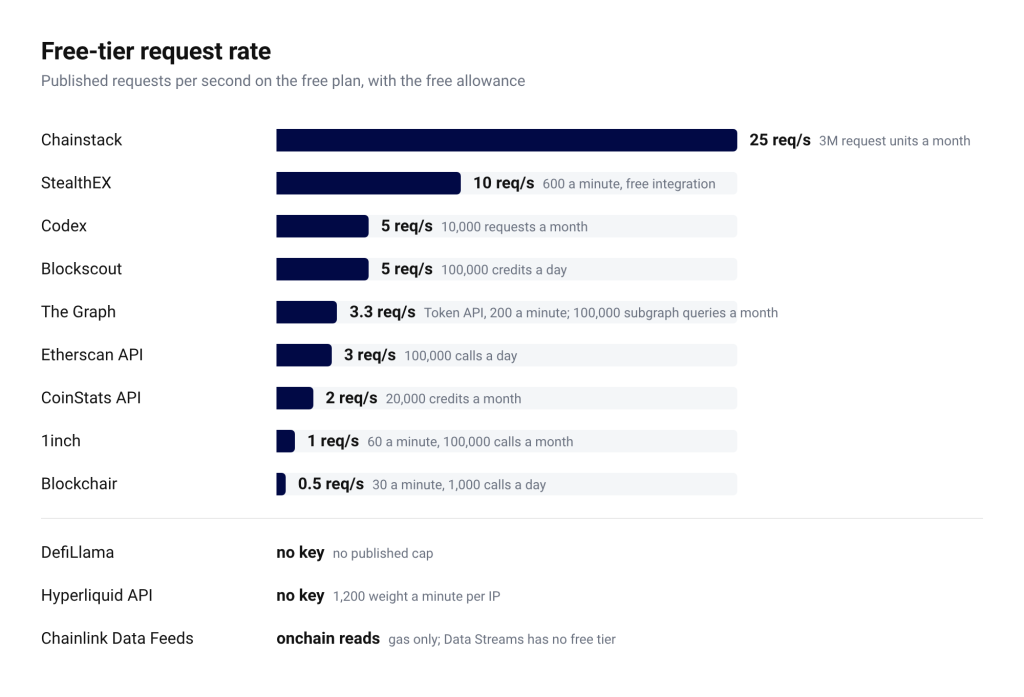
Free-tier request rates compared across the 12 APIs
8. DefiLlama
DefiLlama is the largest open DeFi data source. It lists 7,000+ DeFi protocols across 500+ chains, and it put total DeFi TVL at $88.9 billion on October 18, 2026. The free API needs no key and returns TVL, token prices, stablecoin supply, yields, DEX and perp volumes, fees and open interest. It is the data behind most DeFi dashboards and research desks.
The project is run by Llama Corp with pseudonymous lead developer 0xngmi, publishes its code open source and carries no ads. LlamaAI, launched in November 2025, adds a natural-language layer for Pro subscribers. An official MCP server requires an active API subscription.
The free API has no published quota, SLA or key. The API plan is $300 a month for 1 million calls at 1,000 requests a minute, with $0.60 per 1,000 extra calls. It unlocks premium endpoints such as token unlocks, inflows, active users and token liquidity.
Best for: dashboards, research and risk tools that need DeFi aggregates, yields and stablecoin data without a key or a contract.
Limitations: no wallet-level balances or transactions. The free tier can change without notice because nothing is contracted. Most token prices depend on an upstream price API, and the first paid tier is $300.
9. Hyperliquid API
Hyperliquid API is the native interface to Hyperliquid, the L1 with fully onchain perpetual and spot order books. HyperCore, its exchange engine, handles up to 200,000 orders a second. Per DefiLlama’s perps rankings on October 18, 2026, Hyperliquid held $7.4 billion of the $13.2 billion in open interest across all perp DEXs, about 56%. For a bot builder, this is where onchain perp liquidity sits.
The API has no key, no signup and no pricing page. Info requests return mid prices, order books, candles, fills, funding, user state and vault data. Exchange requests place, modify and cancel orders, run TWAPs, adjust margin and move funds, signed by a wallet or an approved API wallet.
A WebSocket carries subscriptions, HyperEVM exposes a JSON-RPC endpoint, and an official Python SDK is maintained. Builder codes let an app charge up to 0.1% on perps and 1% on spot. Our guide to crypto APIs for trading bots and AI agents covers the bot side of this stack.
There is no subscription. Costs are trading fees: 0.045% taker and 0.015% maker at the base tier, falling with volume. Extra requests above the address-based limits cost an optional 0.0005 USDC each.
Best for: perp and spot trading bots and apps that want a free, keyless exchange API with onchain settlement and builder-code revenue.
Limitations: one venue, no multi-chain data. REST weight is capped at 1,200 a minute per IP, and address limits scale with traded volume. The default EVM RPC keeps no historical state, and there is no SLA or support channel beyond Discord.
10. 1inch Swap API
1inch sells its routing engine and wallet data through 1inch Business, renamed from the Developer Portal in October 2025. Classic Swap uses the Pathfinder router across 17 EVM chains plus Solana. Fusion runs gasless intent swaps. Fusion+ settles cross-chain intent swaps between EVM chains and Solana. Limit orders, balances, spot prices, token metadata, portfolio, history, traces, gas and an archive Web3 RPC share the same key.
Delivery is REST with bearer-token auth, WebSocket RPC, TypeScript SDKs and an MCP server with nine tools. In August 2026, 1inch added x402 pay-per-call from $0.00018 per call in USDC on Base, with no key. The 1inch homepage reports $815 billion+ in swap volume and 28 million+ wallets. GetBlock’s comparison of the best crypto swap exchanges ranks 1inch among eight venues on fees, custody and chain reach.
The free Dev plan allows 60 requests a minute and 100,000 calls a month, and it blocks with a 429 instead of charging overages. Startup is $199 a month for 10 requests a second and 1 million calls. Professional is $399.
Best for: wallets, agents and DeFi apps that want production DEX routing, cross-chain intent swaps and wallet data behind one key.
Limitations: EVM plus Solana only. The free tier is small for a routing API, data retention runs 7 to 90 days by plan, and subscriptions are paid in USDC. Per The Block, 1inch’s share of Ethereum aggregator volume fell from about 30% to 15% in the year to April 2026.
11. Chainlink Data Feeds
Chainlink Data Feeds are the reference prices most DeFi protocols read onchain. Decentralized oracle networks aggregate asset prices, proof of reserves, NAV and interest rates and publish them to smart contracts. The feeds live on dozens of networks, including EVM chains, Solana, Aptos, Starknet and Tron. A Solidity contract reads a feed through one call to latestRoundData on the AggregatorV3Interface, and the same code works on every EVM chain.
Feeds update on deviation or heartbeat. ETH/USD on Ethereum mainnet, for example, updates when the price moves 0.5% and is served by 31 node operators. Data Streams, the pull-based product, delivers sub-second reports over REST and WebSocket with Go, Rust and TypeScript SDKs, verified onchain by verifier contracts. Chainlink reported Total Value Secured of $110 billion in its Q2 2026 review, and DefiLlama ranks it first among oracles by value secured.
Onchain feed reads cost only your own gas. Data Streams is a paid product with no free tier, and self-serve plans start at $150 a month per feed, billed through Stripe.
Best for: DeFi protocols, perps and prediction markets that need audited reference prices or reserve proofs in one contract call.
Limitations: not a blockchain data API; there are no balances, transactions or history. Push feeds only update on deviation or heartbeat, so staleness and L2 sequencer checks are your responsibility. Streams cost $150 a month per feed.
12. Blockchair
Blockchair is a privacy-focused search engine for 43 blockchains whose REST API covers fewer than 20 of them. Bitcoin, Bitcoin Cash, Litecoin, Dogecoin, Zcash, Monero, Ethereum, Cardano, Ripple and Stellar are among the mainnets. Its edge is SQL-like filtering: endpoints accept query, aggregation and sort parameters, so one call can rank addresses by balance or count transactions by fee band. Daily TSV dumps exceed 1 TB compressed.
Data covers blocks, transactions, outputs, addresses, mempool, xpubs, raw node calls and 280,000+ ERC-20 tokens. The company says it collects no personal data, which matters to a Bitcoin-first audience.
The API can be tried for a few days without a key at 1,000 calls a day and 30 requests a minute. Paid access comes as pay-as-you-go keys with a one-year expiry, a monthly Developer plan, Enterprise and Custom above 100,000 calls a day. Prices are not publicly listed.
Best for: Bitcoin and UTXO-chain explorer data with bulk dumps and SQL-style queries at low volumes.
Limitations: API coverage is far narrower than the explorer, mostly UTXO chains with no Solana, TRON or L2 support. Pricing is opaque and the free allowance is small.
FAQs
What is a blockchain API
A blockchain API is a hosted interface that returns chain data or submits transactions without running a node. Node APIs return raw state, explorer and indexing APIs return decoded records, and enriched data APIs add prices, positions and risk scores.
Which blockchain API is free
DefiLlama and Hyperliquid API need no key at all. CoinStats API, Chainstack, Blockscout, Etherscan API, The Graph, Codex and 1inch offer free tiers with a key. They range from 10,000 requests a month at Codex to 100,000 calls a day at Etherscan.
Do blockchain APIs work with AI agents
Eight of the 12 APIs in this review ship an MCP server: CoinStats API, Chainstack, Codex, Blockscout, Etherscan API, The Graph, DefiLlama and 1inch. Six of those query chain data; Codex’s serves its docs and Chainstack’s manages nodes. CoinStats API and 1inch also accept x402 pay-per-call payments, so an agent can pay in USDC without an account.
Which blockchain API is best for Bitcoin
CoinStats API reads Bitcoin balances and HD wallets through xpub, ypub and zpub keys alongside 120+ other chains. Blockchair covers Bitcoin and other UTXO chains with SQL-style queries and bulk dumps, and Chainstack serves Bitcoin RPC nodes.
The post 12 Best Blockchain APIs for Developers in 2026: Expert Review appeared first on CaptainAltcoin.