EU MiCA Crypto License Shows Germany, France Lead and July 1 Deadline Germany leads EU MiCA crypto licenses, with one more nation close behind, together over a third of every license issued.
EU MiCA Crypto License Shows Germany, France Lead and July 1 Deadline
Germany leads EU MiCA crypto licenses, with one more nation close behind, together over a third of every license issued. For traders on exchanges still operating without one, the July 1 deadline isn't a formality; it's a cutoff that determines whether their platform can legally keep serving them tomorrow.
Five countries have issued none at all, and the reasons why reveal a regulatory split that's already reshaping which exchanges survive in Europe.
What Happened: EU MiCA License Count Reaches 244
According to European Securities and Markets Authority (ESMA) registration data, as of June 29, 2026, the European Union has issued 244 MiCA crypto-asset service provider (CASP) licenses, with Germany leading by issuing 57, followed by France with 26. Together, the two countries account for more than one-third of every license granted in the bloc so far.
The EU MiCA framework requires any crypto firm that wants to operate across all 27 member states to hold at least one valid license from a single EU regulator. Once that license is secured, the firm can passport its services throughout the entire union without seeking separate approval in each country.

Source: Wu Blockchain X
Why It Matters: A Hard Deadline Is Here
Per requirements, crypto firms without MiCA licenses must cease providing related services in the EU after July 1. That means any exchange still operating without approval now faces an abrupt halt to its operations this week, directly affecting traders who depend on those platforms for liquidity, asset access, and trading pairs they may not be able to replace easily elsewhere.
Key Details: Who's Missing and Who's Struggling
Greece, Hungary, Poland, Portugal, and Romania have yet to issue any MiCA licenses. Poland's case stands out from the rest: the country has still not established a licensing regime compliant with MiCA, as the relevant legislation has been vetoed by the president three times, leaving its domestic crypto industry in regulatory limbo.
The concentration of licenses in a few member states isn't accidental. Germany, France, the Netherlands, Luxembourg, and Ireland together account for roughly 72% of all financial assets in the EU, which has translated directly into faster regulatory processing and more applicant interest. France alone issued five licenses in a single week, from June 18 to 22, the fastest pace recorded for that period, out of 11 total permits issued across the entire EU during that stretch.
Source: Official X
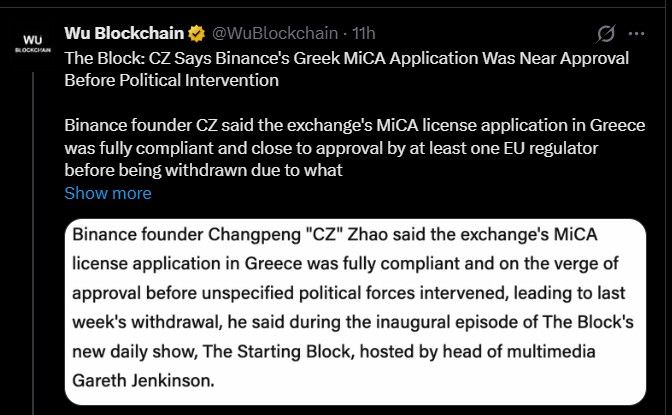
Binance's experience shows how political dynamics, not just technical compliance, are shaping outcomes. Founder CZ said the exchange's Greek application was fully compliant and close to approval from at least one EU regulator, but it was withdrawn after political forces intervened.
He described a bidding war between two countries that wanted Binance's application before other forces moved against it, and stopped short of confirming whether ECB President Christine Lagarde played any role, saying he had only seen unverified claims online.
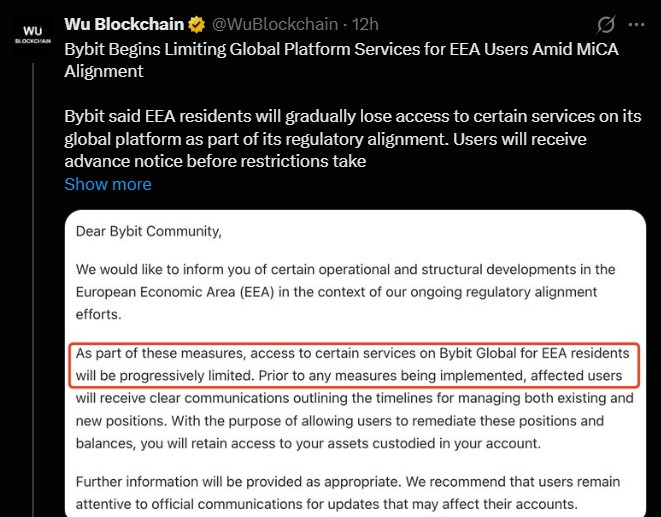
Bybit has taken a notably different path, choosing to scale back rather than fight for blanket approval. The exchange confirmed it will gradually restrict EEA residents' access to certain Bybit Global services, while users keep access to assets already held in custody, as Bybit EU, its MiCAR-authorized entity, pursues an additional license in Austria to widen its product range.
Source: X
What to Watch Next: The July 1 Cutoff and Beyond
Regulators have signaled there's little room left for flexibility. Spain's securities regulator has already stated there will be no exceptions or extensions past the deadline. Traders should watch for Binance's next licensing attempt, reportedly aimed at France, and whether any of the five license-free countries make progress on stalled legislation in the coming months.
Conclusion
The 244-license count shows MiCA is functioning, but unevenly — financial-hub countries are pulling ahead while five nations remain stuck at zero. With the July 1 deadline now in effect, the coming weeks will reveal which major exchanges successfully adapt and which are forced to scale back their European presence.
Disclaimer: This article is for informational purposes only and does not constitute financial, investment, or legal advice. Cryptocurrency markets are volatile, and regulatory environments can change rapidly. Readers should conduct their own research and consult a qualified professional before making investment decisions. CoinGabbar is not responsible for any losses incurred based on this content.