For years, using crypto seriously meant juggling apps. A wallet here. An exchange there. A separate platform for lending, another for swaps. Moving money between them meant paying fees, waiti
For years, using crypto seriously meant juggling apps. A wallet here. An exchange there. A separate platform for lending, another for swaps. Moving money between them meant paying fees, waiting for transfers, and accepting that the whole experience felt more like a workaround than a financial system.
That friction has quietly become one of crypto's biggest unsolved problems, and a handful of platforms are now racing to fix it.
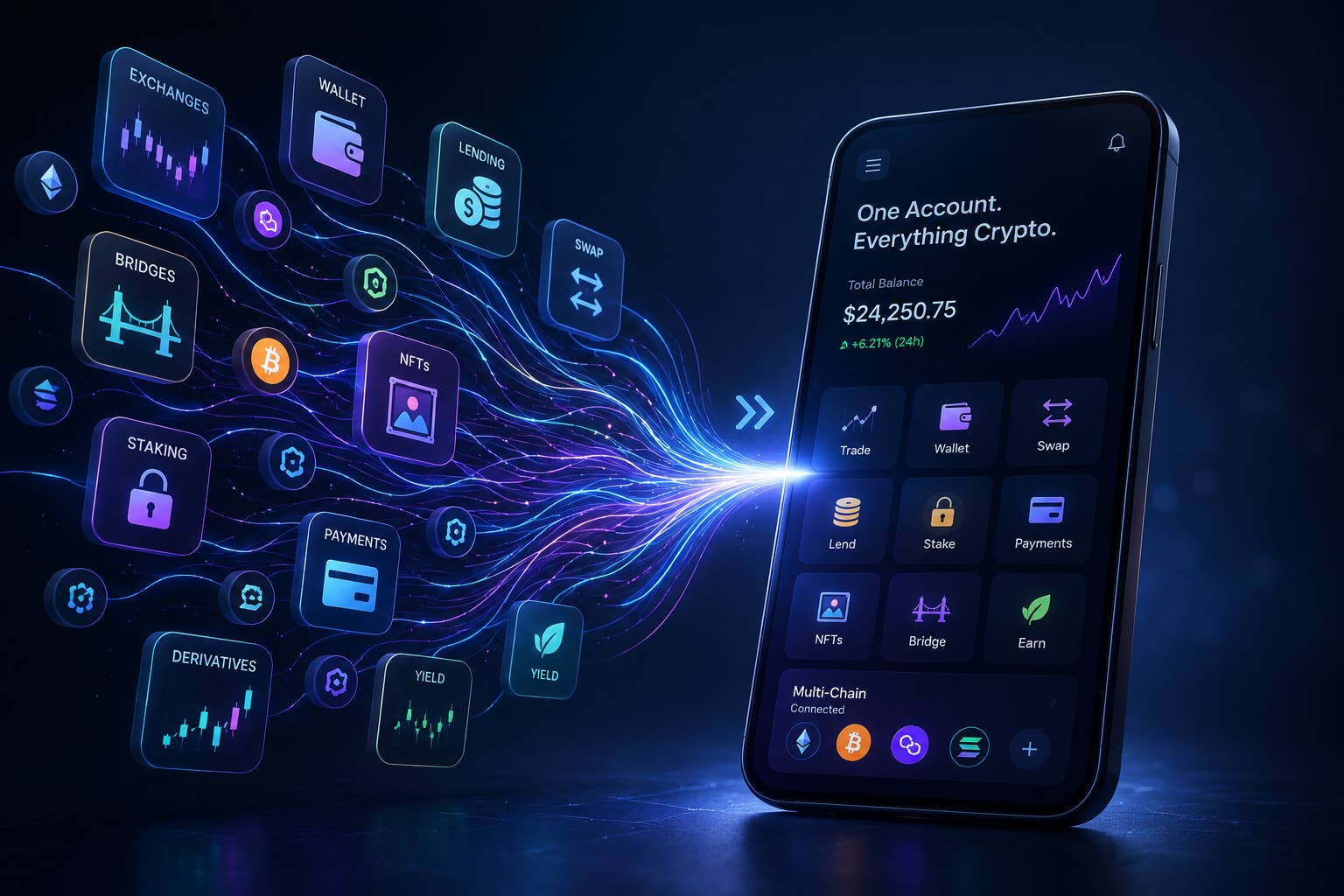
They are called super apps. The premise is simple: everything a crypto user needs, in one place, under one account. No transfers. No switching. No five-step process to do something that should take thirty seconds. The category is still young, but the platforms building it are moving fast, and the products they are shipping are starting to look less like crypto tools and more like the future of everyday finance.
Related: Mysterious whale suddenly moves $41M in Bitcoin after 12 years
The super app category exists because that experience became untenable. Users wanted the sophistication of decentralized finance without the operational complexity that came with it. They wanted self-custody without sacrificing convenience. They wanted one place that could handle all of it.
Three platforms, OKX, Backpack, and MetaMask, are each building their own version of that.
OKX: Built for everyone
OKX began its life as a centralized exchange, a platform where users deposit funds, place trades, and let the company handle the infrastructure. That model still exists within OKX today, but it is now one piece of a much larger product.
The platform now includes a self-custody wallet, a decentralized exchange aggregator, a physical spending card, and a trading suite — all connected within a single interface. Over the past year, OKX has expanded across multiple continents and is preparing to enter the US market.
The company's stated priority is interoperability, the ability for users to move fluidly between features without friction. Haider Rafique, Global Chief Marketing Officer at OKX, describes the platform's broader ambition plainly.
"Trading is the common entry point, but the goal is to make crypto genuinely usable for everyday life: payments, investing, digital commerce," he says.
What makes OKX technically distinctive is its simultaneous support for both centralized and decentralized trading. On the centralized side, OKX holds user funds and executes trades on their behalf.
On the decentralized side, its DEX aggregator lets users retain full custody of their assets until the moment a trade is executed, scanning multiple decentralized exchanges in real time to find the best available price after accounting for fees and slippage. Most platforms offer one model or the other. OKX offers both.
Also Trending on TheStreet Roundtable:
Backpack
Backpack is a newer name in the super app conversation, but it has earned attention quickly. The platform combines a self-custody wallet, a centralized exchange, perpetual trading, lending and borrowing, a predictions market, global fiat on and off ramps, and, coming soon, sock trading, all from one account.
Its most significant technical contribution, however, is in how it approaches the problem of lost access. Losing a private key in crypto means losing everything tied to that wallet, permanently, with no recovery option. It is one of the industry's most enduring pain points, and Backpack has built its platform around solving it.
The solution is account abstraction, a technology that replaces the traditional private key with a programmable smart contract. The smart contract can be configured with custom security rules, but crucially, the user never gives up custody of their funds in the process.
"You can have institutional-grade security without handing over your funds," says Armani Ferrante, CEO of Backpack.
That security-first philosophy runs through everything Backpack builds. The company started as an on-chain self-custody wallet, and Ferrante says that origin directly shaped how its exchange was designed, with "an emphasis on the user experience from a design perspective, a capital efficiency perspective, and a compliance perspective, but also prioritizing security."
As the platform grows and adds features, Ferrante says the goal is to keep the experience clean. "The goal is to make product features with challenging engineering feel effortless, not to show off how much we've built," he says.
MetaMask has been around longer than most. Launched in 2016, it started as a simple browser-based wallet, a tool for holding and managing crypto without handing control to a third party. That core idea, self-custody, has never changed. But the platform built around it has grown considerably.
Today, MetaMask users can trade futures and tokenized stocks, swap assets across dozens of blockchain networks, and spend their balance anywhere Mastercard is accepted, all within a single app. Neal Gorevic, CMO of Consensys, the company behind MetaMask, describes what ties every feature together.
"The through-line is that everything MetaMask builds keeps you in control of your own money. We don't hold your money," he says.
That distinction separates MetaMask from traditional financial platforms. Banks and brokerages hold user funds on their behalf. MetaMask does not, yet it offers a comparable range of financial services.
The platform's trading functionality works by automatically routing swap requests across multiple decentralized exchanges to find the best available price. Security filters run in the background, screening for threats and reducing the risk of failed transactions, without requiring users to understand the mechanics behind it.
"That's the balance we're always trying to strike: make the experience feel effortless without taking control away in the process," says Gorevic.
OKX, Backpack, and MetaMask each take a different path to the same destination: a platform where crypto feels less like a technical undertaking and more like a natural extension of your financial life.
The super app era is here, and it is beginning to look a lot like the future of finance.
Related: Top 3 DEXes changing how crypto trading works