Anthony Scaramucci says the anger that helped bring Donald Trump to power grew out of three economic decisions that squeezed working families and weakened trust in Washington. He points to Am
Anthony Scaramucci says the anger that helped bring Donald Trump to power grew out of three economic decisions that squeezed working families and weakened trust in Washington. He points to America's approach to China, the financing of the post-9/11 wars and the response to the financial crisis.
Buy All the Wrong Moves here.
The financier, author, podcaster and former White House Communications Director laid out that argument in an interview with TheStreet Roundtable publisher James Heckman.
His book, All the Wrong Moves: How Three Catastrophic Decisions Led to the Rise of Trump, examines how decisions by both parties helped create the conditions for Trump's rise.
"It's not a polemic on Donald Trump. It's really not a polemic on anybody," Scaramucci said. He described well-intended leaders making decisions that produced the opposite of what they expected.
Buy All the Wrong Moves here.
Families that once expected to get ahead have instead struggled economically, he argued.
"Let's explain how we got to where we are so that then we can work on policies and hopefully we can work in a bipartisan way to fix it," he said.
Related: Review: Eric Trump’s ‘Under Siege’ reveals the cost of loyalty inside America’s most polarizing family
Where he says Washington went wrong
Scaramucci's first criticism centers on China's integration into the global economy. He said the United States failed to adjust its approach as China grew into an economic superpower, leaving American workers facing wage pressure.
"When they got to the size of Germany, we should have treated them like Germany, but we didn't do that," he said.
China joined the World Trade Organization in December 2001.
The second decision was fighting wars while cutting taxes under George W. Bush. "Two wars, two tax cuts, two decades of fighting," Scaramucci said, arguing that borrowing to finance the conflicts helped send the federal budget into a deficit spiral.
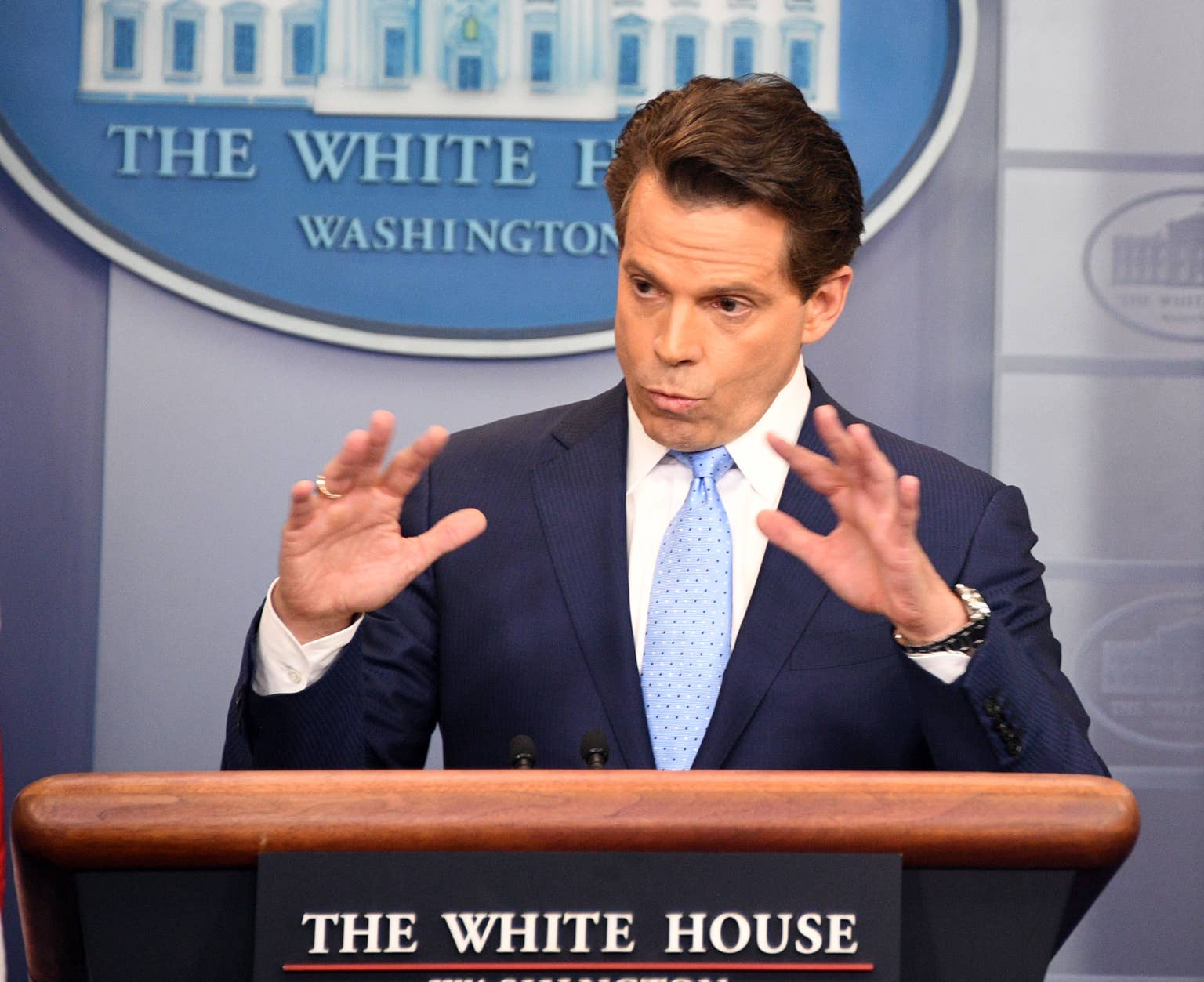
Anthony Scaramucci speaks during a press briefing at the White House in Washington, DC on July 21, 2017.
Getty Images
He cited Brown University's Costs of War research.
Its 2021 estimate put the cost of the post-9/11 wars at about $8 trillion, including interest on borrowing and future veterans' care, rather than combat spending alone.
Scaramucci's third criticism was the decision to rescue banks without providing enough help to lower- and middle-income households at the same time. He said saving the banks was necessary to restore trust, but the unequal response helped fuel anger that later found expression in populist politics.
Buy All the Wrong Moves here.
The bank rescue began before Barack Obama took office.
In October 2008, Treasury announced that it would make $250 billion in capital available to financial institutions.
"By not giving some money to lower and middle income people coterminous to that, it created a lot of anger," Scaramucci said. He linked that anger to Occupy Wall Street, the Tea Party and ultimately the MAGA movement.
Popular on TheStreet Roundtable:
A quick refresher on Scaramucci
Scaramucci grew up on Long Island and earned a bachelor's degree in economics from Tufts University before completing a law degree at Harvard Law School. He joined Goldman Sachs, where he became a vice president in private wealth management.
He went on to co-found the investment partnership Oscar Capital Management, which was sold to Neuberger Berman in 2001. He founded SkyBridge Capital, the global alternative investment manager, in 2005.
SkyBridge launched a Bitcoin fund in January 2021. Scaramucci also started the SALT Conference, an annual gathering of business and political leaders, in 2009.
Buy All the Wrong Moves here.
In January 2017, SkyBridge agreed to sell a majority stake to RON Transatlantic and HNA Capital, the U.S. arm of China's HNA Group. The deal stalled in regulatory review and was terminated in April 2018, and Scaramucci returned to the firm as co-managing partner.
Scaramucci had joined the Trump administration in June 2017 as chief strategy officer of the U.S. Export-Import Bank. Trump named him White House communications director on July 21, 2017. Ten days later, on July 31, newly installed chief of staff John Kelly fired him after a profanity-laced interview with The New Yorker.
His earlier books are Goodbye Gordon Gekko in 2010, Hopping Over the Rabbit Hole in 2016, Trump, the Blue-Collar President in 2018 and From Wall Street to the White House and Back in 2024. He hosts the podcasts Open Book and The Rest Is Politics US and is a CNBC contributor.
What he wants to change
When Heckman asked where the country should go from here, Scaramucci called for restoring pay-as-you-go budget controls and tying spending growth to economic growth. Both would require a bipartisan commitment, he said.
His proposal is to slow the growth of government spending rather than impose abrupt austerity. He argued that allowing spending to grow more slowly than gross domestic product could reduce the debt burden relative to the economy over time.
"You just want to slow the rate of growth so that it's below the GDP's growth," he said. Scaramucci estimated that his approach could bring debt down to 70% or 80% of GDP over about 15 years, a projection he offered rather than an independently established result.
He also raised higher tax rates for wealthy Americans as an option. But he said any changes should be gradual to avoid pushing the economy into a recession.
"You have to do it gradually. You're not going to hit this thing with a chainsaw," Scaramucci said. "You don't want to knock the thing unnecessarily into a recession for no reason."
Buy All the Wrong Moves here.