More than 50,000 people in Europe have urged the European Commission to loosen limits on stablecoin “rewards” as it prepares changes to the bloc’s Markets in Crypto-Assets (MiCA) rules. The c
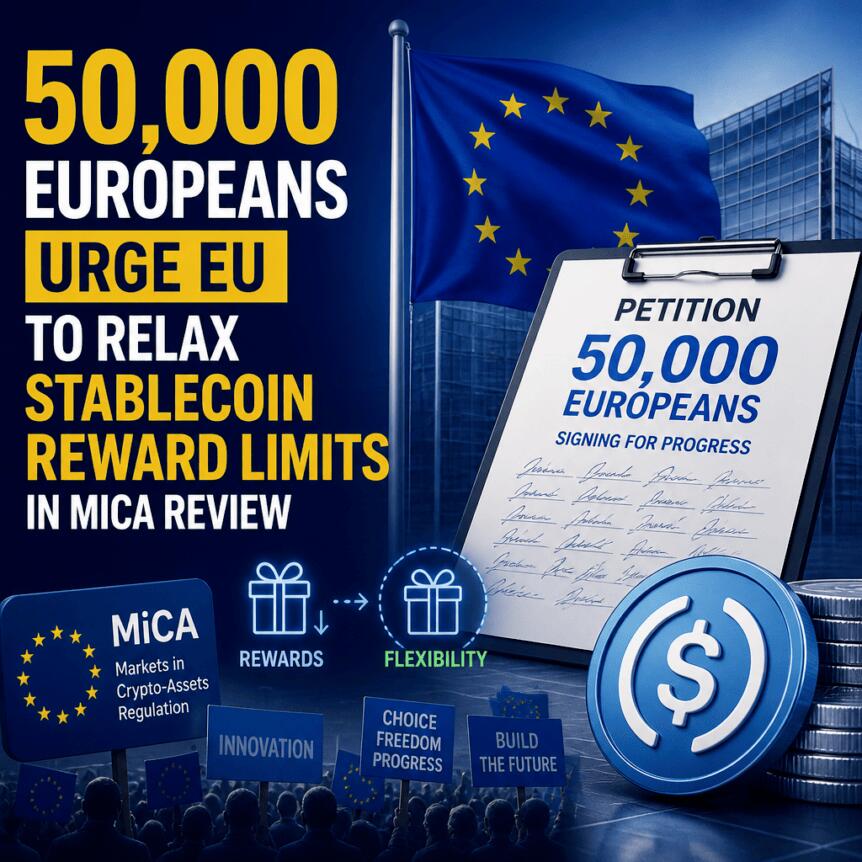
More than 50,000 people in Europe have urged the European Commission to loosen limits on stablecoin “rewards” as it prepares changes to the bloc’s Markets in Crypto-Assets (MiCA) rules. The call, made through advocacy group Stand With Crypto EU, is part of the Commission’s MiCA consultation process that closed on Wednesday.
Stand With Crypto EU argues that MiCA’s current approach—barring issuers and crypto service providers from paying interest on stablecoins—puts regulated euro-linked stablecoins at a disadvantage compared with bank deposits and other e-money products that can offer customer benefits. The group says its outreach dwarfed past participation levels during earlier EU crypto consultations.
Key takeaways
- Stand With Crypto EU says over 50,000 Europeans asked the Commission to allow regulated stablecoins to offer holder incentives during the MiCA review consultation.
- The campaign aligns with a MiCA-specific restriction: MiCA currently prevents stablecoin issuers and service providers from paying interest on stablecoins.
- The group is pushing for rewards such as cashback, loyalty benefits, and fee reductions—rather than interest payments.
- European central banks have simultaneously asked for MiCA stablecoin rules to evolve, including extending the “no interest” prohibition to certain yield-generating arrangements and revising reserve liquidity expectations.
- The debate is unfolding amid central bank concerns about stablecoins’ financial stability implications, including liquidity and bank-deposit dynamics.
A campaign timed to the MiCA consultation closing
Stand With Crypto EU said it collected more than 50,000 submissions to the European Commission during the MiCA consultation. The group also referenced a separate petition it has been running, claiming it has drawn more than 126,000 signatories calling for a more permissive EU stance toward stablecoins.
According to Stand With Crypto EU, its consultation response volume reached a scale far beyond other recent stablecoin or broader crypto rulemaking efforts. The group said its campaign generated more than six times the 8,221 responses submitted to the European Central Bank’s (ECB) digital euro consultation. It also claimed that it exceeded participation seen in the European Commission’s 2020 consultation on crypto rules, which it characterized as receiving 198 responses.
While the petition and submissions reflect public pressure, the policy question at the center is narrower: what kinds of benefits can regulated stablecoin issuers and platforms provide to customers under MiCA.
What Stand With Crypto EU wants: incentives beyond “interest”
MiCA, as described by Stand With Crypto EU, prohibits stablecoin issuers and crypto service providers from paying interest on stablecoins. Stand With Crypto EU’s position is that this restriction discourages usage of compliant stablecoins by preventing them from competing for customer attention with traditional financial products.
In an interview with Cointelegraph, the group’s general manager Harry Pearce Gould said the Commission should use the MiCA review to permit regulated stablecoins to offer rewards to holders. He specifically pointed to an approach that includes incentives such as cashback, loyalty benefits, and fee reductions.
“We are calling on the Commission to use the MiCA review to allow regulated stablecoins to offer rewards to holders,” Stand With Crypto EU general manager Harry Pearce Gould told Cointelegraph.
Gould also argued Europe needs to compete more directly with the United States, noting that U.S. policy has taken a clearer stance on stablecoins as part of the infrastructure for tokenization. In his framing, the European Union does not need to mirror the U.S. approach, but it should ensure euro-based stablecoins can gain adoption in a competitive environment.
“The US has made a clear choice to back stablecoins as the settlement layer for tokenisation. Europe doesn’t need to copy that, but it does need to compete with it.”
The group further tied its argument to broader strategic concerns, saying that stronger euro stablecoins matter for the euro’s global standing and for “payment sovereignty.”
Central bank pressure points: yield, liquidity, and deposit risk
The Stand With Crypto EU push arrives as European central banks have been pressing for changes to how MiCA treats stablecoins. In a response dated Sept. 22 to the European Commission’s MiCA review, the European System of Central Banks (ESCB) called for expanding the reach of MiCA’s “prohibition on stablecoin interest.” The ESCB urged that the restriction should also cover lending, borrowing, and staking arrangements that generate yield.
ESCB also proposed changes to liquidity expectations for stablecoin reserves. In its view, MiCA’s requirement that stablecoin issuers hold a minimum portion of reserves in bank deposits should be replaced with liquidity thresholds. The central banks argued the existing structure could create strain for lenders if a stablecoin run forces an issuer to withdraw deposits quickly.
Separate from the ESCB’s proposals, the ECB has flagged a potential timing mismatch between stablecoin settlement behavior and the operational timelines of reserve assets. In June, the ECB highlighted that stablecoins can settle around the clock, while reserve assets may still follow traditional settlement cycles—an issue the ECB linked to liquidity management and financial stability concerns.
ECB President Christine Lagarde has previously warned that if deposits move from banks into stablecoins, it could weaken bank lending and the transmission of monetary policy. Lagarde’s broader message has emphasized that Europe should prioritize tokenized financial infrastructure anchored in central bank money rather than rely on stablecoins that could pull resources away from the banking system.
Why the “rewards” debate matters for EU stablecoins
For investors, traders, and stablecoin users, the practical difference between “interest” and other forms of incentives is more than semantics. The Commission’s response to the consultation could shape what regulated stablecoins can offer in customer experience terms—potentially influencing adoption, issuer strategies, and competitive positioning versus dollar-denominated stablecoins.
At the same time, central bank proposals suggest regulators are also trying to prevent stablecoin economics from replicating retail-style yield products in ways that could amplify bank-linked stress. That creates an inherent tension: incentives that make stablecoins more attractive to users could also increase customer expectations and flows, while liquidity and yield-related restrictions are meant to limit destabilizing dynamics.
What remains uncertain is where the Commission will draw the line between permissible rewards—such as fee reductions or loyalty programs—and arrangements that could be interpreted as functionally similar to paying yield.
As the MiCA review moves from consultation to policymaking, readers should watch for how the Commission balances consumer-facing incentives with the concerns raised by the ECB and ESCB around liquidity, deposit behavior, and stability—especially whether “reward” frameworks are explicitly defined, narrowed, or constrained in the final guidance.
This article was originally published as 50,000 Europeans urge EU to relax stablecoin reward limits in MiCA review on Crypto Breaking News – your trusted source for crypto news, Bitcoin news, and blockchain updates.