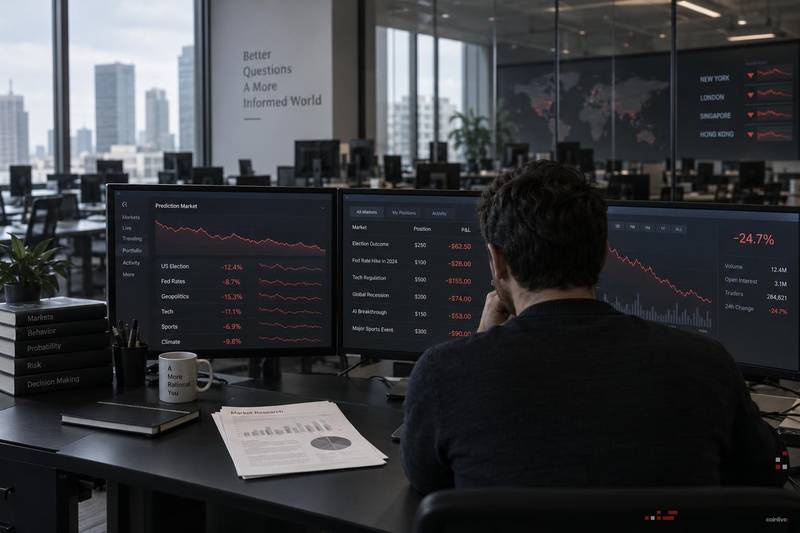
A Galaxy Research study analyzing 2.9 million Polymarket retail accounts found that 69.2% finished below break-even, with the retail-account population down $338.9 million in aggregate, accor
A Galaxy Research study analyzing 2.9 million Polymarket retail accounts found that 69.2% finished below break-even, with the retail-account population down $338.9 million in aggregate, according to the firm's on-chain analysis of the prediction platform's public settlement record.
Galaxy Research's key finding on Polymarket traders
Galaxy Research excluded accounts averaging more than 50 orders per active day as likely automated, stripping out 125,429 accounts (4.1% of the total) that nonetheless placed 80.8% of all orders and 41% of notional volume. The remaining 2.9 million accounts represent the retail population the study assessed. For related coverage, see U.S. Spot Bitcoin ETFs See $102M Inflows Ahead of Jobs Report.
Of those retail accounts, 69.2% finished below break-even.
Retail accounts below break-even
69.2%
Of 2.9 million retail accounts analyzed by Galaxy Research.
The retail-account population was collectively down $338.9 million in aggregate across the period studied.
Aggregate retail-account loss
$338.9 million
Total loss across the analyzed retail-account population.
What the losses reveal about retail participation in prediction markets
The behavioral data points to a churn problem after losses. Galaxy found that 15.2% of accounts had not traded again within 30 days after a loss, compared with just 6.1% after a win. That near-2.5x gap in post-loss inactivity suggests losing traders disengage from the platform at a significantly higher rate than winning ones.
Specialization also tracked with outcomes. Some 44.1% of traders concentrated more than 60% of their activity in one topic; sports specialists were the least profitable category, while tech and science specialists were the most profitable. Profitable traders also tended to size positions slightly larger, with a median position of $13.96 versus $10.00 for unprofitable traders.
Polymarket settles on Polygon. Galaxy noted its analysis covers Polymarket's international platform, which is separate from the U.S. app the company launched through a CFTC-licensed subsidiary. The $12.7 million South Korean police probe into Polymarket wagers and Sportradar's expanded data deal covering 20-plus sports leagues illustrate the platform's growing international footprint and regulatory attention, the same context in which the analyzed order book operates. Polygon's ecosystem token was trading at $0.109896 at the time of publication, roughly flat on a 24-hour basis.
The aggregate loss figure is a population-level outcome, not a forecast for any individual account. But the scale, nearly $339 million down across 2.9 million accounts, underscores that prediction markets carry meaningful financial risk for retail participants who treat them as a straightforward route to profit. The Clarity Act odds tracked on Polymarket and other high-traffic political markets drove substantial retail engagement during the studied period, with election markets like Brazil's presidential race drawing significant activity from accounts that ultimately skewed toward losses.
TLDR Keypoints
- Galaxy Research analyzed 2.9 million Polymarket retail accounts and found 69.2% finished below break-even.
- The retail population was down $338.9 million in aggregate; accounts averaging more than 50 orders per active day were excluded as likely bots.
- The 69.2% figure is an aggregate outcome across a large account population, not a prediction for individual traders, but it signals meaningful risk for retail participants in prediction markets.
Additional source references: galaxy.
Disclaimer: This article is for informational purposes only and does not constitute financial or investment advice. Cryptocurrency and digital asset markets carry significant risk. Always do your own research before making decisions.
Read original article on coinlive.me