Aave Tokenized Stocks: New USDC Rewards Cut Borrowing Costs on Base The Aave protocol has switched on new USDC incentives for its Coinbase-linked equities market on the Base network. Accordin
Aave Tokenized Stocks: New USDC Rewards Cut Borrowing Costs on Base
The Aave protocol has switched on new USDC incentives for its Coinbase-linked equities market on the Base network.
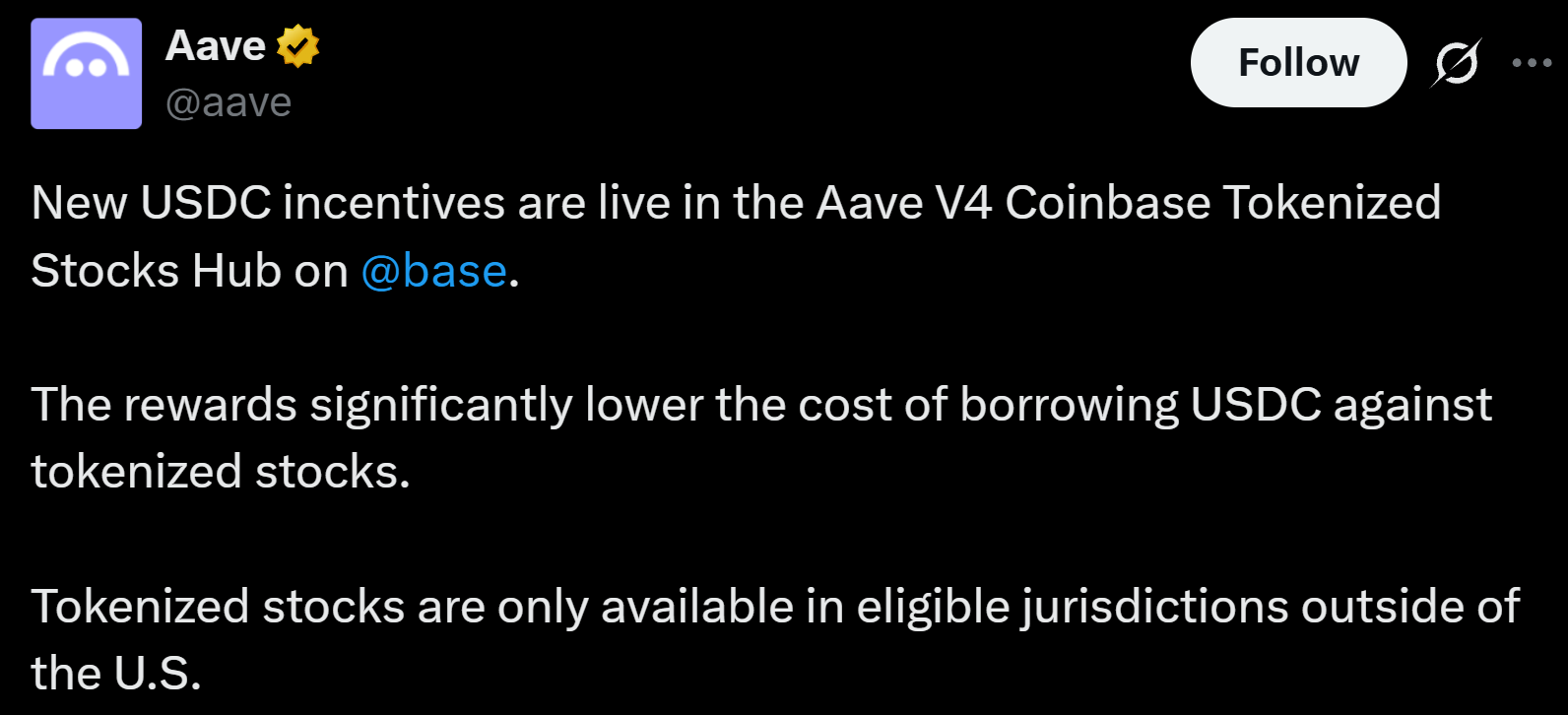
According to its official post on X, the rewards significantly lower the cost of borrowing USDC against tokenized equities.
This update to Aave Tokenized Stocks matters because it makes an already new product cheaper to use.
Below is a clear, source-based look at how it works, what is confirmed, and what is still unknown.
What the Protocol Announced
The post says the incentives are live in the Aave V4 Coinbase Tokenized Stocks Hub on Base.
It adds that these tokens are only available in eligible jurisdictions outside the U.S. The hub’s own page, titledCoinbase Stocks Hub on Base, shows liquidity, borrowing, and utilization data for the market.
Its sections include Total Liquidity, Total Borrowed, Available Liquidity, Utilization Rate, Connected Markets, Deposit Opportunities, Borrow Opportunities, and a Liquidity & Risk view.
The post does not state the reward size, the reward token, the duration or who funds it. Since the hub page loads its numbers dynamically, readers should check live rates there before acting.
Which Tokens Work as Collateral
The market itself launched earlier. In itsofficial post dated 25 September 2026, Aave Labs said tokens of seven US technology companies can be deposited as collateral to borrow USDC.
Users may post any mix of them, and each token carries its own collateral factor.
Token
Underlying company
AAPLc
Apple
AMZNc
Amazon
GOOGLc
Alphabet (Google)
METAc
Meta
MSFTc
Microsoft
NVDAc
NVIDIA
TSLAc
Tesla
At launch, these tokens work as collateral only. It says borrowing the tokens themselves and opening equity-against-equity positions are not enabled.
What One of These Tokens Really Is
It explains that each token represents a certificate issued by Coinbase Onchain SPV Ltd.
The underlying shares sit with Alpaca Securities LLC, an SEC-registered broker-dealer, in segregated custody accounts in the issuer’s name.
The custodian may not lend those shares or use them for its own account, and it holds no lien over them.
Key points from the blog:
The issuer holds the shares as bare trustee for holders under a deed of trust
Holders get the economic exposure of real shares, not a synthetic price copy
Dividends are reinvested after fees and withholding tax, so each token’s claim grows
Stock splits work the same way, through a multiplier that starts at 1.0
Because the multiplier moves only on corporate actions, a token can drift above the raw share price over time.
How Aave Tokenized Stocks Borrowing Works
Under theV4 documentation, liquidity sits in a central hub, while spokes handle borrowing with separate risk settings.
The equities hub holds one USDC reserve and one lending spoke that pools all collateral, as it describes.
The market stays open 24/7. Users can supply, borrow, repay, and withdraw at any time, except during corporate actions such as stock splits, when the affected reserve pauses until the new multiplier is applied.
Prices come from Chainlink’s 24/5 feeds, which publish from Sunday 20:00 ET to Friday 20:00 ET.
Over weekends and US market holidays, the feeds hold the last price. Collateral values therefore stay flat until the underlying market reopens, and a position’s health factor can fall only through interest build-up.
According to the documentation, the health factor must stay above 1 to avoid liquidation, and positions become eligible for liquidation below 1.0.
Interest also follows a utilization curve, meaning rates rise as more of the pool is borrowed, and the documentation adds a user risk premium that depends on collateral quality.
For readers who track Aave Tokenized Stocks, three items matter most:
The live borrow rate on the hub page after rewards
Any official update on how long the incentives last
Changes to caps, new tokens, or GHO borrowing
Conclusion
The new USDC rewards make borrowing against tokenized equities more attractive on Base.
Still, Aave Tokenized Stocks remain limited to eligible non-U.S. users, and the reward details are not yet public.
Readers should check the official pages and manage collateral risk carefully.
Disclaimer
This article is for educational and informational purposes only and is not financial or investment advice. Crypto assets are high risk, their prices can be very volatile, and you can lose some or all of your money. Always do your own research and consider speaking with a licensed financial advisor before making investment decisions.