Aave has announced a Base equities market designed to accept seven Coinbase-issued tokenized stocks as collateral for USDC loans, with an initial borrowing cap of $21 million. Summary Seven t
Aave has announced a Base equities market designed to accept seven Coinbase-issued tokenized stocks as collateral for USDC loans, with an initial borrowing cap of $21 million.
Summary
- Seven tokens tied to U.S. technology stocks are included in Aave’s Equities Hub.
- Borrowers can pledge the stocks for USDC, while lenders supply the market’s dollar liquidity.
- AAVE traded near $146.80, up 2.4% over 24 hours, according to CoinGecko.
- Coinbase’s stock tokens remain restricted to eligible users outside the United States.
According to a Sep. 25 X post, the Equities Hub covers tokens tied to Apple, Amazon, Alphabet, Meta, Microsoft, Nvidia and Tesla. Eligible holders can deposit the tokens and borrow USDC against them without selling their stock exposure. Aave’s published Base deployment proposal lists the same seven assets, but still sets out governance votes as steps before deployment.
Aave V4 sets separate limits for each stock
Within the proposed market, the seven stocks serve only as collateral. Users cannot borrow the equity tokens or borrow one stock token against another, according to Aave’s governance materials. USDC is the sole borrowable asset.
Aave has set a $32 million limit on USDC supplied to the main lending market and a $21 million limit on USDC borrowed. Its risk provider, LlamaRisk, put the combined initial stock collateral cap at roughly $29 million. The limits describe how large positions can become; they do not measure deposits or loans already made.
You might also like: Aave plans Avalanche RWA hub with Tether’s USA₮
Each stock also has its own borrowing limit relative to its collateral value. Aave’s published factors range from 65% for Meta and Tesla to 79% for Microsoft, with Apple at 78%, Alphabet at 76%, Amazon at 73%, and Nvidia at 70%. The amount a user can borrow therefore depends on which tokens they deposit, even when several stocks sit in the same position.
Aave’s V4 design places the equity positions in a dedicated Equities Hub with a shared USDC reserve. Suppliers who put USDC into that hub take exposure to loans backed by the seven stock tokens, while the equity market’s risks remain separate from Aave’s other Base markets. A separate supply-only route is intended for USDC vaults and aggregators.
Stani Kulechov, founder and CEO of Aave Labs, described the lending use:
“Until now a tokenized stock was something you could hold or trade. Today it becomes something you can borrow against.”
Aave’s governance materials describe the Base deployment as a proposal requiring an offchain Snapshot vote followed by an onchain vote.
Chainlink feeds price the collateral around U.S. stock hours
Chainlink supplies the feeds Aave plans to use when valuing each stock token. LlamaRisk says the initial feeds publish from Sunday evening through Friday evening Eastern time and retain their last published value over weekends and market holidays.
Loans can operate around the clock, but the shares behind the tokens trade during U.S. market sessions. According to LlamaRisk, information released while the stock market is closed may appear in the feed as a single price change when publication resumes. The risk provider says that gap matters when setting collateral factors and liquidation terms, because a borrower’s position may have less room to absorb a sharp reopening move.
Chainlink expects to provide continuous feeds for the tokens later, LlamaRisk said. The risk provider plans to review market settings once those feeds are operating. For now, its published design uses the existing schedule and monitors the equity tokens and external markets.
Coinbase’s stock products reached Base before the Aave announcement. In August, the exchange introduced four tokens tied to Apple, Alphabet, Meta and Nvidia; September additions brought its lineup to 10. The seven selected for Aave’s market are all tied to publicly traded U.S. technology companies. As crypto.news reported on the initial rollout, Coinbase describes the tokens as beneficial interests backed by underlying shares, rather than products that only track stock prices.
U.S. investors remain outside Coinbase’s current offering
Coinbase issues the products through an Abu Dhabi-based entity, while Alpaca Securities acts as broker and custodian for the underlying public shares, according to the token prospectus reviewed in the earlier report. The tokens are offered to eligible non-U.S. users and are not registered under the U.S. Securities Act. Their connection to Apple, Nvidia, and other American stocks does not make the products available to U.S. investors.
The distinction also applies to the new borrowing use. Base Head of Growth Antonio García-Martínez said eligible customers outside the United States can use the tokens to borrow USDC, while suppliers of USDC can earn interest. The Equities Hub announcement does not change Coinbase’s stated geographic restrictions.
The Securities and Exchange Commission has separately opened a conditional, five-year route for certain tokenized U.S. stocks to trade on qualifying permissioned venues. In coverage of the SEC relief, analysts identified Coinbase as a company that could seek to use the route, while noting that its existing offshore products would need to meet the applicable U.S. conditions. The Aave announcement concerns lending against Coinbase’s current tokens on Base, not authorization for those tokens to be offered to U.S. persons.
Aave is also pursuing another tokenized-asset lending market. On Sep. 16, it outlined an Avalanche credit hub where institutions would borrow Tether’s USA₮ against tokenized assets. The Base proposal instead names seven Coinbase stock tokens as collateral and USDC as the loan asset.
AAVE price approaches $155 resistance
On the daily chart, AAVE rose slightly to $147.41 after reaching $150.14 during the session. The token traded above its Supertrend line at $117.29, while the Aroon Up reading of 85.71% exceeded Aroon Down at 35.71%, pointing to a stronger upward trend. AAVE now faces resistance at $155.43; the nearest marked support is $134.56.
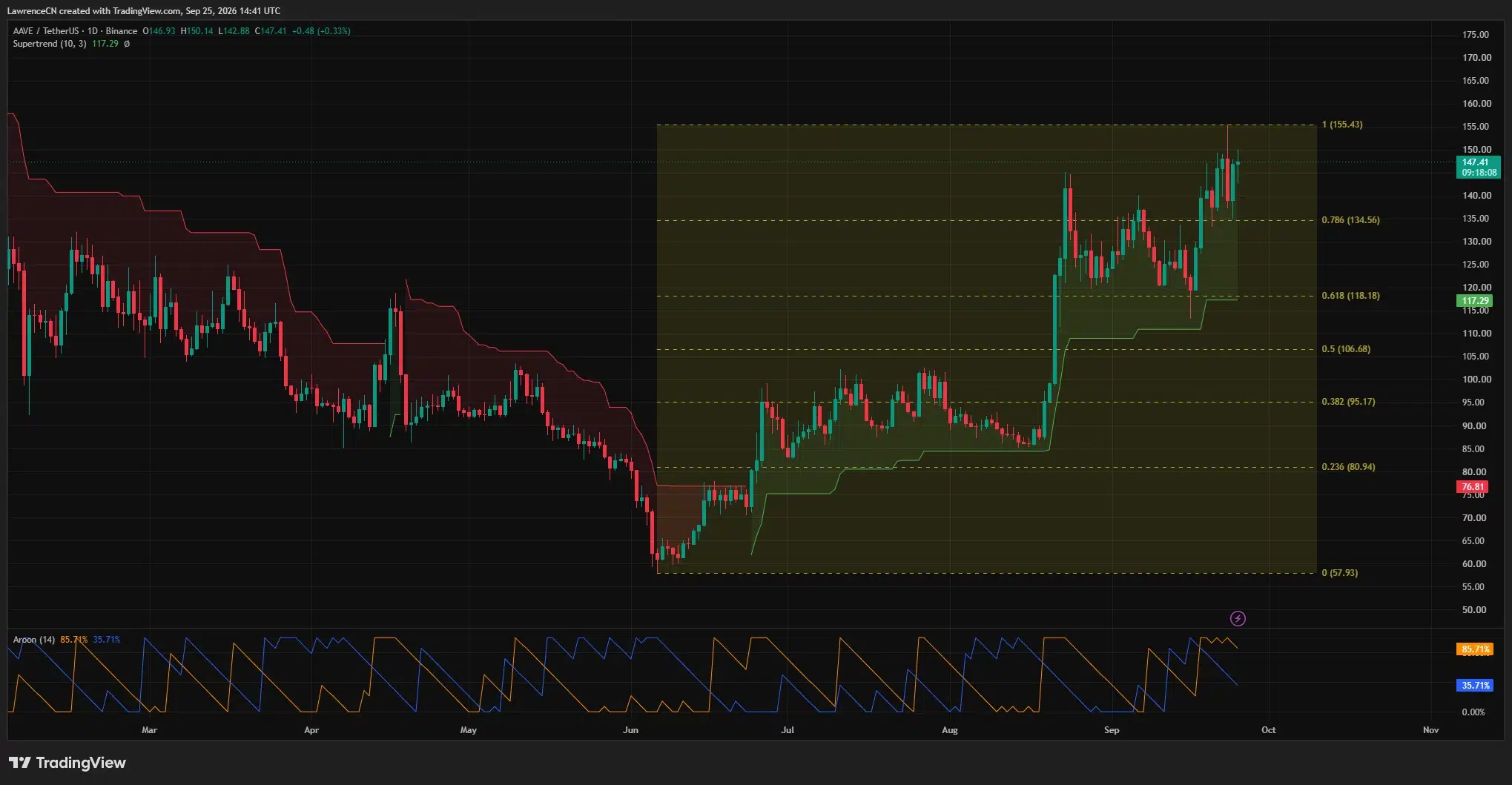
Aave price daily chart — Sep. 25 | Source: TradingView
The next marked level above the price is $155.43. A daily close above it would put AAVE beyond the upper boundary shown on the chart. If the price pulls back instead, the marked levels below are $134.56 and $118.18, with the Supertrend line near the latter.
Disclosure: This article does not represent investment advice. The content and materials featured on this page are for educational purposes only.
Read more: Polygon payment channels hit 11 million updates per second across 25 hubs