Aave V4 Model — Source: CoinGape Aave V4 surpassed $200 million in deposits within three months of launch. The upgrade introduces a Hub-and-Spoke architecture designed to reduce liquidity fra
Aave V4 Model — Source: CoinGape
- Aave V4 surpassed $200 million in deposits within three months of launch. The upgrade introduces a Hub-and-Spoke architecture designed to reduce liquidity fragmentation. V4 enables customizable lending markets for institutions, stablecoins and real-world assets.
Aave V4:- When Aave unveiled V4 three months, the upgrade was billed as the protocol’s most ambitious overhaul yet. Just three months later, the market appears to be validating that vision.
Lttle did CEO Stani imagine that within such a short period of time, Aave V4 would surpassed $200 million in deposits .
That’s a milestone, achieved yesterday, that underscores growing demand for a new generation of decentralized lending infrastructure. The achievement becomes all the more significant as Aave continues to dominate the lending sector, accounting for roughly 46% of active DeFi lending activity. It continues to maintain its position as the industry’s largest lending protocol.
Yet the real story isn’t the $200 million figure itself. It’s what this rapid adoption figure says about the future of how DeFi lenders generate revenue.
How Aave V4 is Changing Defi Lending
For years, DeFi lending protocols faced a fundamental challenge. Growth often came at the cost of liquidity fragmentation.
Each new market, asset class or lending strategy typically required its own liquidity pool. That forced users and capital to spread across multiple venues. The result was lower efficiency and increased complexity.
Aave V4 attempted to solve that problem through its new Hub-and-Spoke architecture.
Instead of creating isolated liquidity pools for every market, the system allows multiple lending environments to tap into a shared liquidity hub while maintaining independent risk controls. The model is designed to let developers launch specialized lending markets without sacrificing liquidity depth.
In effect, Aave is evolving from a lending protocol into a lending infrastructure platform.
The Rise of Modular Lending Markets
One of the most significant innovations that Aaave CEO pointed out is the introduced by V4 is the concept of customizable lending markets.
These markets can be configured for specific use cases. These include stablecoins, institutional lending, tokenized real-world assets (RWAs) amid the growing institutional rush in crypto.
Aave’s V4 model doesn’t forces all users into a single framework. Instead, it enables developers and institutions to create tailored lending environments with customized collateral requirements, liquidation thresholds and risk parameters.
The approach reflects a broader shift occurring across decentralized finance. As the industry matures, users increasingly want products designed for specific needs rather than generic financial infrastructure.
Aave’s answer is modularity. And perhaps the biggest long-term opportunity lies beyond retail DeFi users.
Aave V4’s architecture is specifically designed to support institutions and tokenized asset issuers that require customized risk frameworks and compliance structures.
A New Revenue Engine for DeFi?
Interestingly, as per the official blog, V4 is not only designed to improve lending efficiency.
In Aave V3, user deposits mostly stayed inside lending pools. The main way Aave earned money was through borrowers paying interest.
Idle or unused capital often stayed unproductive.
In Aave V4, the protocol changes this as the protocol also introduces a Reinvestment Module,
It can now take idle or unused liquidity and deploy it into safe, approved yield strategies. This creates additional income streams, not just borrowing interest. That’s particularly economical for assets such as Aave’ over $1V tokenized RWAs and stablecoins.
In short, Aave V4 is also creating additional revenue streams for depositors and the Aave DAO. In just 3 months, as per data from DefiLlama, the model has generated cumulative revenue of about $23,077, with $555 in the last 24 hours. DefiLlama also shows 30-day revenue of $12,727 and annualized revenue of $97,863.
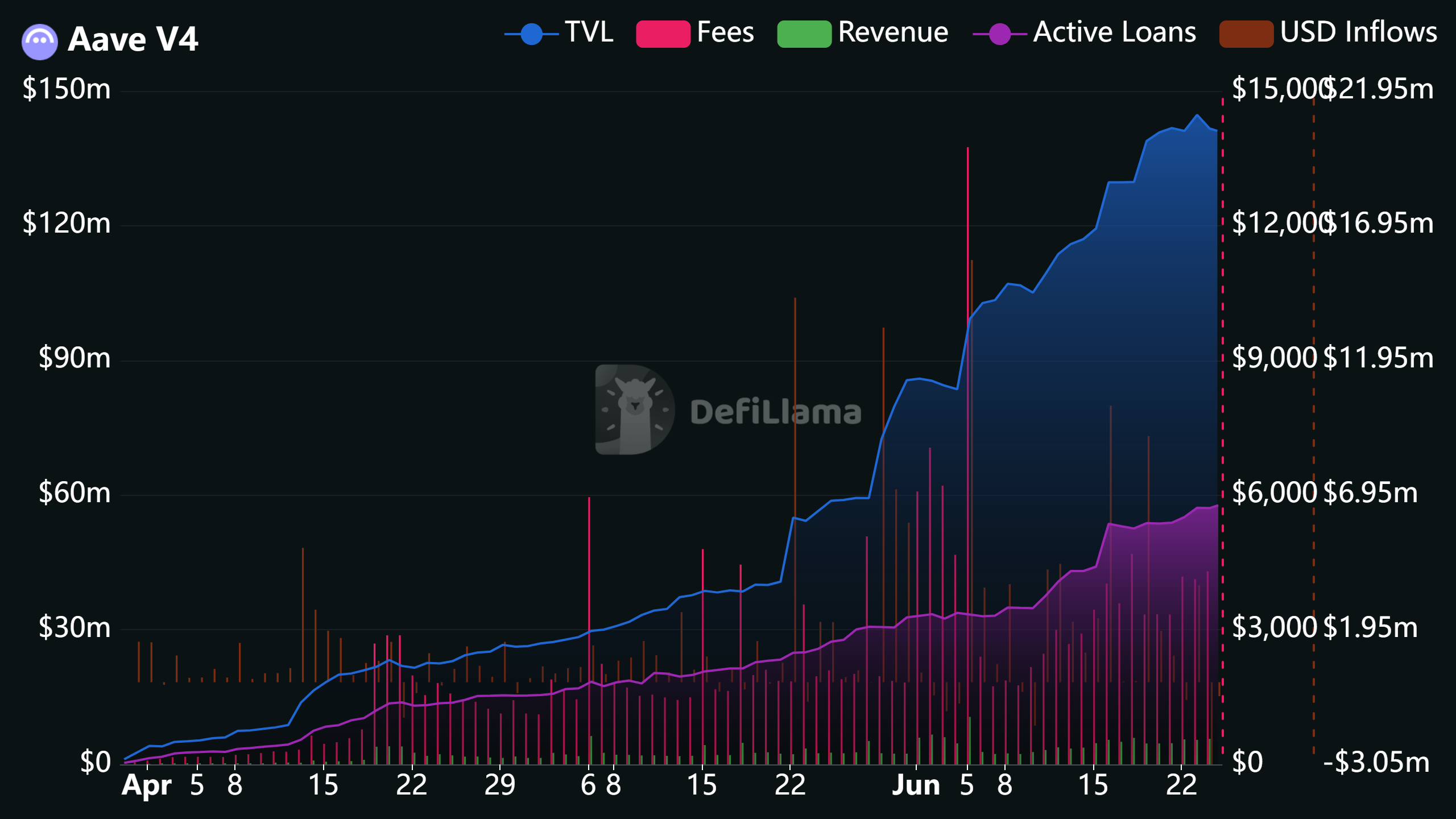
Aave V4 Revenue | Source: Defillama
Thus, the first $200 million in deposits may represent only a small fraction of Aave’s broader ecosystem, but it offers an early glimpse into where decentralized lending is heading.
If that vision materializes, Aave V4 will be remembered as more than just another protocol upgrade. It could mark the beginning of a new era for decentralized lending.
About the author
Aave V4 Crosses $200M Deposits. How It Is DeFi Lending’s New Revenue Engine originally appeared on CoinGape