Quick answer Payment failures on advertising platforms are usually caused by a mismatch between the platform's billing model and the card's configuration rather than by insufficient funds. Me
Quick answer
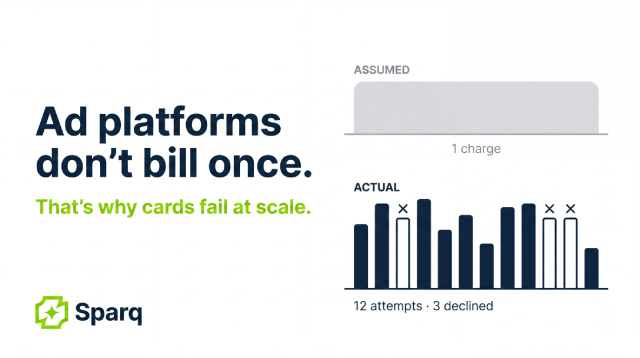
Payment failures on advertising platforms are usually caused by a mismatch between the platform's billing model and the card's configuration rather than by insufficient funds. Meta uses postpay threshold billing, Google applies thresholds across payment profiles that can govern dozens of accounts, TikTok operates prepay, and Amazon splits billing across two non-synchronised systems. Cards fail primarily due to unsuitable BIN classification, absent 3-D Secure support, single-card use across many accounts, and threshold spikes when spend scales.
Table of contents
- How each platform bills
- Why cards fail specifically
- The standard mitigation structure
- Rising costs and why the problem compounds
- Where card payment stops being appropriate
- FAQ
The four major platforms use materially different billing models. A payment configuration designed around one will produce apparently random failures on another.
PlatformModelKey characteristicMetaPostpay thresholdCharges when accumulated spend reaches a threshold; new accounts start near $25, standard ceiling near $2,500, higher on requestGoogleThreshold-basedA single payments profile can govern dozens of accounts — one failure cascades portfolio-wideTikTokPrepayCampaigns halt immediately when balance reaches zero; no threshold bufferAmazonSplitBilling runs across two separate systems that do not synchronise
A significant change took effect on 1 April 2026: Meta now requires high-spend accounts connected to a Business Portfolio to move from credit cards to monthly invoicing or direct debit. Accounts below that spend threshold may continue using cards.
Why cards fail specifically
Four causes account for the majority of failures at agency scale.
Unsuitable BIN classification. Advertising platforms screen card type during verification. Cards classified as prepaid frequently fail verification before any charge is attempted. This is the most common cause and the least visible, since classification cannot be determined by inspecting a card number.
Absent 3-D Secure support. Card verification on these platforms commonly triggers 3DS. Cards without support fail without a distinguishing error.
Single card across multiple accounts. Linking one card to many ad accounts functions as a risk signal in itself, independent of spend levels or payment history.
Threshold spikes. Scaling spend increases the size of each threshold charge. Fraud rules calibrated to a smaller operation trigger on the larger amounts, producing declines precisely when a campaign is performing well.
The standard mitigation structure
Established practice among agencies and media buyers converges on a consistent structure:
- A dedicated card per ad account rather than one card across the portfolio
- Sufficient balance maintained rather than topped up reactively
- No repeated retry attempts following a decline, since consecutive failures extend temporary blocks
- Backup cards provisioned in advance rather than after a failure
- Spend visibility maintained across the team
The card-per-account element carries benefits beyond failure isolation. It produces clean per-account attribution for reporting, and prevents a single frozen card from halting an entire portfolio simultaneously.
This structure requires a card provider that issues multiple cards at low friction with independent controls. Sparq supports this model: multiple virtual cards issued instantly from a single crypto balance, each with independent spending controls, on debit BINs across multiple countries with 3-D Secure and recurring billing support. The Infinite Card tier carries limits of $250,000 per transaction, $500,000 daily, and $1,000,000 monthly for higher-volume operations.
Rising costs and why the problem compounds
Advertising costs have risen substantially, which increases the size of each threshold charge and consequently the frequency of fraud-rule triggering.
Meta CPMs climbed approximately 20% year-over-year to around $14.19, according to Triple Whale benchmark data covering nearly 35,000 ecommerce brands. Google Ads cross-industry average CPC reached approximately $2.96 in Q1 2026, up 12% from the prior year.
EMARKETER forecasts Meta will surpass Google in global digital ad revenue during 2026, at $243.46 billion against Google's $239.54 billion — with Meta growing at 24.1% against Google's 11.9%.
Higher spend produces larger charges, which produce more declines. The billing problem scales alongside the cost problem.
Where card payment stops being appropriate
Cards are not the correct instrument at every scale, and this warrants stating directly.
Meta's April 2026 requirement means the largest Business Portfolio accounts must transition to invoicing or direct debit regardless of card configuration. Any claim that a card product resolves advertising payment at all spend levels contradicts what the platforms have already established.
Card-based payment remains well suited to the substantial middle segment: operations running multiple accounts that require per-account separation, clean attribution, and spending controls administrable without dedicated finance infrastructure.
FAQ
Why did my card work on Google but fail on TikTok?The billing models differ fundamentally. TikTok is prepay with no threshold buffer, while Google applies threshold charges across a payments profile. A configuration adequate for one may not suit the other.
Can I use one card across all my ad accounts?Technically possible but inadvisable. It functions as a risk signal, and a single failure or freeze affects every account simultaneously.
Why do declines increase when campaigns scale?Threshold charges grow with spend. Fraud rules calibrated to previous transaction sizes trigger on the larger amounts.
Should I retry a declined charge immediately?No. Consecutive failures typically extend temporary blocks rather than clearing them.
Do crypto-funded cards face additional restrictions on ad platforms?Not inherently. What matters is BIN classification, 3-D Secure support, and card limits — not the funding source.