Key Takeaways Data center operations now represent AMD’s primary revenue catalyst, powered by EPYC server chips and Instinct AI accelerators Market share gains don’t require overtaking Nvidia
Key Takeaways
- Data center operations now represent AMD’s primary revenue catalyst, powered by EPYC server chips and Instinct AI accelerators
- Market share gains don’t require overtaking Nvidia — capturing a significant portion of explosive AI chip demand is sufficient
- Conservative 2031 projection points to approximately $704, while optimistic scenarios exceed $1,500
- Analyst sentiment remains constructive: 30 Buy recommendations, 12 Hold, 1 Sell — overall Moderate Buy rating
- Current trading levels exceed consensus price targets, suggesting near-term valuation concerns following recent gains
Advanced Micro Devices has emerged as a critical player in the artificial intelligence infrastructure expansion.
The firm’s first-quarter 2026 financial report illustrated this strategic shift unmistakably. Revenues climbed substantially, fueled by robust appetite for EPYC data center processors and Instinct GPU accelerators. The data center segment has displaced gaming and consumer processors as the company’s dominant growth driver.
Shares currently change hands near $537. This valuation reflects significant optimism already embedded in the market price.
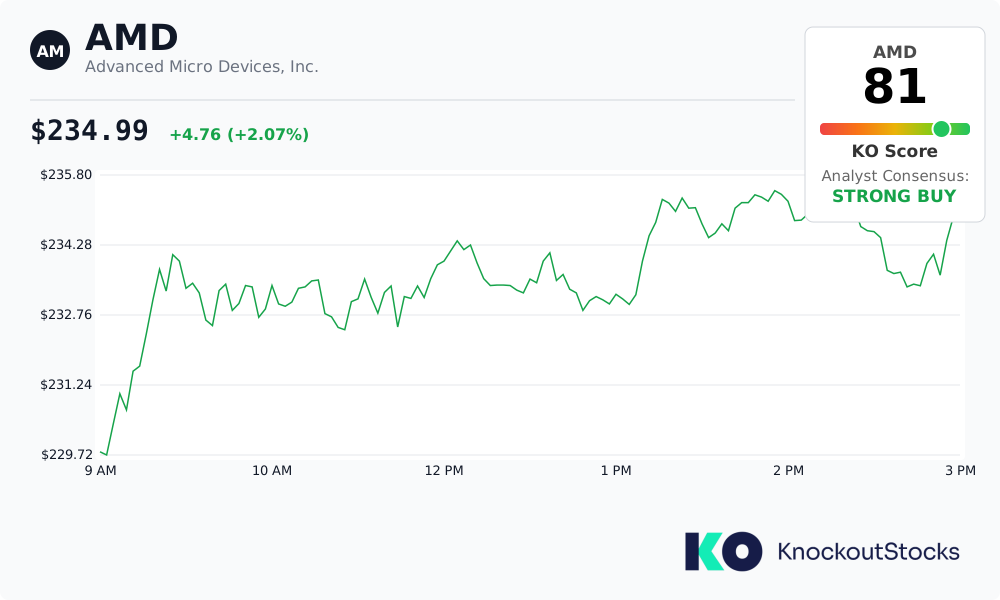 Advanced Micro Devices, Inc., AMD
The optimistic investment thesis hinges on three critical factors. Cloud hyperscalers increasingly prioritize vendor diversification for AI silicon. AMD has established substantial positioning in server processors following years of systematically capturing territory from Intel. The company’s AI accelerator development timeline positions it as a viable alternative computing platform.
Nvidia maintains commanding leadership in AI acceleration hardware. However, AMD’s success doesn’t require outright victory in this competition. Even a substantial minority position in an explosively expanding market translates to dramatically increased business scale.
Three Potential Trajectories Through 2031
Financial analysts have constructed three distinct scenarios for AMD’s evolution over the next seven years.
Under pessimistic assumptions, AMD expands but struggles to secure adequate AI accelerator adoption. Revenues might approach $70 billion, yet margin compression limits profitability. Applying a 25x earnings multiple yields a stock price near $200.
The middle-ground projection presents more favorable conditions. AMD sustains data center penetration, expands Instinct GPU deployment, and achieves margin improvement. Revenue could reach $120 billion with earnings per share around $22. A 32x valuation multiple supports a price target of approximately $704.
The optimistic scenario envisions transformational success. Should AMD establish itself as the definitive second AI chip platform while simultaneously expanding CPU and enterprise computing presence, revenues might hit $180 billion. With EPS at $40 and a premium valuation, shares could trade beyond $1,500.
Weighting these scenarios by probability generates a blended target near $807 — representing roughly 50% appreciation from current levels, or approximately 8.5% annualized returns.
Current Wall Street Perspective
The analyst community maintains generally favorable views, albeit with important caveats.
AMD presently carries 1 Strong Buy, 30 Buy ratings, 12 Holds, and 1 Sell, per MarketBeat data. The aggregate rating stands at Moderate Buy.
The complication: average analyst price targets fall below AMD’s current market price. This gap suggests analysts appreciate the business fundamentals while believing the stock has outpaced near-term justification following its recent advance.
The Road Ahead for AMD
AMD’s EPYC processor family has systematically captured CPU market share from Intel over consecutive quarters. This provides the company with established data center relationships independent of Instinct GPU revenue contributions.
Executive guidance has previously outlined expectations for sustained multi-year expansion, anchored by data center growth. These projections form the foundation for 2031 valuation models.
For AMD to generate meaningful market outperformance from current levels, execution closer to the bullish scenario appears necessary. The base-case trajectory delivers returns roughly aligned with broader equity market expectations — respectable, but below the outsized gains growth-oriented investors typically seek.
First-quarter 2026 data center revenue established a new company record for quarterly performance.
The post Advanced Micro Devices (AMD) Stock: Can It Reach $1,500 by 2031? appeared first on Blockonomi.