Key Takeaways Advanced Micro Devices delivered record-breaking Q2 revenue totaling $11.54 billion, representing a 50% year-over-year surge and exceeding analyst projections The company’s adju
Key Takeaways
- Advanced Micro Devices delivered record-breaking Q2 revenue totaling $11.54 billion, representing a 50% year-over-year surge and exceeding analyst projections
- The company’s adjusted earnings per share reached $1.66, surpassing the consensus estimate of $1.62
- Data center segment revenue skyrocketed to $6.7 billion—more than doubling from last year—and now accounts for 58% of overall revenue
- Despite beating expectations, AMD shares dropped between 5-8.5% as the market anticipated an even more impressive performance
- Third quarter revenue guidance of approximately $13 billion exceeded some forecasts but disappointed those expecting as much as $14 billion
In a scenario that highlights the elevated standards for AI semiconductor companies, AMD surpassed Wall Street projections on both top and bottom lines, upgraded its outlook, and still witnessed a stock decline.
 Advanced Micro Devices, Inc., AMD
The semiconductor manufacturer reported second quarter revenue of $11.54 billion, representing a substantial increase from $7.69 billion in the same period last year. The company’s adjusted profit per share reached $1.66, outperforming the $1.62 consensus forecast. Using conventional metrics, these results would typically be considered exceptional.
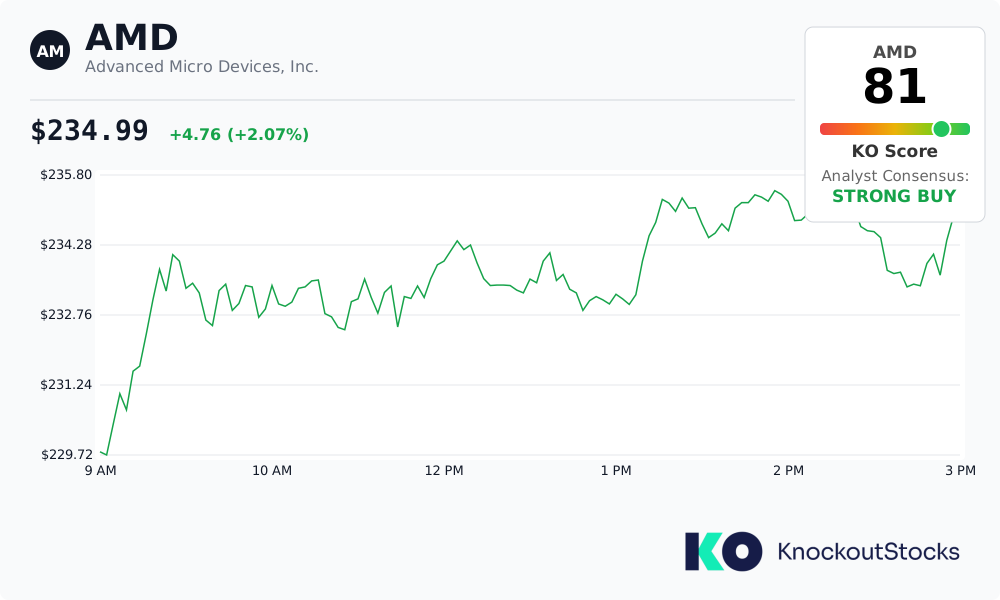
Nevertheless, AMD shares declined approximately 5% on Wednesday in the wake of the earnings announcement.
“The market had positioned itself for something significantly more spectacular,” noted Shay Boloor, chief market strategist at Futurum. “Expectations were calibrated for an extraordinary outcome, and while solid, this didn’t qualify as extraordinary.”
The standout metric from the quarter came from the data center division, which generated $6.7 billion in revenue, marking a 107% year-over-year increase. This segment now comprises 58% of AMD’s total revenue, a significant jump from 42% twelve months prior.
This expansion solidifies AMD’s role as the primary competitor to Nvidia in artificial intelligence infrastructure. Leadership also shared an ambitious forecast, projecting the server CPU market could expand from approximately $26 billion in 2025 to roughly $220 billion by the end of the decade.
The company’s earnings per share surged 246% compared to the prior year period.
Surging Capital Spending Raised Red Flags
A figure that surprised market participants was the capital expenditure total. AMD’s capex reached $808 million during the quarter, climbing sharply from $282 million in the year-ago period and $389 million in the first quarter.
“That represents a startling upward adjustment in capital spending,” Boloor remarked.
Elevated investment levels sparked concerns regarding short-term profit margins and free cash generation, factors that likely contributed to downward pressure on shares. The investments target expanded manufacturing capabilities for EPYC processors and the company’s Helios rack-scale artificial intelligence systems.
Looking ahead to the third quarter, AMD projected revenue of approximately $13 billion, with a variance of plus or minus $300 million. While this exceeded certain analyst projections of $12.5 billion, it came up short against the most optimistic predictions reaching $14 billion.
“The results were strong across all metrics, but insufficient to recalibrate expectations for a stock valued at nearly 60 times earnings,” Boloor observed.
AMD also highlighted weakening conditions in the PC market for the latter half of the year, attributing the softness to elevated memory and component pricing that’s dampening consumer demand. CEO Lisa Su indicated the company anticipates its client segment will exceed broader market performance despite these challenges.
Revenue from gaming graphics products fell year-over-year as increased component expenses drove up graphics card retail prices and reduced overall market demand.
Heading into this earnings report, AMD had gained more than 115% year to date, with total returns of approximately 142% in 2026. Such dramatic appreciation established extraordinary benchmarks. The investment community is no longer merely evaluating whether AMD exceeded projections—they’re assessing whether the margin of outperformance justifies the stock’s premium valuation multiple.
This quarter, third quarter guidance of $13 billion coupled with record-setting data center results proved insufficient to meet that elevated threshold.
The post Advanced Micro Devices (AMD) Stock Drops Despite Crushing Q2 Earnings Expectations appeared first on Blockonomi.