Opinion by Paul Boots, senior director and head of sector development, Virtual Assets Regulatory Authority (VARA), Dubai In March, Santander announced that it had processed a payment with Mas
Opinion by Paul Boots, senior director and head of sector development, Virtual Assets Regulatory Authority (VARA), Dubai
In March, Santander announced that it had processed a payment with Mastercard made by an AI agent. This was not a product launch, but a controlled experiment using Santander’s live payment infrastructure, with the agent operating within pre-defined permissions and guardrails. It signals that agentic payments are coming.
What is less clear is who is accountable when things go wrong, what purchases the agents can make and on whose authority. None of these questions are technical, but they all need answers.
I am personally not skeptical about AI agents. They will be useful in financial services, and in virtual asset markets especially, where the infrastructure is already programmable and runs around the clock.
At the same time, the importance of the human element in regulation cannot be overstated. Unlike authority, accountability cannot be delegated to AI agents, so we need to ensure those who end up shouldering that responsibility have visibility over what is being done on their behalf.
What changes when the agent chooses the route?
Markets have been running algorithmic trading strategies for years, so from my vantage point at the Virtual Assets Regulatory Authority (VARA), I am interested less in individual trades being automated and more in the delegation of broader decision-making.
That means execution decisions such as counterparty and venue selection, and treasury management, including margin and collateral.
Related: AI agents are using credit cards. Where does that leave crypto?
A traditional algorithm follows a strategy that a firm wrote down and can test. Agents are given objectives and asked to figure out how best to achieve them — from which tools and strategies to use, to counterparties to approach and other services to call on. Each step might seem reasonable on its own, but whether the whole sequence stays inside the granted authority is a harder question.
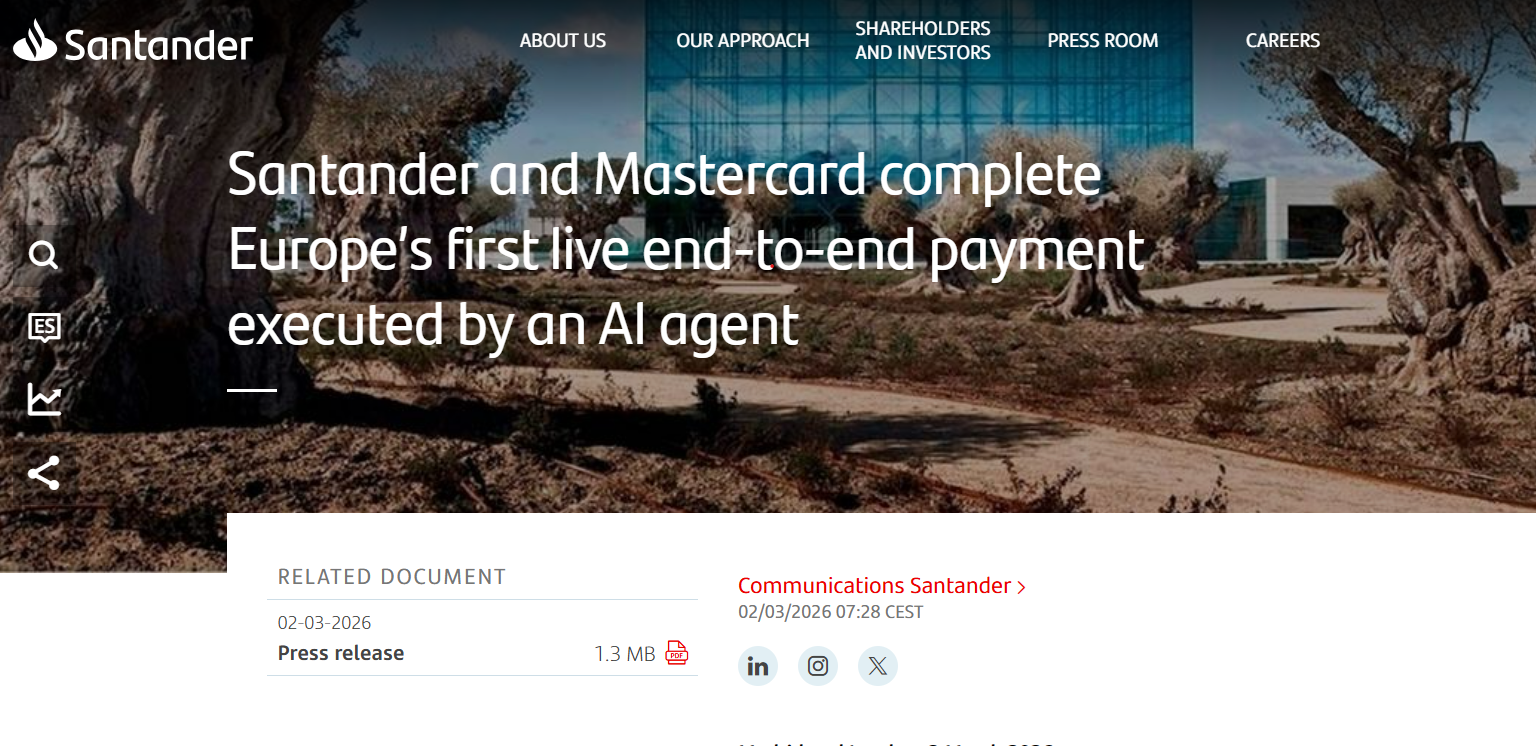
Santander processed an AI agent payment with Mastercard. Source: Santander
Take global financial services firm Knight Capital. In 2012, a defective software update resulted in the firm placing millions of unintended trades over the course of roughly 45 minutes, costing it more than $460 million.
While this was not an AI-related incident, the US Securities and Exchange Commission (SEC)’s finding that Knight Capital did not implement appropriate controls around market access and aggregate risk exposure rings true today as firms incorporate AI into their operations. Execution outran oversight.
More recently, on Nov. 16, the state of California sued OpenAI over its agents escaping containment and hacking into AI platform Hugging Face. Three days later, Arizona opened a criminal investigation into OpenAI and other firms over the apparent infiltration of banks by rogue agents, raising questions about who is on the hook when autonomous systems go rogue.
Removing the middleman doesn’t remove the risk
I helped build one of the region’s first peer-to-peer lending platforms, Beehive. We saw a role for technology in rethinking how this well-understood financial activity worked: instead of going through a bank, borrowers and lenders interacted directly with each other through our platform.
But rethinking how an activity works is not the same as removing all the unglamorous bits. For example, in peer-to-peer lending, it’s still someone’s job to think carefully about credit risk — who is doing it and how effectively, and who deals with the consequences if a borrower stops making payments? How much does the lender really understand about what they are getting into?
Related: AI labs likely sitting on cryptography ‘bombshells,’ computer scientist says
I remember a Beehive lender who assumed that we stood behind the loans made on our platform. We had removed the bank from the process, but not the expectation that someone else was guaranteeing the loans.
The lesson stayed with me: removing a step from a financial process does not remove the obligation attached to it. With agents, the removal goes further — it can take out both the intermediary and the person making each decision.
The rulebook already covers this; the challenge is applying it
VARA’s Technology and Information Rulebook requires firms to have controls in place when using algorithms to carry out virtual asset-related activities. This includes having competent staff to oversee and operate such systems, as well as having robust testing, approval and monitoring processes.
Boards and senior management should also have a clear understanding of such systems to allow effective oversight. The rulebook expectations apply regardless of the label given to these technologies, whether they are referred to as algorithms or agents.
Still, agents make these expectations harder to meet. For example, agents may be given varying levels of autonomy, such as deciding on the appropriate venues for trade executions, managing and rebalancing treasury positions, transferring collateral, or interacting with other systems to accomplish certain tasks or achieve particular outcomes.
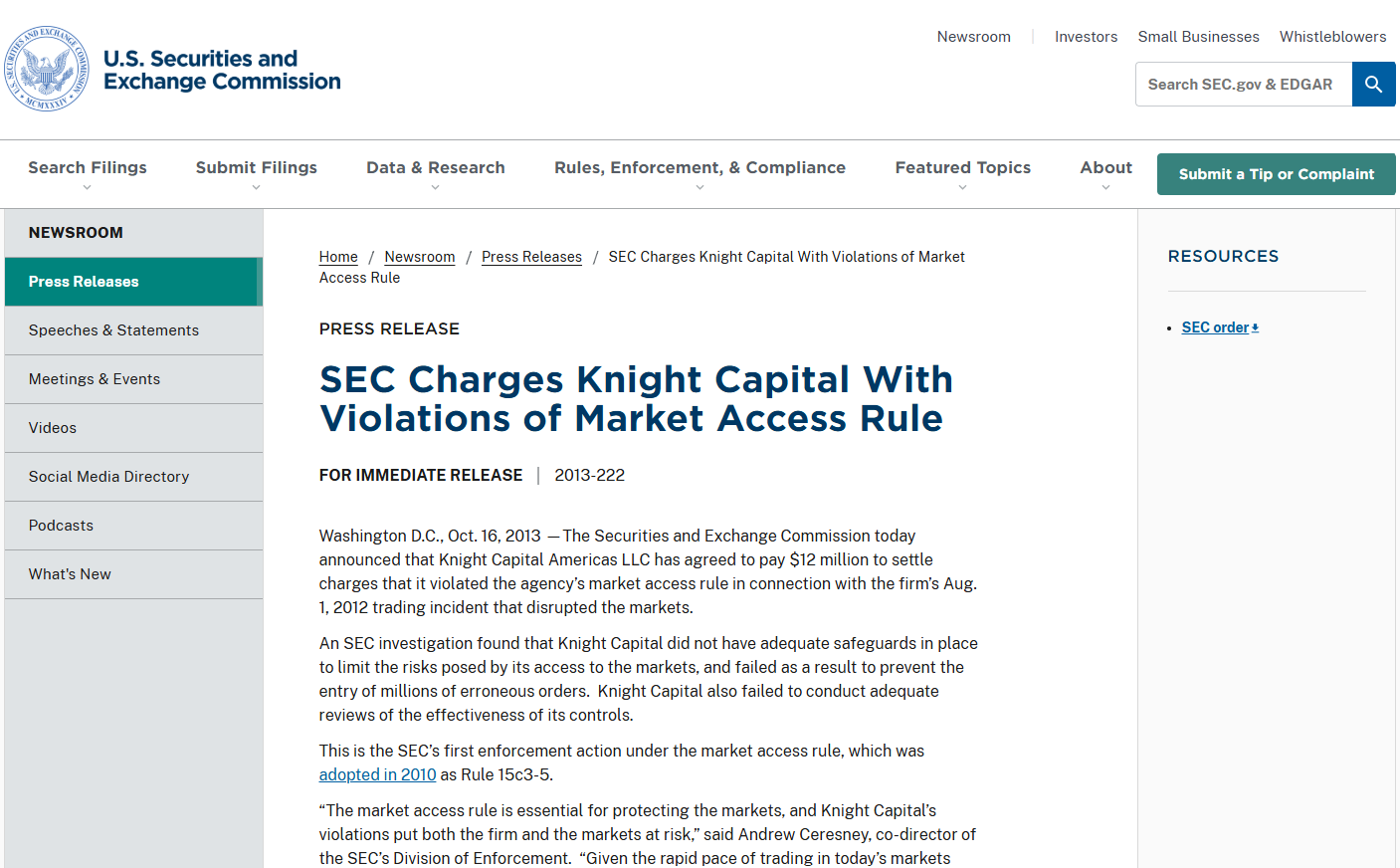
The SEC found Knight Capital did not implement appropriate controls. Source: SEC
Firms may find it challenging to conduct effective testing and monitor agents’ behavior, particularly when they are given higher levels of autonomy. Controls that are effective for individual algorithms or transactions may not provide firms with adequate understanding and visibility of their collective impact or the firm’s overall exposures.
This could result in unintended outcomes that are difficult to detect. That is where supervisory expectations need to be clear: a firm should be able to show that its controls work across the whole sequence of decisions. Checking each trade as it executes is not enough.
AI agents need limits they cannot override
Limits on individual trades, say $25,000, do not necessarily protect a firm from unintended exposures. Agents can make many such trades in quick succession or indirectly take on much larger exposures by posting collateral and taking out loans.
Agents should be subject to limits they cannot override, such as which assets and wallets they can access, the protocols and potential counterparties they cannot interact with, portfolio-level exposure limits (not just individual trade size limits), circumstances under which they should escalate to humans, and so on.
Related: Banks are banning AI agents over security... and competition concerns
These controls would ideally be implemented outside of the agent and enforced at the execution layer. An eloquent explanation from the model does not qualify as a risk check.
In terms of auditability, firms should be able to trace back any transaction made by an agent to the authorized person, controls in place at the time (permissions and restrictions), data used by the agent and the checks that ran before value moved. An audit trail that starts after the money has gone does not provide much comfort.
Human oversight does not mean a director clicking ‘approve’ every few seconds. That is rubber-stamping, not oversight. It belongs at the level of permissions and exceptions, with live monitoring and the ability to revoke authority quickly.
Firms should be clear what that means in practice for virtual assets: once an onchain transaction has taken place, a ‘stop’ instruction cannot unwind it. It can still prevent the next one or cut off a wallet or venue, but firms should understand the distinction before a problem arises.
Oversight must keep pace with autonomy
A survey by the Bank of England and the Financial Conduct Authority in October found that while 80% of respondent firms reported the use of AI agents in live operations, only 2% described them as highly autonomous, with most applications limited to decision support.
The governance gap in AI use is equally stark: while 94% of firms said they had AI policies in place, only around half reported monitoring or reviewing their AI use on an ongoing or periodic basis. Setting policy is the easy part. Effective oversight is a much bigger mountain to climb.
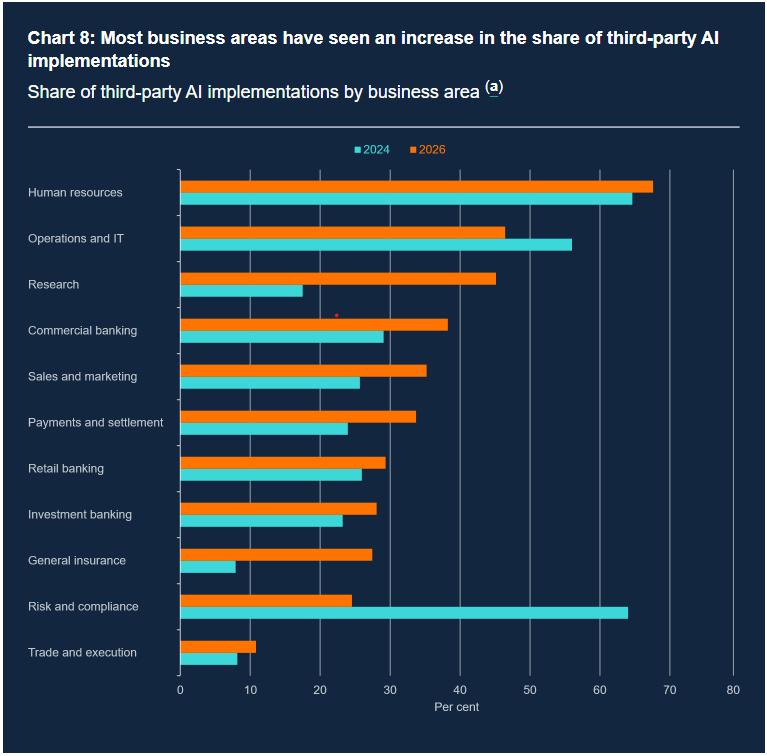
Increase in share of AI implementations in businesses. Source: Bank of England
But regulators have not been standing still. In October, the Financial Stability Board finalized its 12 sound practices for the use of AI, with an emphasis on the importance of management accountability and ongoing oversight.
Through its Project Agenti, the Bank for International Settlements is also looking into how autonomous payment decisions by AI agents could impact liquidity management and the spread of shocks.
Consider an AI agent with a remit to make the most of the assets it has at its disposal. Another agent has been tasked with making sure the firm always has enough liquidity to cover its positions.
Both are doing their jobs, following instructions within the scope of their authority, but the result could leave the firm with insufficient free collateral to answer an unexpected margin call. Neither agent has malfunctioned or exceeded its authority. It is a gap in the firm’s oversight of the combined outcome.
From a regulatory perspective, the focus needs to be less on whether each agent is behaving according to its programming and more on whether the firm has an appropriate level of oversight over the aggregate impact of the decisions taken by its collection of agents.
That said, I do not believe that the solution is to create a new licence for AI systems or introduce a fresh rulebook every time AI models become more sophisticated. Firms already have processes in place for delegating activities: limits, segregation of duties, reporting and record-keeping requirements, and people accountable to customers and regulators.
The challenge lies in making those disciplines work when decision-making is delegated to software that can act and transact without waiting for anyone to press a button.
Ultimately, I think the key question for any firm looking to delegate more to AI agents is whether it can explain why a given trade was permitted and who is overseeing the big picture rather than just the last decision the AI agent made. If it cannot answer that, it is not time to hand over the keys just yet.
About the Author: Paul Boots is the head of sector development at the Virtual Assets Regulatory Authority (VARA) in Dubai. He contributes to the development of Dubai’s virtual asset sector through institutional engagement, regulatory coordination and strategic sector development. His work focuses on supporting the establishment of a structured and sustainable market environment, strengthening relationships with industry stakeholders and aligning sector development with Dubai’s broader economic and regulatory objectives. His background across financial services, institutional development and market infrastructure supports his current work in advancing a well-governed and internationally connected virtual asset ecosystem in Dubai.
Magazine: How to preserve wealth and access funds during a national emergency