The Nasdaq Composite wiped out its entire gain for 2026 on Friday, November 20, as the sell-off in artificial intelligence stocks deepened on Wall Street. By 12:43 p.m. in New York, the tech-
The Nasdaq Composite wiped out its entire gain for 2026 on Friday, November 20, as the sell-off in artificial intelligence stocks deepened on Wall Street. By 12:43 p.m. in New York, the tech-heavy index was down 3.6 percent at 23,011 points, about 1 percent below where it ended 2025, according to data from Yahoo Finance. Chip stocks fell by up to 15 percent, Nvidia lost more than 7 percent, and Anthropic, which raised a record $81.3 billion in its IPO this week, traded just 43 cents above its $83 offer price on its second day of trading.
The S&P 500 fell 2.2 percent and the Dow Jones Industrial Average 0.7 percent. Both indexes are now more than 10 percent below their record closes, which puts them in what Wall Street calls a correction. According to CNN, the S&P 500 was on track for its seventh straight losing day, its longest losing streak since February 2020.
AI bubble: the numbers at a glance
Market
Level
Change on the day
Nasdaq Composite
23,011
−3.6% (−1.0% in 2026)
Nasdaq 100
25,493
−3.9%
S&P 500
7,017
−2.2%
Dow Jones
48,732
−0.7%
PHLX Semiconductor Index (SOX)
8,598
−8.7%
Nvidia
$135.31
−7.3%
Micron
$606.93
−12.1%
SanDisk
$80.92
−14.3%
AMD
$434.44
−11.2%
Anthropic (ANT), IPO price $83
$83.43
−14.1%
VIX volatility index
32.2
+13.1%
Taiwan Taiex (close)
36,033
−6.2%
Kospi (close)
4,870
−5.2%
Nikkei 225 (close)
56,437
−5.1%
DAX (close)
24,803
−2.6%
Gold (per ounce)
$3,532
−4.2%
10-year Treasury yield
4.94%
from 5.05%
Bitcoin
$58,966
−4.7%
As of November 20, 2026, 12:43 p.m. ET (17:43 UTC); Asia and the DAX at their Friday close. Source: Yahoo Finance.
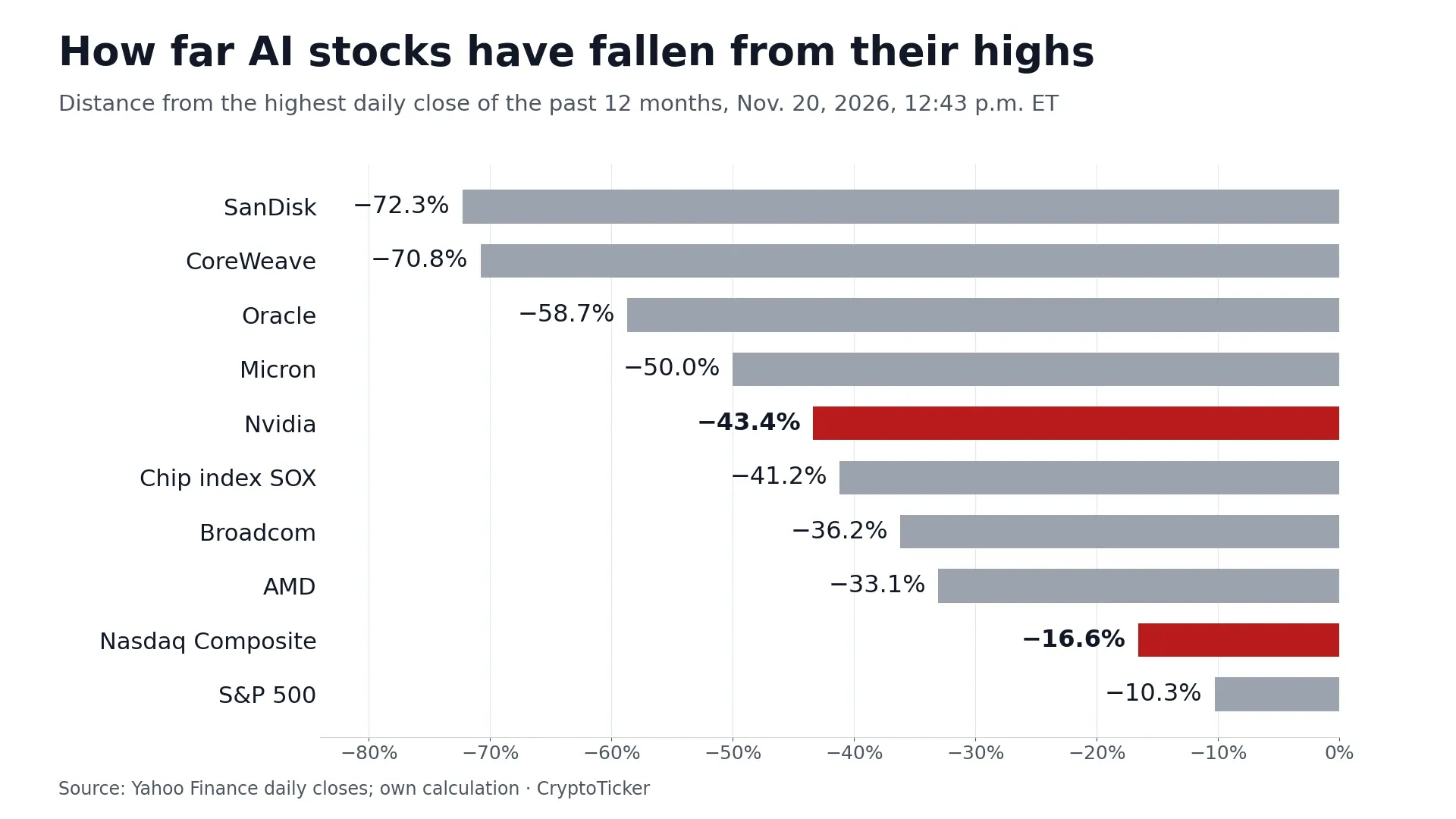
Distance from the highest daily close of the past 12 months. Data: Yahoo Finance, as of November 20, 2026, 12:43 p.m. ET
The chart shows how much air has already come out of the AI trade. The Nasdaq is 16.6 percent below its record close of 27,600 points on October 6. The PHLX Semiconductor Index has lost 41 percent since its June high, Nvidia 43 percent since early October. SanDisk and CoreWeave, two of the biggest winners of the AI boom, are down more than 70 percent from their peaks.
Why the AI trade is unravelling
The selling has built for weeks and has several triggers. According to the CNBC live blog, investors had hoped that Nvidia's quarterly results earlier this week and Anthropic's IPO would revive enthusiasm for AI. Instead, the debut prompted them to take profits. Signs that the spending spree on data centers is slowing, the Democratic wins in the 2026 midterm elections and the departure of Jensen Huang as Nvidia's chief executive have all raised doubts about how long the AI build-out can keep its pace.
Interest rates add to the pressure. Markets expect the Federal Reserve to raise its key rate by a quarter point at its meeting on December 8 and 9. Fed Governor Lisa Cook warned on Friday that waiting too long could force larger rate increases later. On Thursday, a short-seller report by Hunterbrook on AMD's business ties to China had already weighed on chip stocks; AMD told Bloomberg that it complies with US export control laws.
The losses run through the whole AI supply chain. Micron fell 12.1 percent, SanDisk 14.3 percent and Western Digital 11.9 percent. AMD and Broadcom lost more than 11 percent each, optical component maker Coherent 14.3 percent. Oracle and CoreWeave, which build computing capacity for AI customers, fell 7.4 and 10.4 percent. Investors moved into defensive names instead: Walmart gained 2.7 percent and Costco 1.8 percent.

Illustrative image, AI-generated
What analysts say: exodus or a mild cold
Steve Sosnick, chief strategist at Interactive Brokers, told CNN he sees "a real exodus out of tech stocks". Massimo Santicchia, head of US equities at Procyon, told CNBC that the move is no longer just a correction of high valuations but is spreading across the market. James Reilly of Capital Economics expects the losses to run further and sees the S&P 500 at 6,500 points by the end of next year, about 7 percent below Friday's level.
Others see no end to the AI story. David Kelly, chief global strategist at JPMorgan Asset Management, called corrections inevitable after years of strong gains and compared the slide to a mild cold rather than a serious illness that should pass within a week or two. In a note on Friday, UBS said the risk-reward in equities had become more balanced and the AI investment story remains intact. The bank estimates that revenue from AI models and applications would have to reach at least $1.5 trillion by 2030 to earn an adequate return on the money being spent.
Anthropic close to its IPO price
Anthropic shares fell 14.1 percent to $83.43 and gave back almost all of Thursday's first-day gain, when the stock closed at $97.17. At that price, the company is worth about $1.10 trillion, based on the 13.22 billion shares outstanding after the offering listed in its final prospectus. That is roughly $180 billion less than at Thursday's close. Seaport Research started coverage with a neutral rating; analyst Jay Goldberg wrote that the company will need time to grow into its valuation, according to CNBC. The first trading day in numbers is in our Anthropic day-one review.
From Taipei to Frankfurt: a global sell-off
Asia took the hit before Wall Street opened. Taiwan's Taiex closed 6.2 percent lower at 36,033 points and lost 17.5 percent for the week, its worst week since 1991, 24/7 Wall St. reported, citing Bloomberg. South Korea's Kospi fell 5.2 percent, Japan's Nikkei 225 5.1 percent to a seven-month low. SoftBank plunged 14.5 percent, memory maker Kioxia 11.7 percent and chip tester Advantest 10.3 percent. According to Reuters, MSCI's index of Asia-Pacific shares outside Japan was heading for its worst week since March 2020.
In Europe, the DAX closed 2.6 percent lower at 24,803 points, and the Euro Stoxx 50 lost 2.8 percent. Gold offered no shelter: the metal fell 4.2 percent to $3,532 an ounce, silver 7.4 percent. Investors bought US government bonds instead, which pushed the 10-year Treasury yield down to 4.94 percent from 5.05 percent. Bitcoin fell below $60,000 for the first time since July and stood at $58,966, as our report on Bitcoin below $60,000 shows. The moves minute by minute are in our Bitcoin crash live blog.

Illustrative image, AI-generated
What comes next
- US close: Wall Street closes at 4 p.m. ET (21:00 UTC). A close below 23,242 points would leave the Nasdaq in the red for 2026. According to CNN, all three major indexes are on track for their worst week since April 2025.
- Federal Reserve: The next rate decision is due on December 9. UBS expects quarter-point hikes in December and in March, but no long tightening cycle.
- Anthropic lock-up: From December 15, existing shareholders may sell up to 303 million shares, the first step of the lock-up release set out in the prospectus.
- Weekend: Stock exchanges are closed, but crypto keeps trading. Bitcoin and perpetual futures on stocks such as Anthropic move on crypto exchanges on Saturday and Sunday as well.
In June, we described what a burst AI bubble could mean for crypto in our analysis of an AI bubble crash and Bitcoin. Nvidia's latest quarterly figures are in our Nvidia earnings report.
Trading the AI sell-off: shares, CFDs and futures
Stocks such as Nvidia or Anthropic can be held as shares or traded with CFDs and futures on rising (long) or falling (short) prices. Leverage multiplies every price move in both directions.
- XTB: Nasdaq stocks such as Nvidia and Anthropic as shares and as CFDs, long and short. 78% of retail investor accounts lose money when trading CFDs with this provider.
- Bitget: perpetual futures on crypto and on stocks such as Anthropic (ANT), around the clock including weekends.
More providers with fees and regulation are listed in our crypto broker comparison and our crypto exchange comparison.
Risk warning: trading with leverage can lead to the loss of your entire stake. This section explains options and is not investment advice. These are partner links; if you open an account through them, cryptoticker.io earns a commission at no cost to you.
At the time of writing, 12:43 p.m. ET, the Nasdaq Composite stood at 23,011 points.