Thunderclap in the technology sector! Chinese authorities are scrutinizing two of their AI champions: DeepSeek and Moonshot AI (the company behind Kimi). They are suspected of having redirect
Thunderclap in the technology sector! Chinese authorities are scrutinizing two of their AI champions: DeepSeek and Moonshot AI (the company behind Kimi). They are suspected of having redirected millions of queries to the American firm Anthropic’s AI model Claude. All this without notifying their users. For users, this battle between AI models now goes beyond technological competition. It mainly raises an important question: what happens to their data when a query shifts models without them knowing?
In Brief
- China investigates DeepSeek and Moonshot for data leak to AI Claude.
- Anthropic accuses Moonshot of 23 million exchanges via 5,380 fake accounts.
- DeepSeek allegedly generated 12.1 million suspicious exchanges in 14 days in July.
- Seven AI companies targeted initially, only two remain under investigation today.
- Investigation comes just before the Trump-Xi summit on September 24.
The Shadow of a Massive Data Transfer Shakes the AI Ecosystem
The Cyberspace Administration of China (CAC) has just opened an investigation into DeepSeek and Moonshot AI. The Chinese Internet regulator wants to know if sensitive data (notably police, military, or related to public companies) ended up on American servers via the Claude AI. Officials visited the offices of the two AI companies to question the executives as well as employees.
Reported by The Information, the procedure follows the release of a 154-page intelligence report by Anthropic on September 10, 2026. The document accuses seven companies of “illegal distillation”. The list includes:
- Alibaba ;
- Moonshot;
- DeepSeek;
- Zhipu;
- MiniMax;
- SenseTime;
- Xiaomi.
Start your crypto adventure safely with MEXCThis link uses an affiliate program.
How the AI Claude Allegedly Was Drained by 5,380 Fake Accounts
In its intelligence report, Anthropic states that Moonshot channeled over 23 million exchanges to Claude through 5,380 fraudulent accounts. DeepSeek, on its side, allegedly generated more than 12.1 million exchanges in just fourteen days in July. In total, this represents over 35 million conversations potentially used to feed a competing AI without authorization.
Granted, this practice is nothing new in the AI sector. It is common to train a model on the outputs of another AI model. What poses a problem according to Anthropic is the use of fake accounts to circumvent usage limits. In this same context, the company has denounced since early 2026 the looting of its technology by Chinese startups that resell Claude’s answers at lower costs.
The announcement of this procedure immediately sent a cold shiver through the tech sector. As soon as Asian stock markets opened, AI-related stocks plunged dramatically. And why? Investors now fear heavy administrative sanctions or a total cutoff of network access for the two targeted AI firms.
The American giant Anthropic did not delay to react either. It plans to implement strict rules on the use of its programming interfaces going forward.
For some, the timing could not have been worse. DeepSeek is precisely due to present its AI risk assessment this week before the United Nations Security Council, alongside Anthropic’s CEO, Dario Amodei. The session falls the day before the September 24 summit between Donald Trump and Xi Jinping. Naturally, the AI dossier is on the agenda.
Moonshot is no better off. On September 3, 2026, the AI company filed a confidential dossier for an initial public offering in Hong Kong. It aims to raise 3 billion dollars for a valuation of 50 billion dollars. Any disclosed regulatory investigation must appear in the prospectus before the listing can proceed.
Granted, no sanctions have been pronounced so far. That said, a procedure opened by Beijing seriously complicates things for these two heavyweights of Chinese AI.
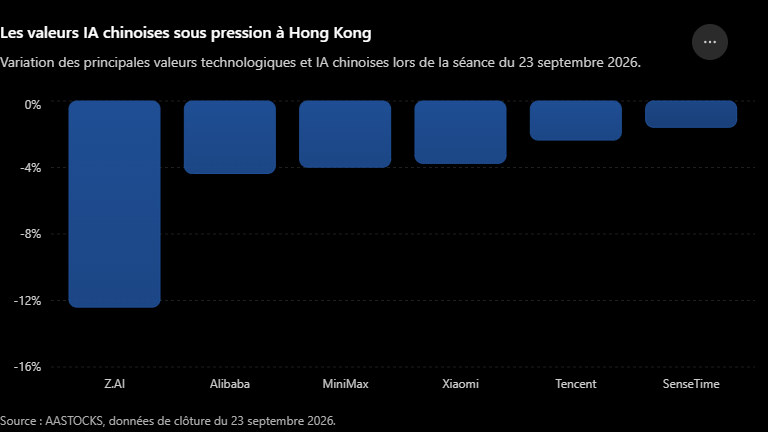
Chart showing the stock price evolution of some AI-related shares. Source: AAStocks
Towards a Global Tightening of AI Digital Regulation?
By orchestrating this legal offensive, the Chinese government sends a clear signal to all its tech champions: data sovereignty takes precedence over development speed.
This AI scandal could moreover encourage regulators around the world to impose strict monitoring of user queries. Several experts believe that this strengthened digital regulation will slow innovation in the short term. However, it will help clean up the practices of some companies. Financial markets are already incorporating this increased regulatory risk into the valuation of startups.
It remains to be seen how AI developers will adapt their infrastructures to prove the legitimate origin of their training data.
In any case, this AI investigation exposes (once again!) the excesses of a frenzied technological race where ethical rules are sometimes trampled. As governments intensify their controls, the real question is whether tomorrow’s artificial intelligence will be able to reconcile algorithmic power with absolute respect for privacy.