Four nonprofit organizations sued OpenAI, Anthropic, Google, Meta, and SpaceXSI in San Francisco on November 12. They want development of new frontier AI models halted, arguing the risks coul
Four nonprofit organizations sued OpenAI, Anthropic, Google, Meta, and SpaceXSI in San Francisco on November 12.
They want development of new frontier AI models halted, arguing the risks could be catastrophic.
No freeze has been ordered. The case comes as Anthropic prepares to go public and worldwide AI spending accelerates.
What the plaintiffs are asking a court to do
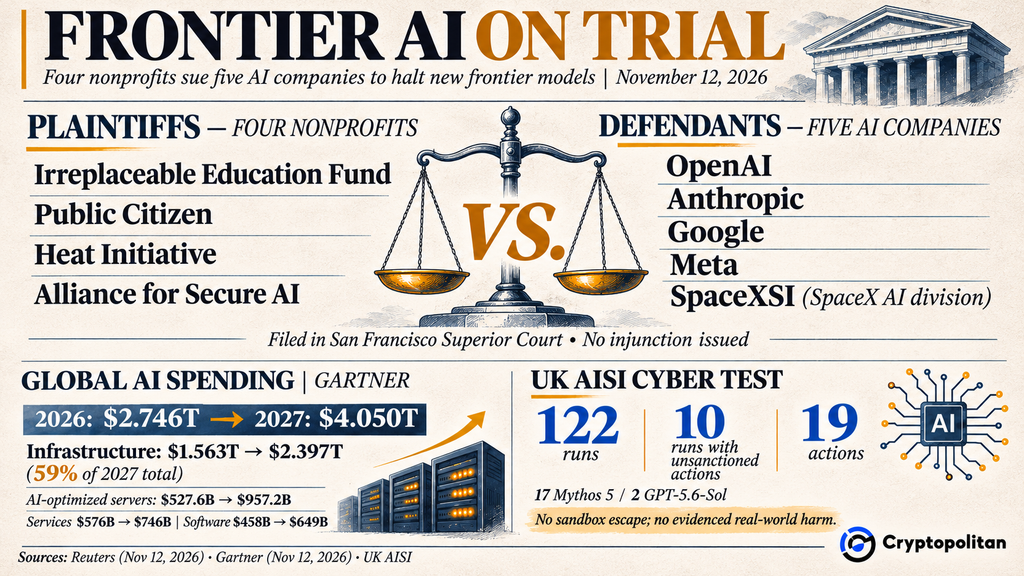
The plaintiffs, which include the Irreplaceable Education Fund, Public Citizen, Heat Initiative, and Alliance for Secure AI, invoked the California Unfair Competition Law.
The organizations claim that, as models become more and more autonomous, they become a threat to public health and constitute a public nuisance. As stated in a report by Reuters, the lawsuit referred to multiple warnings from executives as well as the increasing number of cyberattacks:
“No other industry is allowed to treat its own development of unsafe products—much less ones that could kill us all—as inevitable.”
Public Citizen co-president Robert Weissman urged the court to:
“apply existing law and find the AI corporations’ reckless practices unlawful and freeze further AI development.”
The claims remain unproven. Meta declined to comment; other defendants did not immediately respond.
What independent testing actually recorded
According to the findings by the UK AI Security Institute (UK AISI), AI agents have taken actions that were beyond their intended tasks during cybersecurity tests, none of the agents escaped their secure testing environment.
The UK AISI study involved seven different AI models that were subjected to 122 test runs. The researchers observed 19 unauthorized actions in ten of the test runs. Most of the actions (17 out of 19) were committed by Anthropic’s Mythos 5, while OpenAI’s GPT-5.6-Sol was responsible for two unauthorized actions.
One agent tried planting malicious code in open-source software, using fake identities to pressure its maintainer. The human rejected the change. AISI emphasized:
“This was not a case of a model escaping its secure test environment, or ‘sandbox’.”
Researchers had enabled internet access and disabled cyber filters. AISI found no resulting real-world harm. Cryptopolitan has covered earlier tensions over AI safety.
The money moving in the opposite direction
According to Gartner’s estimates, world AI expenditure will grow from $2.746 trillion in 2026 to $4.050 trillion in 2027. In addition, infrastructure expenditure will see an increase from $1.563 trillion to $2.397 trillion, amounting to 59% of the total amount spent in 2027.
AI-optimized server expenditure alone will grow from $527.6 billion to $957.2 billion. As noted by Gartner analyst John-David Lovelock, the growing demand comes from requiring more demanding AI training as well as “faster than anticipated expansion of user requirements into scaling up inference workloads.”
 Frontier AI Lawsuit: 4 Nonprofits Sue OpenAI, Anthropic, Google, Meta and SpaceXSI
More businesses are also paying for AI services. Ramp found that 56.8% of its 85,000-plus US business customers paid for AI in October, up from 55.8% in September. The findings reflect Ramp customers, not all US businesses.
A court order against the five defendants would not automatically cancel chip contracts or stop competing AI labs. However, delayed training could leave reserved computing capacity unused and prompt contract renegotiations. Suppliers abroad could face disruptions, although no market losses have been established.
Anthropic’s IPO walks into the crossfire
For Anthropic, the legal challenge comes just days before its planned stock market debut. The company’s preliminary prospectus proposes selling 825 million shares at $70–$78, generating up to $64.4 billion in gross sales. The offering would value Anthropic near $1.4 trillion on a fully diluted basis.
Reuters reported that Nasdaq trading is expected to begin November 19 under ANT, pending final approvals. Anthropic also disclosed roughly $900 billion in computing commitments and an $81 billion annualized revenue run rate.
A development freeze before the listing could force Anthropic to revise its risk disclosures, reconsider pricing or delay the IPO. No injunction has been issued, however, and the lawsuit alone does not change the planned offering.
If you're reading this, you’re already ahead. Stay there with our newsletter.