Key Takeaways Alibaba introduced its inaugural robotics AI model collection, featuring RynnBrain, a spatial perception platform Qwen3.7-Max, the company’s newest large language model, targets
Key Takeaways
- Alibaba introduced its inaugural robotics AI model collection, featuring RynnBrain, a spatial perception platform
- Qwen3.7-Max, the company’s newest large language model, targets autonomous AI agent operations
- The technology reportedly maintains stable performance during autonomous operations extending up to 35 hours
- Alibaba presents itself as China’s comprehensive “AI factory,” encompassing every tier of the AI technology stack
- No commercial pricing structure, deployment schedule, or priority customer access details have been announced
Alibaba Group (BABA) revealed its inaugural robotics-focused AI model suite this Tuesday, representing a tangible push into embodied artificial intelligence as Chinese technology firms shift focus from conversational interfaces toward autonomous systems.
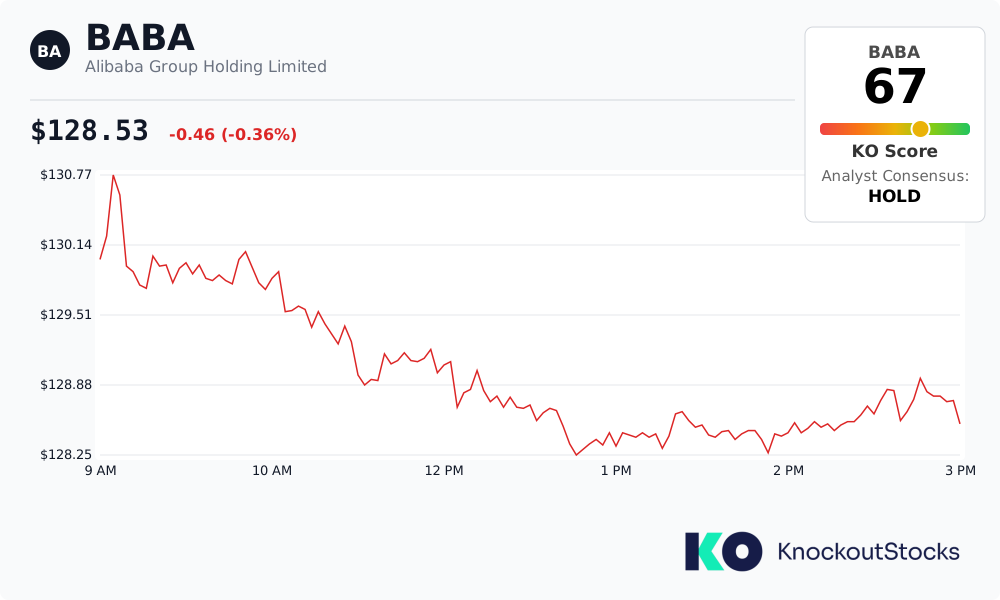 Alibaba Group Holding Limited, BABA
The announcement revolves around RynnBrain, a perception framework engineered to enable machines to comprehend spatial relationships, object recognition, and movement patterns. During a presentation by Alibaba’s DAMO Academy research division, a robotic system utilized the technology to recognize a fruit item and deposit it into a container — a straightforward demonstration suggesting broader industrial applications.
Complementing RynnBrain, Alibaba revealed Qwen3.7-Max, the newest iteration in its proprietary large language model family. Rather than positioning it as a conversational interface, the company markets it as infrastructure for AI agent development.
A notable assertion: Qwen3.7-Max maintains operational consistency for autonomous tasks lasting up to 35 hours without performance deterioration. This specification directly targets enterprise scenarios requiring sustained agent functionality over prolonged durations. The benchmark originates from Alibaba’s internal evaluations.
Alibaba’s stock performance has drawn significant attention as the corporation manages both China’s domestic AI competition and wider geopolitical challenges. Tuesday’s product release introduces another element to this narrative — embodied AI and robotic systems.
The Complete AI Infrastructure Strategy
The corporation positioned itself as China’s sole enterprise operating throughout all five tiers of the comprehensive AI infrastructure: semiconductor technology, agentic cloud computing, foundational models, model deployment platforms, and end-user applications.
This vertical integration strategy forms the cornerstone of the company’s competitive positioning. The underlying concept suggests that controlling every infrastructure layer enables cumulative advantages throughout the entire ecosystem — establishing a competitive barrier more difficult to replicate than a single powerful model.
The messaging mirrors what Western competitors like Google and Siemens have employed while advancing AI integration into manufacturing environments. For Alibaba, combining a domestically developed model infrastructure with China’s established strengths in hardware production and logistics networks strengthens the business case.
The robotics initiative aligns with a wider industry transformation. Chinese technology corporations, mirroring their American counterparts, have predominantly determined that AI agents — systems capable of executing actions including reservations, purchases, scheduling, and operations — deliver greater commercial value than conversational interfaces alone.
Robotics extends this strategic direction into tangible environments. A robot powered by an AI agent transcends simple query responses; it physically manipulates, organizes, and manages objects. This represents the domain Alibaba now seeks to establish itself within.
The competitive landscape presents genuine challenges. Alibaba contends with Chinese competitors including Baidu, Huawei, and ByteDance, alongside American research laboratories, to establish practical definitions for the agent-driven technological era.
The distance between a controlled demonstration and machinery operating dependably under field conditions is where robotics announcements frequently encounter obstacles. Alibaba has yet to disclose pricing structures, commercial availability schedules, or which enterprise clients will receive initial access to the robot AI technologies.
The post Alibaba (BABA) Stock: New Robot AI Models Challenge American Tech Giants appeared first on Blockonomi.
