Key Takeaways Alphabet has committed a $3.2 billion financial backing for New York’s Lake Mariner AI data center, deploying its TPU chips to support Anthropic’s computing needs. The tech gian
Key Takeaways
- Alphabet has committed a $3.2 billion financial backing for New York’s Lake Mariner AI data center, deploying its TPU chips to support Anthropic’s computing needs.
- The tech giant is adopting Nvidia’s proven strategy of offering financial guarantees and circular funding arrangements to attract customers to its proprietary AI processors.
- Google revealed in May its intention to market TPUs directly to enterprise clients and introduced its inaugural inference-focused processing chip.
- A $5 billion partnership with Blackstone will launch a new cloud computing venture, positioning Google against Nvidia-supported rivals like CoreWeave and Nebius.
- Additional guarantees include $7 billion for the River Bend facility near Baton Rouge and $1.4 billion for a Texas-based data center in Colorado City.
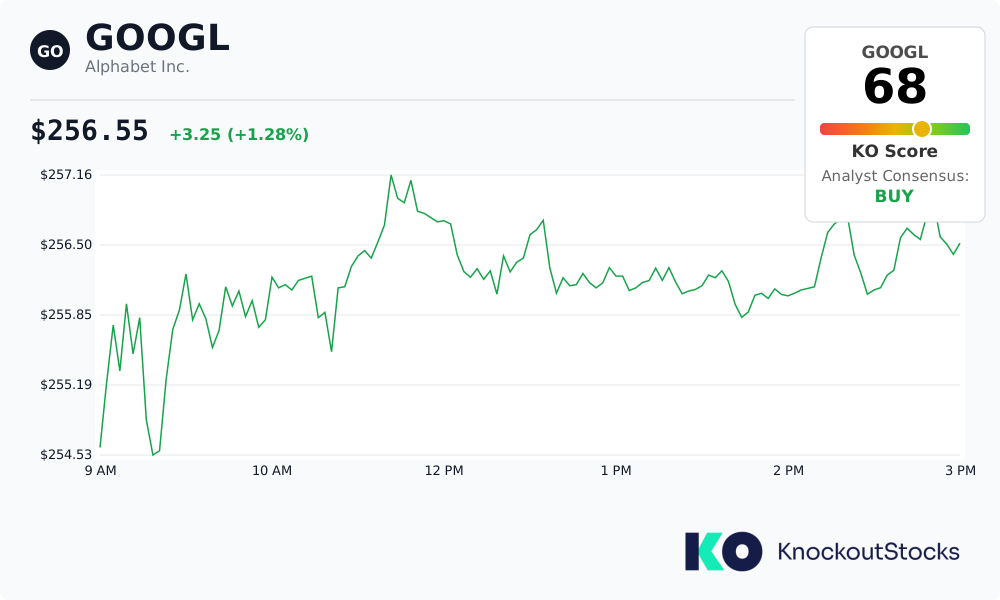
Alphabet (GOOGL) stock climbed 1.17% following revelations that the company is mounting an aggressive campaign to expand its custom AI chip operations, directly challenging Nvidia’s (NVDA) stronghold in the data center ecosystem.
 Alphabet Inc., GOOGL
The genesis of Google’s Tensor Processing Units traces back to 2013, when chief scientist Jeff Dean calculated that scaling an AI speech recognition model would require doubling the company’s entire computational capacity. Custom-designed chips became the solution.
Today, these processors form the foundation of an ambitious external commercialization strategy.
At the Lake Mariner site along Lake Ontario’s southern coastline, Google has committed a $3.2 billion financial guarantee supporting an AI data center development. The installation, a collaboration between TeraWulf and FluidStack, will provision computing capacity from thousands of Google TPUs to Anthropic.
This approach mirrors Nvidia’s established methodology — leverage corporate financial strength to help infrastructure projects secure favorable financing terms, creating a pipeline for hardware procurement.
Google’s ambitions extend beyond this single project. The company is also providing financial backing for a $7 billion Anthropic initiative dubbed River Bend in the Baton Rouge region, along with $1.4 billion in guarantees for AI computing infrastructure in Colorado City, Texas.
Direct Sales Strategy Emerges
Google intensified its competitive stance in May by announcing it would offer TPUs for direct purchase to enterprise customers for the first time, while simultaneously launching its inaugural inference-optimized chip — a product positioned to compete directly with Nvidia’s new Groq 3 LPU.
Mark Lohmeyer, who oversees AI and computing infrastructure for Google Cloud, indicated that the inference processor has attracted clients previously uninterested in TPU technology.
Citadel Securities represents one such adopter. The financial services company reports achieving 30% cost reductions and performance improvements reaching four times faster on critical workloads when utilizing TPUs.
Google has also forged a $5 billion alliance with Blackstone to establish a new cloud infrastructure company designed to compete head-on with CoreWeave and Nebius — platforms that rely exclusively on Nvidia processors.
Nvidia’s CEO Responds
Nvidia CEO Jensen Huang has been vocal in his response. During an April appearance, he noted that Anthropic represents Google’s sole significant external TPU client and questioned whether Google could prove a cost-performance advantage.
“Our market reach is far greater than any TPU or ASIC can possibly have,” Huang stated.
Nonetheless, industry observers are taking notice. Bernstein analyst Stacy Rasgon highlighted that Google is exhibiting “more opportunistic and more aggressive” behavior in commercializing its chip technology compared to previous years.
The internal champion of this initiative is Amin Vahdat, who received a promotion in December to oversee Google’s AI infrastructure expansion. His reporting structure includes direct lines to both Google Cloud leader Thomas Kurian and CEO Sundar Pichai. Colleagues describe him as uncompromising in pursuing performance enhancements, consistently demanding engineers achieve 10% incremental improvements in chip capabilities.
Google announced plans earlier this month to secure $85 billion through equity financing, predominantly earmarked for AI infrastructure investments.
Vahdat characterized the market opportunity succinctly: “There’s so much demand out there.”
The post Alphabet (GOOGL) Stock: How Google Is Turning Nvidia’s Tactics Against It in AI Chip War appeared first on Blockonomi.
