In June, Illinois created a tax no state had tried before. Every time someone buys crypto, sells it, or even moves their own coins from one wallet to another, the state takes 0.2%. It doesn't
In June, Illinois created a tax no state had tried before.
Every time someone buys crypto, sells it, or even moves their own coins from one wallet to another, the state takes 0.2%. It doesn't matter if they made money or lost it. Using crypto, by itself, became the taxable event.
On Thursday, Illinois agreed to hit pause on its own invention.
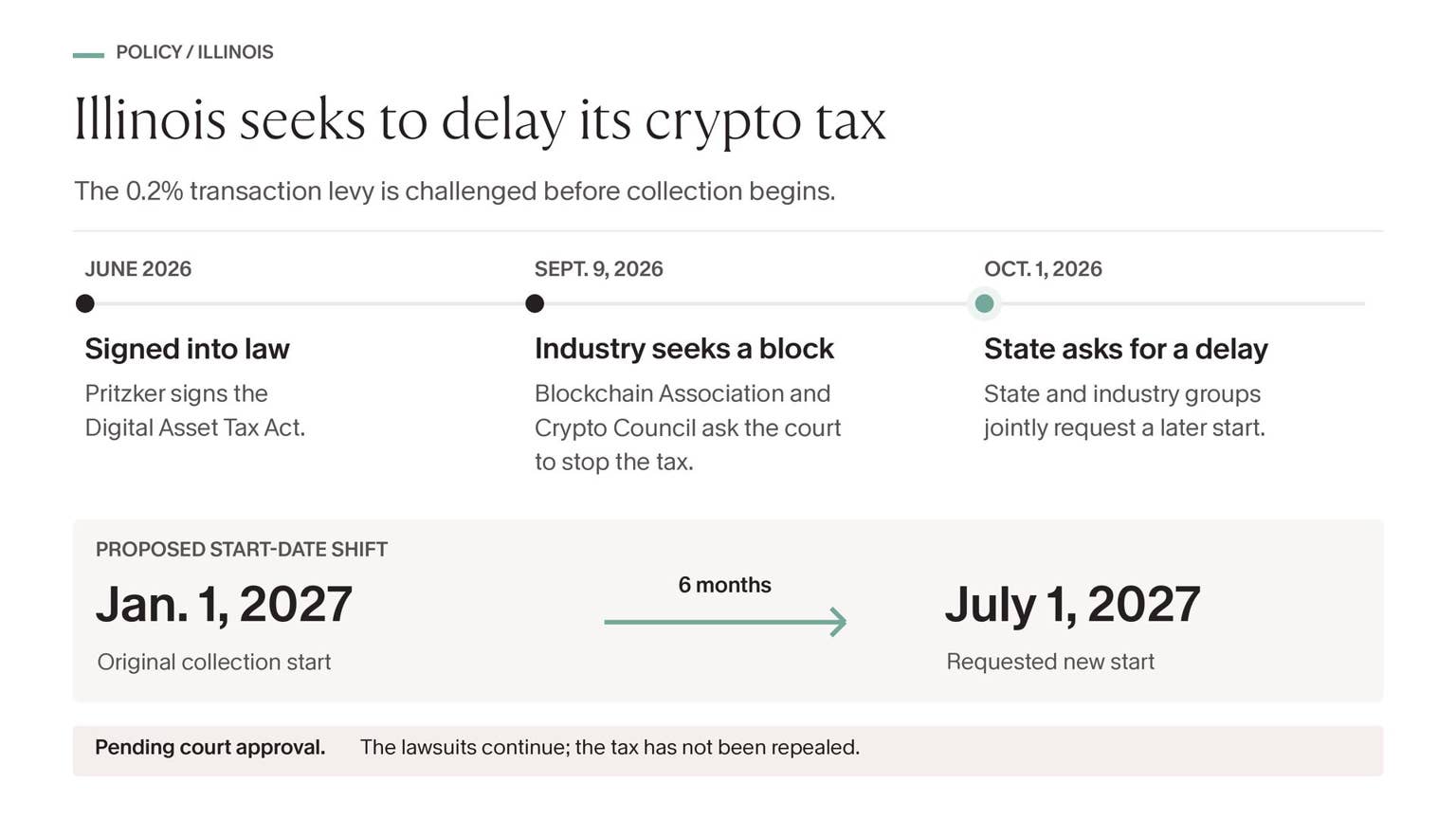
State officials and crypto industry groups jointly asked a Sangamon County judge to push the tax's start date from Jan. 1 to July 1, 2027, according to a court filing.
A judge still has to approve it.
Editor's Inputs: "When a state volunteers to delay its own tax, alongside the people suing to kill it, the fight is not going the state's way."
Related: 214-year-old Wall Street bank just reversed its biggest call of the summer
How we got here
Illinois is the sixth most populous state, home to about 12.7 million people, with the fifth-largest state economy at roughly $1.2 trillion.
Democrats control the governor's mansion and both legislative chambers, and Governor JB Pritzker, the billionaire Hyatt heir now seeking a third term, is widely discussed as a 2028 presidential contender.
It is also the most taxed place in America. Illinois households carry the heaviest tax burden of any state, about $13,699 a year from a median household per WalletHub, and its property taxes trail only New Jersey.
Illinois' 0.2% tax on every crypto transaction, signed in June, sued by September, delayed to July 2027 while the courts decide. (Photo: TheStreet Roundtable)
The state has more than 6,900 separate taxing bodies, the most in the nation, which means a property owner can be billed by a county, a city, a school district, a park district, a library district and a mosquito abatement district, all at once.
So when the state went hunting for revenue in this year's budget, crypto looked like found money: a young industry, no real lobby in Springfield, and a projected $60 million a year.
Pritzker signed the Digital Asset Tax Act in June, with exchanges required to collect the 0.2% on the state's behalf.
The outrage was immediate.
Stocks, bonds and houses are taxed when you sell at a profit. This tax hits the transaction itself, loss or no loss.
The Crypto Council for Innovation called it the most punitive digital asset tax in the country. And whatever the industry lacked in Springfield lobbyists, it made up for in lawyers.
Legal battle on multiple fronts
Two industry groups, The Digital Chamber and the Illinois Blockchain Association, sued the state.
On Sept. 9, the Blockchain Association and the Crypto Council asked the same court to block the tax before it starts.
Their core argument was that a federal law, the Internet Tax Freedom Act, bars states from slapping special taxes on electronic commerce, and a levy that applies only to digital assets looks like exactly that. They also argue the tax violates the Illinois constitution.
Exchanges were expected to start collecting on Jan. 1, yet with months to go, the state still hadn't finished writing the rules.
What happens next
The delay settles nothing. The case continues toward a ruling, and the industry's goal is not six more months. It is zero.
The federal government, meanwhile, is moving in the opposite direction.
Last month the House Ways and Means Committee advanced the Digital Asset Tax Certainty Act, which would scrap gain-or-loss paperwork on small crypto network fees of $10 or less starting in 2028.
Related: Analyst warns Bitcoin is flashing a 2023 warning sign