Google made its SynthID Detector available in English to everyone in the world on October 7. The free tool looks through pictures, videos, and audio for a watermark that you can’t see. Google
Google made its SynthID Detector available in English to everyone in the world on October 7.
The free tool looks through pictures, videos, and audio for a watermark that you can’t see. Google has put this watermark on more than 180 billion pictures, videos, and 240,000 years of audio.
There are already checkers built into Chrome, Search, and the Gemini app that do more than a million checks every day. So now the detector has its own site called synthid.com next to them.
Gemini’s built-in AI check had been used 50 million times before May
Up until now, only researchers, journalists, and people who work in the media had access to an early version that Google gave out last year. Now, anyone can upload a file and find out if it was made by a participating model.
Google added SynthID checks to Lens, AI Mode in Search, and Chrome at its I/O event in May 2026. The check had been run 50 million times in the Gemini app by that point.
In the notice, Pushmeet Kohli said the goal is to give people “more context about the media you see online.” He is VP of science and strategic initiatives at Google DeepMind.
In 2023, Google DeepMind started with images. Later, they added text, video, and audio to SynthID. In 2024, they made the text version open source.
The mark stays inside the content, in the pixels of an image or video frame, or the waveform of an audio file. This means that it never interacts with the file’s metadata. Veo, Lyria, Nano Banana, Gemini, Flow, ProducerAI, and Vids are all Google’s own generators that add it to their output.
Image types supported by the site include JPG, PNG, WEBP, GIF, and HEIC. Video types supported include MP4, MOV, and WEBM. Audio types supported include MP3, WAV, and FLAC.
The detector reads OpenAI, Nvidia and Kakao marks
Google lists OpenAI, Nvidia, and Kakao as partners and says Apple will be joining them soon. ElevenLabs also supports SynthID.
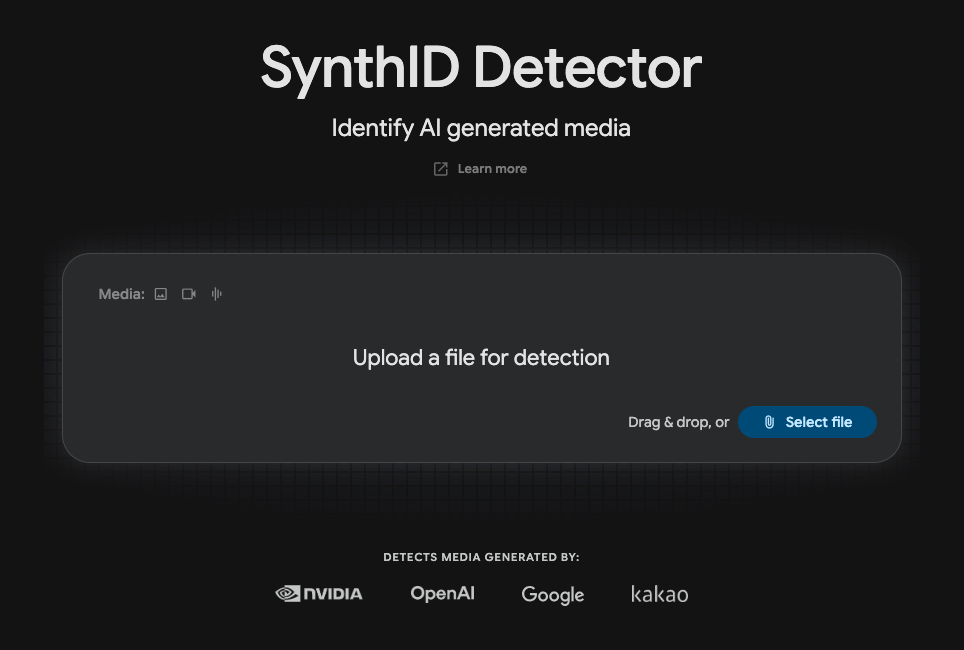
The SynthID Detector homepage at synthid.com.
OpenAI also has its own site that checks for content. Microsoft and Meta have different rules for watermarking and verifying content, and their tools often miss content that was made by their own models.
If the answer is “yes,” the file is linked to Google or one of its partners. The detector comes back empty when it comes across output from AI systems that are not in that group.
A negative result only means that there was no SynthID signal. It doesn’t prove that someone made the file.
Google adds the C2PA Content Credentials on top of the hidden mark. This is an industry standard that keeps track of where a file came from and how it was changed.
Apple is going to add SynthID to its image tools in iOS 27. Cryptopolitan reported in August that Apple is also testing its own method in the iOS 27 beta. This is done with a Reference Image feature that connects a picture to the camera sensor that took it.
The smartest crypto minds already read our newsletter. Want in? Join them.