Apepe Tokenomics 2026: How the 210 Trillion Supply Is Divided Apepe Coin comes with one of the biggest supply numbers in the meme market: 210,000,000,000,000 tokens. A number that large says
Apepe Tokenomics 2026: How the 210 Trillion Supply Is Divided
Apepe Coin comes with one of the biggest supply numbers in the meme market: 210,000,000,000,000 tokens. A number that large says little on its own. What matters is who holds each share and how much is ready for trading.
This guide breaks down Apepe tokenomics 2026 in plain steps. It covers supply, allocation, the tax setting and the Polygon base. All figures come from the project's official docs, which were read on October 6, 2026.
Key Takeaways
The APEPE token supply is 210 trillion. The docs state that all tokens are deployed on-chain.
Buy and sell tax are both 0%. The token itself takes no cut from trades.
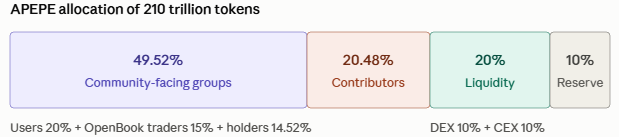
Community-facing groups hold 49.52%. That is the largest block, ahead of contributors, liquidity and reserve.
What Is Apepe Coin? The Ape and Pepe Basics
Apepe is a meme coin on the Polygon network. The name joins "Ape" and "Pepe", two names well known in meme culture. The wider Ape and Pepe ecosystem is built around community activity, exchange access and platform integrations.
Most guides start with the story. This one starts with the numbers, because tokenomics shows how a project is structured long before any price chart does.
Source: official website
Apepe Coin Tokenomics: The Token Snapshot
Detail
Official information
Ticker
$APEPE
Network
Polygon (ERC-20)
Total supply
210,000,000,000,000
Token tax
0% buy, 0% sell
Contract address
0xA3f751662e282E83EC3cBc387d225Ca56dD63D3A
The contract address is listed in the docs. Anyone planning to trade should compare it with the project's official site first, since fake tokens often copy real names.
Apepe Coin Total Supply: Reading a Very Large Number
The Apepe Coin total supply is 210 trillion tokens, and the docs say every one of them is deployed on-chain. For a beginner, that means the full amount already exists. Nothing in the tokenomics page points to a hidden batch waiting to be created.
A huge supply does not decide value by itself. The split between holders, traders and liquidity matters more, and that is where the next section helps.
APEPE Token Distribution: Who Gets What
The Apepe Coin distribution uses seven groups. The token counts below are calculated from the published percentages.
Group
Allocation
Tokens (calculated)
Early Contributors
20.48%
43.008 trillion
APEPE Community Users
20.00%
42 trillion
Early OpenBook Traders
15.00%
31.5 trillion
APEPE Holders
14.52%
30.492 trillion
DEX Liquidity
10.00%
21 trillion
CEX Liquidity
10.00%
21 trillion
Reserve
10.00%
21 trillion
Source: official Apepe tokenomics documentation
The seven lines are easier to read as four blocks:
Block
Groups inside it
Share
Community-facing
Users, OpenBook traders, holders
49.52%
Early contributors
One group
20.48%
Liquidity
DEX and CEX
20.00%
Reserve
One group
10.00%
Together, these add up to exactly 100%. Close to half of the supply sits with people who use, trade or hold the token. That is a notable choice for a project that calls itself community driven.
Liquidity: Why DEX and CEX Get Equal Shares
DEX liquidity and CEX liquidity each receive 10%. Liquidity is the pool of tokens that lets buyers and sellers trade without huge price jumps. An equal split suggests the project wants access on both decentralized and centralized platforms.
The Polygon docs back this up. They say the network helps APEPE support exchange liquidity movements efficiently. In other words, the allocation and the chain choice point in the same direction.
The 0% Tax Setting
Many meme coins add a fee to every buy or sell. APEPE does not. The docs list a 0% buy and 0% sell tax.
That does not mean trading is free. Exchanges and the network still charge their own fees. It only means the token contract adds no extra cut. For small traders, a zero-tax design keeps costs easier to predict.
APEPE Polygon Token: How the Chain Supports the Numbers
APEPE is deployed on Polygon, which the docs describe as a scalable, EVM-compatible Layer 2. The project says it picked Polygon for long-term scalability, not because the chain was trending.
Source: official documentation
Polygon feature
Link to the token
Low transaction costs
Cheap participation for community members
Efficient liquidity moves
Supports the 20% held in DEX and CEX liquidity
EVM compatibility
Works with major wallets, exchanges and tools
Scale without congestion
Room for activity to grow
The docs also list what this foundation is meant to support: exchange listings, wallet integrations, NFT exploration, gaming and mini-app integrations, and brand-driven participation. Polygon is called the "expansion layer", not just the place where the token lives.
For readers searching APEPE Polygon details, the practical point is simple. Low fees make small transfers realistic, and that fits a token aimed at wide community use.
Apepe Tokenomics 2026: What the Docs Do Not Say
Good analysis also notes the gaps. The tokenomics page gives allocation percentages, supply and tax. It does not list a vesting or unlock schedule. It also does not explain how each group received its tokens, or how the reserve may be used.
That is not a red flag by itself, since the page may simply be a short summary. Still, readers who want full clarity should look for further detail in the project's other official channels.
Checks Before Acting on Apepe Coin Tokenomics
Check
Why it matters
Contract address
Confirms the token is the real one
Supply on a Polygon explorer
Matches the docs against on-chain data
Official links only
Avoids fake sites and wallet drains
Liquidity on the chosen exchange
Affects how easily the token trades
Position size
Meme tokens can swing sharply
Final Thoughts
Apepe tokenomics 2026 shows a clear structure: 210 trillion tokens, no trading tax, nearly half the supply in community-facing groups and a Polygon base built for low costs. The missing piece is detail on unlocks and reserve use. Readers should verify every figure on-chain and treat the token as a high-risk asset.
Disclaimer: This article is for information only and is not financial advice. Crypto is volatile, and losses are possible.