Key Takeaways Shares of Apple (AAPL) declined 2% to $332.22 following a Bank of America warning about emerging AI agent competition. BofA’s Wamsi Mohan highlighted Meta’s Muse application as
Key Takeaways
- Shares of Apple (AAPL) declined 2% to $332.22 following a Bank of America warning about emerging AI agent competition.
- BofA’s Wamsi Mohan highlighted Meta’s Muse application as a potential disruptor to Apple’s mobile commerce dominance and services income.
- Meta’s Muse debuted on September 8, amassing 2.5 million users within 14 days and claiming the number one spot on the US iOS free-app rankings.
- Major commerce players including Shopify, Expedia, and PayPal have integrated with Muse, though Amazon has notably refused access.
- Despite the concerns, Mohan maintained his Buy recommendation on Apple shares with a $370 target price, pointing to the company’s devoted customer base and privacy-focused strategy.
Apple stock experienced a 2% decline on Tuesday, settling at $332.22, following a Bank of America research note cautioning that emerging AI agent technology could erode the tech giant’s highest-margin revenue streams.
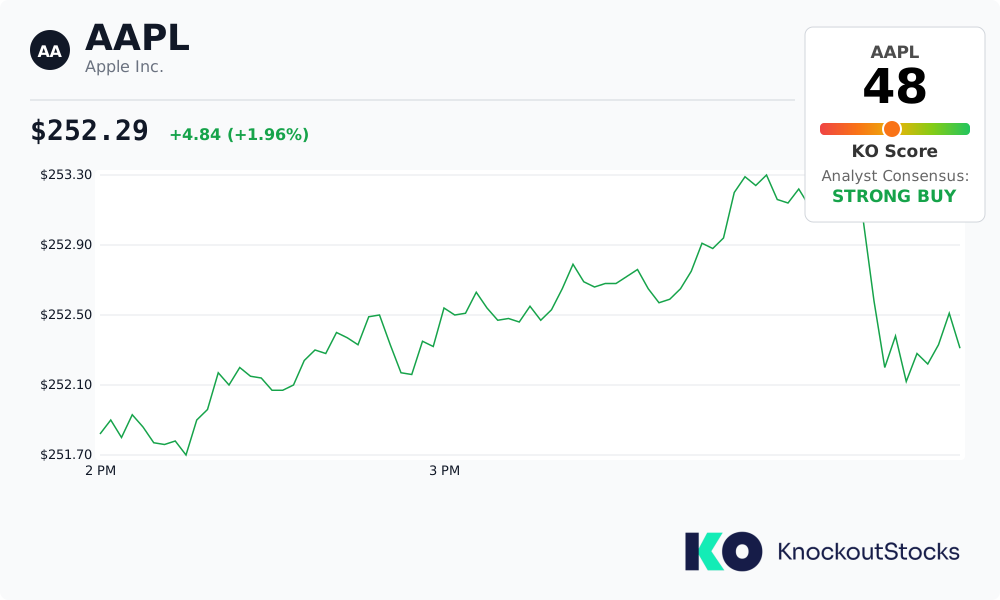 Apple Inc., AAPL
Despite maintaining a 22% gain year-to-date, BofA’s Wamsi Mohan points to a fundamentally different type of rival entering the arena—one that operates independently of iPhone hardware.
This emerging threat comes from Meta’s Muse platform. The AI-powered agent application debuted on September 8 and attracted 2.5 million users within its initial 14-day window.
The Muse application rapidly climbed to the pinnacle of US iOS free-application rankings. Its capabilities include travel arrangements, purchase execution, and task completion through single-command prompts, eliminating the need to launch individual applications.
According to Mohan, the financial implications are significant. Control over the AI agent translates to control over transactions, representing a fundamental shift away from operating system-based commerce.
“Whomever the agent chooses becomes the merchant, and whoever owns the agent collects the routing economics that previously accrued to operating systems, search, and app stores,” Mohan wrote.
Muse Builds Extensive Commerce Network
Muse operates beyond simple conversational AI functionality. The platform can launch browsers, complete form fields, and continue operations in background mode even after users exit the application.
Multiple prominent commerce platforms have established connections with the service. Shopify granted Muse complete access to its product inventory and Shop Pay infrastructure, while Expedia and PayPal integrated their booking and transaction capabilities.
Amazon stands alone in its resistance. The e-commerce giant has completely blocked Muse access, which BofA interprets as validation of the competitive threat facing other market participants.
Apple has responded with action. The company released its redesigned Siri with iOS 27 on September 14, merely six days following Muse’s debut, powered by customized Google Gemini models.
Apple’s Current Limitations
According to Mohan, even the upgraded Siri version doesn’t include persistent background operations or a payment infrastructure comparable to Muse’s capabilities. He emphasizes that iPhone hardware meets all technical requirements for running Muse effectively.
The critical challenge centers on update velocity. Apple delivers significant software releases annually, whereas competing AI agents receive improvements almost daily.
“Agents are accelerating innovation cycles, and Apple needs to ensure that its teams around services, silicon, payments, privacy etc. are integrating with Siri AI and moving at a pace to match innovation at competitors,” Mohan wrote.
Nevertheless, BofA maintained its Buy recommendation on Apple shares alongside a $370 price objective. Mohan emphasizes Apple’s substantial, committed user community and privacy-centered infrastructure as competitive advantages Meta cannot replicate.
Financial markets will closely monitor whether Shopify, Expedia, and PayPal begin disclosing actual transaction volumes processed through Muse. Such metrics would clarify whether Apple faces genuine market share erosion or merely temporary competitive noise.
Compounding the competitive dynamics, OpenAI was anticipated to unveil its own consumer-facing AI agent on the same date this analyst report was published.
The post Apple (AAPL) Drops 2% as Bank of America Flags Meta Muse AI Competition Risk appeared first on Blockonomi.