Key Takeaways Bank of America maintained its Buy recommendation on Apple with a $370 target price Maximum trade-in incentives for iPhone 18 Pro Max increased to $1,200 from $1,100 previously
Key Takeaways
- Bank of America maintained its Buy recommendation on Apple with a $370 target price
- Maximum trade-in incentives for iPhone 18 Pro Max increased to $1,200 from $1,100 previously
- Wireless carrier offers effectively neutralize Apple’s $100 price increase across iPhone 18 models
- Initial out-of-pocket expenses remain between $291–$405 based on device selection
- Samsung’s reported memory pricing agreement with Apple suggests potential cost increases in 2027
Wamsi Mohan, an analyst at Bank of America, maintained his Buy recommendation on Apple (AAPL) with a $370 price objective Thursday, highlighting that wireless carrier incentive programs have expanded sufficiently to counterbalance the elevated pricing of the iPhone 18 series.
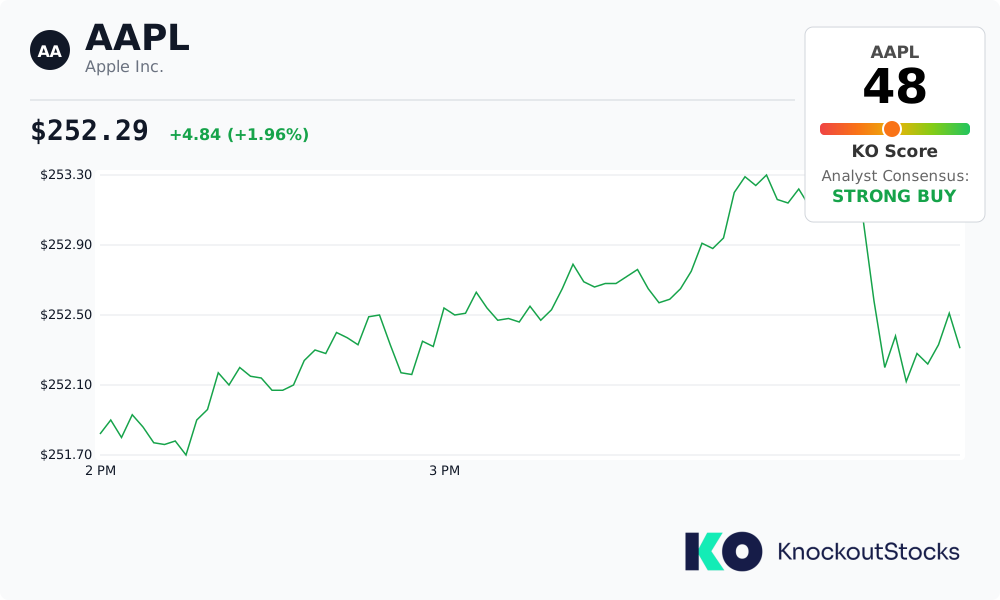
AAPL stock climbed 1.38% during trading.
 Apple Inc., AAPL
Apple introduced the iPhone 18 Pro and Pro Max with retail prices elevated by $100 compared to their predecessors. The company extended these price adjustments to include iPhone 17 and 16 models as well.
According to Mohan’s analysis, top-tier trade-in incentives for the iPhone 18 Pro Max have reached $1,200, representing an increase from $1,100 for the prior generation and $1,000 for the model before that.
“The enhanced promotional offers essentially neutralize Apple’s pricing strategy for this cycle,” Mohan explained.
Mobile service providers are additionally rolling out 36-month payment structures that integrate device installments with monthly service fees, which Mohan believes enhances accessibility for consumers.
Delivery timeframes indicate the iPhone 18 Pro and Pro Max are becoming available to customers more quickly than last year’s launch, and Mohan suggested the improved subsidies may sustain consumer interest throughout the initial release period.
The promotional strategies aren’t universally available. Wireless providers are concentrating on subscribers with recent-model devices, aiming to stimulate upgrade cycles within this demographic.
Verizon (VZ) and AT&T (T) typically require an iPhone 14 or more recent model to access maximum credit amounts. T-Mobile (TMUS) maintains stricter eligibility criteria, necessitating an iPhone 15 Pro or newer device.
Initial Payment Requirements Remain
Trade-in programs don’t eliminate all immediate expenses. Buyers must cover activation charges plus applicable taxes calculated on the device’s full retail value, resulting in upfront payments ranging from approximately $291 to $296 for the iPhone 18 Pro and $400 to $405 for the Pro Max variant.
These promotional structures benefit carriers as well. They mandate enrollment in premium unlimited service packages, while trade-in value is distributed as monthly account credits throughout the financing duration, effectively securing long-term customer retention.
Additional Price Adjustments May Follow
The present pricing adjustments might not represent the final changes. Industry reports from South Korean media outlets indicate Samsung has been renegotiating memory component pricing with smartphone manufacturers, and Apple has allegedly agreed to the revised terms.
Beginning in the first quarter of 2027, Apple is projected to pay approximately $2.00 per gigabit for LPDDR5X RAM, rising from $1.50 in the third quarter of 2026. NAND flash storage costs are scheduled to increase from $0.26 to $0.33 per gigabit during the same timeframe.
Not all device manufacturers accepted these conditions. Oppo and vivo allegedly declined Samsung’s elevated pricing structure, leaving uncertainty about which alternative memory vendors they’ll partner with for upcoming flagship products.
The post Apple (AAPL) Stock: Wireless Carriers Absorb iPhone 18 Price Increases With Enhanced Trade-In Deals appeared first on Blockonomi.