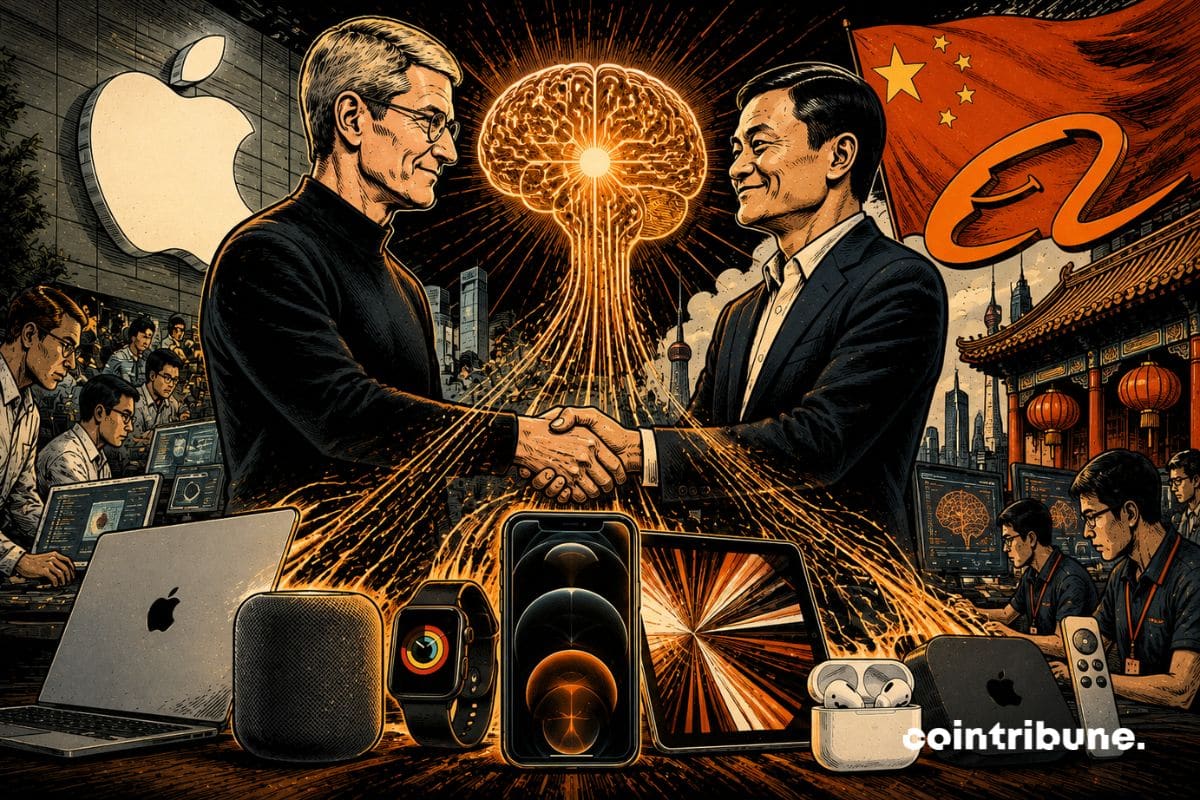
Apple has just trained its own AI model for China with the help of Alibaba. Nothing official yet, but the timing is telling. While Cupertino courts Beijing on AI, Washington presses Tim Cook’
Apple has just trained its own AI model for China with the help of Alibaba. Nothing official yet, but the timing is telling. While Cupertino courts Beijing on AI, Washington presses Tim Cook’s company to bring back its production. Two fronts, one giant.
In brief
- Apple has trained a model tailored for China, associated with Alibaba’s Qwen and Baidu technology.
- Apple would become the first foreign company authorized to operate a proprietary AI model in China.
- Apple faces criticism after a fake Bitcoin app drained funds from crypto users.
A tailored AI model in Apple devices intended for China is the real novelty here. Until now, Apple relied on third-party models to equip its Chinese iPhones with artificial intelligence. That choice belongs to the past. The new model will be associated with Qwen, Alibaba’s AI, and Baidu technology, all integrated into the version of Apple Intelligence that will equip iPhone, iPad, Mac, and Vision Pro for the Chinese market.
Regulation, long an insurmountable wall, has just yielded. In July, the Cyberspace Administration of China registered Apple’s generative AI service. As a result, Apple would become the first foreign company authorized to operate its own proprietary AI model in China. A notable exception, in a climate where ChatGPT and Claude remain closed.
Apple: a Pressure-Stricken Giant’s Acknowledged Deceit
Thousands of kilometers from China, Tim Cook cuts the ribbon of Apple’s new Advanced Manufacturing Center in Houston, United States, in the presence of Secretary of Commerce Howard Lutnick. It will notably serve to produce the Mac mini starting this year. The White House praised Apple’s $600 billion commitment to the American economy. Two narratives, one company. On one side, Apple earns praise from Washington for its domestic investment.
On the other, it quietly negotiates a strategic access to the Chinese market through AI, in a sector that both countries treat precisely as a sovereignty issue. Especially as the US government recently ordered Apple to stop buying memory chips made in China. But Apple does not have the luxury of choosing a side. With nearly $5 trillion in market value to defend, and two markets it cannot afford to lose… Playing both sides may not be a choice. It is a constraint.
Your 1st cryptos with BitpandaThis link uses an affiliate program.A Bitcoin Scandal that Damages the Reputation of the App Store
While Apple tends to its AI image, another case quietly worsens on its own turf: the App Store. A complaint filed at the end of July 2026 accuses Apple of allowing a fake Bitcoin app to siphon funds from its users. The app impersonated Sparrow Wallet, a reputed Bitcoin wallet that doesn’t even exist on iOS. Three victims reportedly lost around $1.8 million after entering their recovery phrases into the fraudulent app.
The painful detail is that the app reportedly remained active after the first loss report, before the second victim was affected. The irony is hard to miss because a company negotiating access to a market of over a billion users through a sophisticated AI partnership struggles in parallel to filter a fake Bitcoin app on its own store. The technological rigor displayed on one side does not seem to permeate all corners of the house.
The AI deal with Alibaba marks a real turning point for Apple in China. But this success coexists with growing trade tensions and imperfect quality control on its own App Store. On AI, Apple moves fast. On consistency, however, it still has a way to go.