TLDR Apple shares fall 1.08% as new Macs target enterprise AI workloads locally. Mac Studio clusters can run trillion-parameter models from one wall outlet. Apple pitches local AI hardware as
TLDR
- Apple shares fall 1.08% as new Macs target enterprise AI workloads locally.
- Mac Studio clusters can run trillion-parameter models from one wall outlet.
- Apple pitches local AI hardware as a lower-cost alternative to recurring cloud fees.
- Unified memory supports large local models across Apple’s computing lineup.
- Apple faces a steep enterprise gap, with Windows holding about 91.3% share.
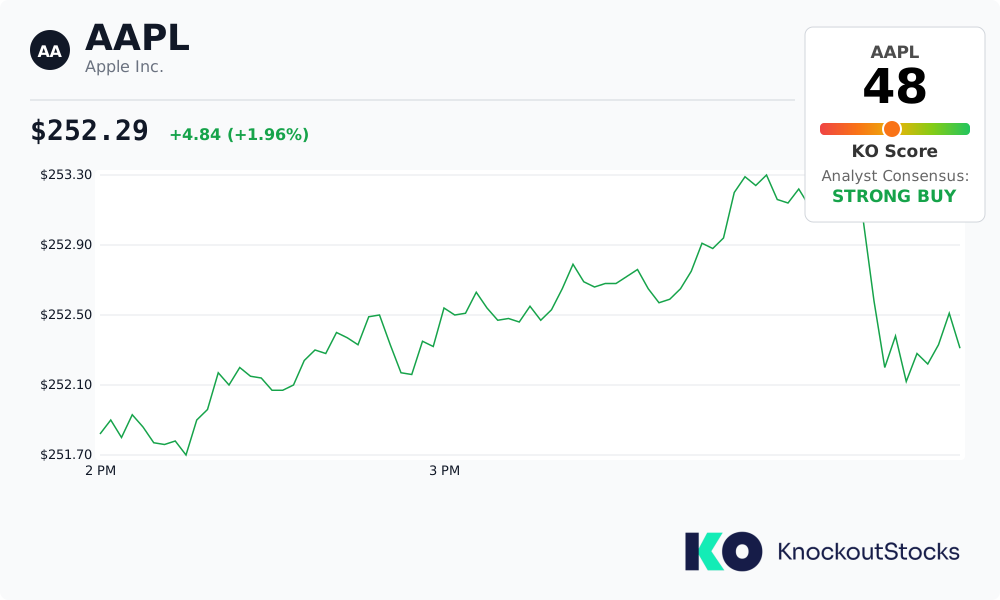
Apple (AAPL) shares traded at $336.09, down 1.08%, as the company pushed into enterprise artificial intelligence with upgraded Macs. Apple now promotes local computing as a lower-cost option for businesses running demanding models, software tasks, and complex workflows. The strategy targets recurring cloud expenses while expanding the Mac beyond its established creative and professional customer base.
Apple Inc., AAPL
Apple Expands Local AI Computing
Apple began shipping upgraded Mac mini and Mac Studio systems Tuesday, giving corporate customers hardware for demanding local computing workloads. The machines combine stronger processors, larger memory options, and faster connections for development, inference, and intensive business tasks. Some high-end configurations approach $20,000, placing them between traditional workstations and the much larger cost of dedicated data-center infrastructure.
Apple also demonstrated four Mac Studios working together through high-speed connections to handle a trillion-parameter model during its launch event. The system identified and fixed a graphics coding problem that normally requires much larger computing resources inside specialized data centers. Apple powered the four-machine cluster from one wall outlet, supporting its argument around efficiency, scale, and lower infrastructure requirements.
That demonstration builds on Apple Silicon, which Apple introduced across Macs after moving away from Intel processors several years ago. Apple combines computing components and memory through its unified-memory design, allowing processors to access one shared pool more directly. The structure can support large models locally while reducing dependence on separate graphics memory found in many high-performance systems.
Mac Economics Challenge Cloud Computing
Apple is focusing heavily on recurring expenses attached to cloud-based artificial intelligence services used by businesses and software teams. Cloud providers often charge by computing consumption, so operating costs can rise as employees generate more requests and process tokens. Apple argues that purchased hardware can remove some recurring usage charges when companies keep suitable workloads on their own machines.
The approach does not position Macs as direct replacements for every Nvidia-powered data center or large cloud computing environment. Nvidia still holds a major position in large-scale training, acceleration, networking, and infrastructure supporting advanced models across global data centers. Instead, Apple targets inference, development, coding, and corporate workloads that companies can potentially move closer to employees and internal systems.
Apple also uses similar design principles across Macs, iPhones, and iPads, which can simplify development across different hardware sizes. Developers can build workloads for larger Macs and adapt parts of those applications for smaller devices when computing requirements permit. That flexibility supports Apple’s effort to make local processing a broader platform strategy rather than one high-end hardware experiment.
Enterprise Market Share Remains the Main Barrier
Apple still faces a major distribution challenge because Windows-based systems dominate enterprise desktops and laptops across large organizations worldwide. IDC data cited by Reuters puts Apple’s enterprise share near 4.6%, versus about 91.3% for devices running Windows. That gap gives Microsoft a much larger installed base, established corporate relationships, and extensive support across software and hardware vendors.
Microsoft is also pursuing more local artificial intelligence processing, while Nvidia continues expanding beyond traditional data-center products and platforms. Those efforts place Apple in a market where major competitors already control key enterprise relationships, software ecosystems, and infrastructure spending. Apple must convert technical efficiency into deployment advantages that corporate technology teams can measure across security, cost, and performance.
The Mac business could gain another growth channel if companies move suitable workloads away from heavily used cloud infrastructure. Demand for higher-memory configurations could raise average Mac spending while expanding Apple’s presence among developers, researchers, and corporate technology teams. However, broader enterprise penetration will depend on software support, deployment tools, purchasing economics, and consistent performance across business workloads.
The post Apple Inc. (AAPL) Stock: Targets Enterprise AI With Powerful Macs appeared first on Blockonomi.
