A federal judge on Tuesday ordered defendants in Apple’s trade-secret suit to produce forensic records of former engineer Chang Liu’s use of ChatGPT, Claude, Codex and OpenClaw. Davila gives
A federal judge on Tuesday ordered defendants in Apple’s trade-secret suit to produce forensic records of former engineer Chang Liu’s use of ChatGPT, Claude, Codex and OpenClaw.
Davila gives the defendants 14 days to produce
The order was signed by US District Judge Edward Davila in Apple Inc. v. Liu, No. 5:26-cv-07078-EJD, in the Northern District of California. Davila had put off several of Apple’s requests earlier this month, and now is granting most of them.
The records include Liu’s use of AI for alleged “personal experimentation” and anything related to “Apple Originated Information.” They include Liu’s Mac Mini, personal accounts and corporate devices, from January 23, 2026 to the present.
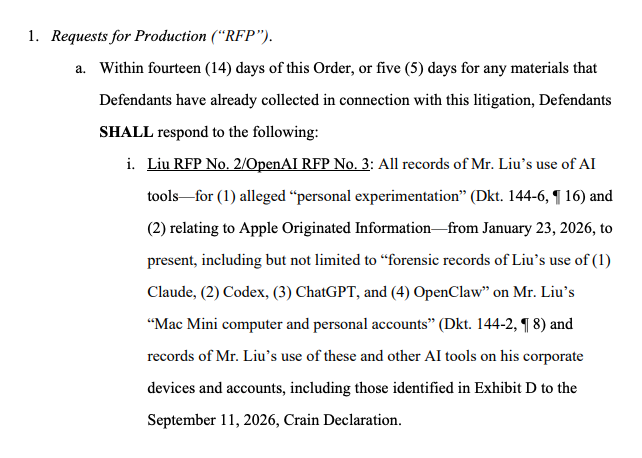
Judge Edward Davila’s October 27, 2026 order in Apple Inc. v. Liu, listing the AI-tool records the defendants must produce, published on
CourtListener.
OpenAI said Liu’s last day at Apple was Jan. 22, 2026. The defendants have 14 days to turn over the records or just 5 days for anything they have already collected for the case.
Liu and Tang Tan, also a co-defendant, must also list all accounts, devices, storage locations and apps used to handle Apple information covered by the order, which names the LINE app, Signal, Telegram and Kik.
Liu’s list starts after Jan. 22, 2026. Tan’s goes back to February 2, 2024.
If that information has since disappeared from a device or account, Liu and Tan have to explain what was on it, how long it sat there and how it was accessed.
They must also explain any deletion, when it occurred, who was involved and the reason for it.
Davila is also allowing Apple to depose OpenAI and io Products under Rule 30(b)(6) on three topics. The first is any work Liu, Tan and Yu-Ting “Alyssa” Peng did at OpenAI that touched Apple information on power management, batteries or metal finishing.
The second is interviews OpenAI conducted with, or through, Liu, Tan and Peng, and any Apple information that surfaced in those interviews. The third is what OpenAI did or didn’t do to prevent that information from being used.
But Apple didn’t get everything it asked for. Davila turned down Apple’s questions about OpenAI’s own devices and accounts, its internal investigations and any deletions on OpenAI’s part, deferring those to regular merits discovery.
Two other testimony topics were dismissed as “too broad at this stage and better suited for merits discovery.”
Cryptopolitan reported that Apple filed a lawsuit on July 10, accusing Liu, Tan, OpenAI and io Products of taking confidential hardware information to help OpenAI build consumer devices. Tan is a design executive with more than 24 years experience at Apple, according to OpenAI.
More than 400 former Apple employees are working at OpenAI, the complaint says. It also claims that OpenAI used Apple’s internal code names to get at confidential information from job candidates.
In early August, OpenAI asked the court to dismiss the case, calling it a “baseless and pretextual lawsuit” in a motion. The court was told in October the company may file counterclaims.
The filing says an employee who left Apple for six months at OpenAI, then went back, transferred more than 100 confidential files on an unreleased OpenAI device to personal accounts. Apple said it found no evidence to corroborate the claim.
The smartest crypto minds already read our newsletter. Want in? Join them.