What Is the Arcium Network, and Why Does It Matter Now Arcium Network is a decentralized confidential-computing network built on Solana. It lets apps process encrypted data without exposing i
What Is the Arcium Network, and Why Does It Matter Now
Arcium Network is a decentralized confidential-computing network built on Solana. It lets apps process encrypted data without exposing it, and its ARX token handles staking and governance.
Public blockchains show everything. Balances, trades, wallet history, all of it. Arcium Network aims to close that gap. The project calls it a confidential supercomputer, a network that processes data without revealing it.
Readers are searching for it because the project now publishes a full token design and a four-quarter roadmap. This guide covers the technology, $ARX token utility, supply split, vesting schedule, and roadmap, based on Arcium's official tokenomics page and related pages checked on Nov 23, 2026.
How Does Arcium Privacy Technology Work?
Ordinary encryption protects data while it sits in storage or travels between systems. But computing on that data usually means unlocking it first. That's the weak moment. Anyone handling unlocked data can read it.
Arcium targets the gap with multi-party computation, or MPC. MPC splits data into encrypted pieces, called secret shares, and spreads them across several nodes. Each node works on its own piece. None sees the full data. Together, the nodes build the answer without any single party reading the inputs.
What Is an MXE in Arcium Network?
MXE stands for MPC Execution Environment. According to Arcium Explorer's guide, it's an application-owned encrypted environment that holds the app's computation definitions and submitted computations.
A computation passes through four steps:
Define: an MXE program publishes a computation definition
Queue: a client submits encrypted inputs
Execute: Arx nodes in a cluster run the MPC work
Finalize: the result is recorded on-chain or sent back through the program
How Is a Cluster Different From an MXE?
An MXE belongs to an app and defines what can run. A cluster is a group of Arx nodes that supplies the capacity to run it.
A cluster's tier sets how much it can compute in parallel. A node joins by staking ARX up to that tier's requirement. Customers can move work to whichever cluster fits best. That keeps operators competitive on price and performance.
What Is the Cerberus Security Protocol?
Cerberus is the main backend for MPC computations on Arcium, according to the project's research library. It operates under a dishonest majority security model.
In general, that model aims to keep data private even when most nodes misbehave. The roadmap also lists a Hydra and Cerberus network upgrade for Q4 2026. Encrypted computation still isn't guaranteed privacy. Security depends on the cryptography, the software, and how independent the nodes really are.
How Does Arcium Compare With FHE and ZKPs?
Fully homomorphic encryption, or FHE, lets one party compute directly on encrypted data. Zero-knowledge proofs, or ZKPs, prove a statement is true without revealing the data behind it.
MPC differs because several parties compute together on secret shares. These tools solve different problems, and projects often combine them. Arcium's research page lists both MPC and FHE papers. None of that proves one method beats another.
Which Products Run on the Network?
Arcium lists three product areas on its website:
Confidential DeFi: dark pools and settlement over hidden order flow
Confidential Transfers: hidden balances and amounts for any token on Solana
Confidential AI: Blackthorn, covering inference and training over private data
A dark pool is a trading venue where orders stay hidden until they execute. Blackthorn's page shows a private alpha, with access by application. That's an early stage, not a general launch.
What Does Network Activity Show Right Now?
On the Nov 23, 2026 review, Arcium Explorer showed about 2.89 million computations, 15 active Arx nodes, and 125 programs.
Those numbers are snapshots. They show real usage but not paying customers or long-term demand. The node count also stands out. The project's site still lists "Run a node" as coming soon, so the operator side isn't fully open yet.
What Does the ARX Token Actually Do?
ARX has a fixed supply of 1,000,000,000 tokens. According to the published tokenomics, there's no inflation, no dynamic minting, and no dilution.
Two jobs define the token: staking and governance. Staking comes first. Operators lock ARX as collateral to offer compute, and more compute means more ARX behind it.
Governance runs on two tracks. Node operators vote on technical settings like staking thresholds and fee splits. Holders who lock ARX vote on everything else, and longer lockups earn more voting power.
The tokenomics page says both tracks go live later this year. Other project pages describe holders as governing the network, so the exact status needs checking.
Where Does ARX Demand Come From?
Customers don't pay computation fees in ARX. They pay in the chain's native token, such as SOL on Solana.
Fees split three ways for each computation:
70% to node operators performing the work
20% to Recovery Nodes that hold secret shares
10% to the Network Treasury for development and resilience
So the payment asset is SOL, the collateral is ARX, and the token's role is securing the network. The tokenomics page describes no mechanism that converts native-token fees into ARX.
ARX demand therefore rests on staking needs. Operators need ARX to join clusters, and delegators can add ARX to raise an operator's capacity. Delegation carries risk. Delegated ARX faces slashing, meaning partial or full loss if a node misbehaves, and the protocol guarantees no return.
How Is the ARX Token Allocation Split?
Published figures, rounded:
Allocation
Share
Tokens
Vesting
Early Backers & Supporters
27.12%
~271.2M
12-month cliff, 24-month linear
Core Contributors
21.07%
~210.7M
12-month cliff, 27-month linear
Ecosystem & R&D
20.43%
~204.3M
42.8% at launch, then a 12-month cliff, 42-month linear
Community (Community Initiatives)
18.52%
~185.2M
54.7% at launch, 3.164% at month one, the rest on a 12-month cliff, 42-month linear
Angels
5.6%
~56.0M
12-month cliff, 18-month linear
Validators
5.26%
52.6M
12-month cliff, 24-month linear
Community Sale
2%
20.0M
Fully liquid
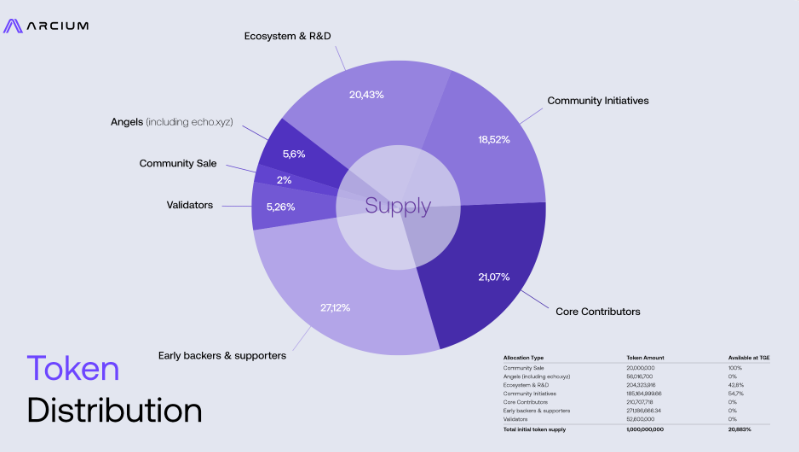
The tokenomics page labels one group "Community" in its detail section and "Community Initiatives" in its summary text. The figures match.
How Does the ARX Vesting Schedule Affect Supply?
At launch, 20.88% of supply, about 208.8 million $ARX, counts as unlocked. The other 791.2 million ARX stays locked.
That 20.88% is the published launch figure. It isn't today's circulating supply, so current numbers should come from a market data tracker. A cliff is a waiting period before any tokens unlock. Linear vesting then releases them in steady steps.
Each investor and contributor pool carries a 12-month cliff. The project expects the full initial supply to unlock about four and a half years after launch. Ecosystem & R&D, community initiatives, and the community sale together make up close to 41%. Adding validators pushes the network-side share past 46%.
Market cap counts circulating supply only. Fully diluted valuation, or FDV, counts all one billion tokens, so the gap between the two is wide at launch, nearly fivefold.
What Does the Arcium Roadmap Target, and What Has Landed?
The Year One roadmap runs from Q3 2026 to Q2 2027. The page itself says every figure is a target, not a reported result.
Quarter
Targets
Current progress
Q3 2026
~50 GPUs, 10M daily AI computations; Blackthorn, Arcium Enterprise, C-SPL on Solana mainnet
Blackthorn in private alpha; other items not reported
Q4 2026
~250 GPUs, 50M; Quickthorn, Thorngate, Hydra, and Cerberus upgrades
Live quarter, no results reported
Q1 2027
~1,250 GPUs, 250M; Umbrellathorn, Thornforge, Arcium for Government
Not started
Q2 2027
~5,000 GPUs, 1B; Firethorn
Not started
Daily on-chain confidential computations are meant to climb from 500K to 5M across those quarters. A product page showing alpha access isn't the same as a finished milestone. That's why the progress column stays cautious.
What Could Limit Arcium Network's Growth?
Several factors could slow the plan:
Hardware supply: the roadmap targets about 100 times more GPUs in four quarters
Node decentralization: 15 active nodes is a small base, and node onboarding is still marked as coming soon
Computation costs: confidential work costs more than ordinary processing
Security assumptions: any MPC design relies on its protocol holding up
Developer adoption: tokens need steady app usage
Token unlocks: 79.12% remains locked at launch, so later releases may add selling pressure
What Does the Data Say About the Arcium Network?
The stronger signal is simplicity. Supply is fixed, fees sit outside the token, and every investor pool faces a 12-month cliff.
Execution is the main concern. Growing from about 50 to about 5,000 GPUs in four quarters is a 100-fold jump. At first, that target reads like marketing. On second thought, the quarterly ladder is specific enough to check, and that counts for something.
Still, a target isn't a delivery. The harder test is whether usage and node growth keep climbing after the unlocks begin.
One more open item: the tokenomics page uses pre-launch wording, while the token page lists contract addresses on Solana and BNB Smart Chain. Readers should verify addresses and trading status only through official channels.
Conclusion: What Should Readers Check Next?
Arcium Network aims to let apps compute on encrypted data through MPC, with ARX handling staking and governance. Supply is fixed at one billion, and computation fees are paid in native tokens such as SOL.
The simple token design and the dated roadmap stand out. Delivery speed, unlock timing, node growth, and governance status remain uncertain.
Disclaimer
This article is for informational purposes only and isn't financial advice. Crypto assets carry a high risk of loss, and project claims and roadmap targets may change. Readers should research independently and consult a licensed adviser before any financial decision.