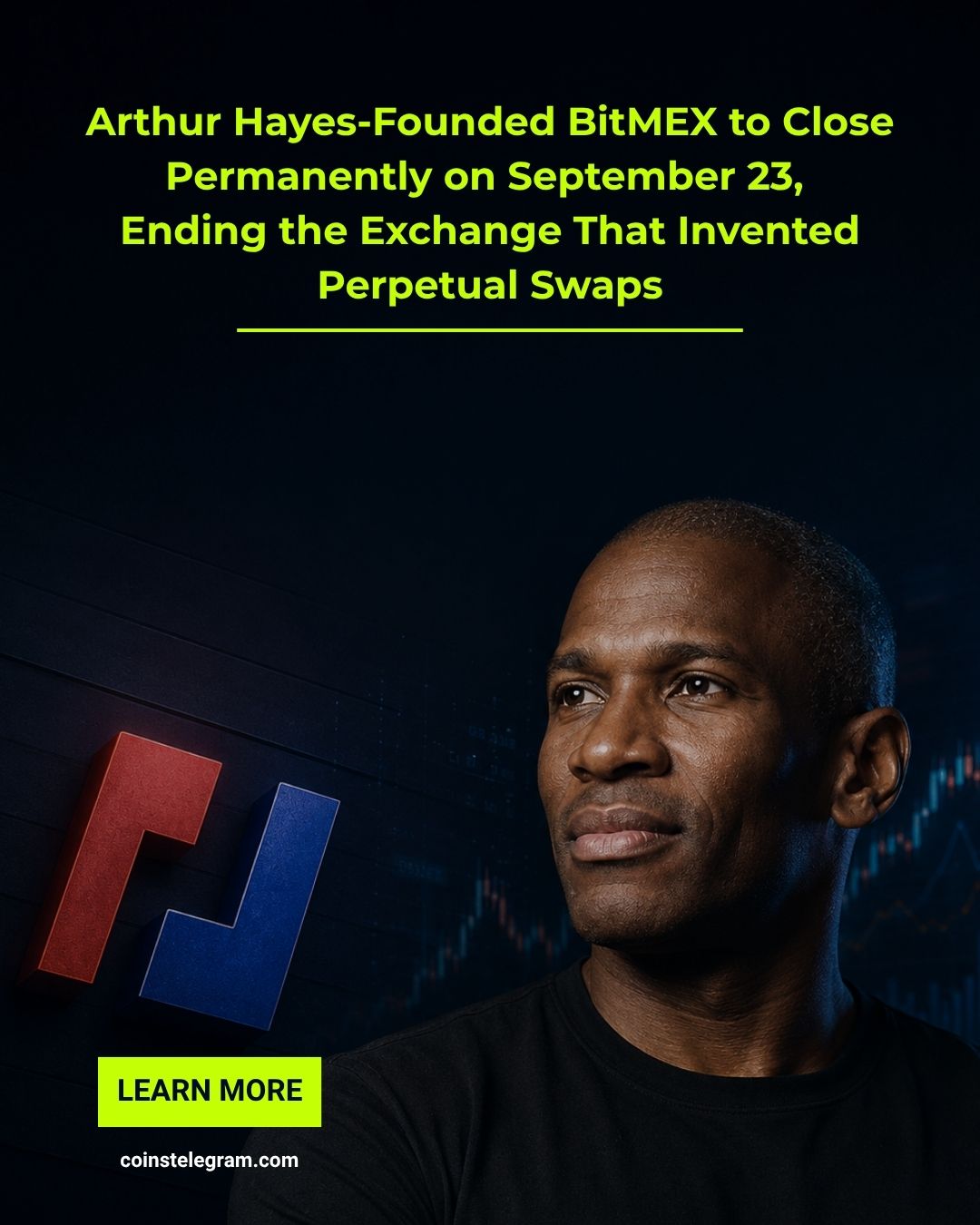
BitMEX, the pioneering cryptocurrency derivatives exchange founded by Arthur Hayes, announced it will permanently cease operations effective September 23, 2026, at 04:00 UTC. The closure mark
BitMEX, the pioneering cryptocurrency derivatives exchange founded by Arthur Hayes, announced it will permanently cease operations effective September 23, 2026, at 04:00 UTC.
The closure marks the end of an eleven-year run for a platform that fundamentally transformed how traders speculate on cryptocurrency prices, inventing the perpetual swap contract that has since become the industry’s dominant trading instrument.
The Announcement
BitMEX broke the news to its user base via its official X account, stating:
“Today, we share with a very heavy heart that BitMEX exchange will shut down its operations, effective 23 September 2026 at 04:00:00 UTC.”
The exchange’s owner and operator, HDR Global Trading Limited, cited a strategic review of the business as the driving factor behind the closure, without specifying deeper financial or regulatory motivations.
The company sought to reassure remaining users about the safety of their holdings during the wind-down period:
“We want to reassure you that your assets remain fully safe and under your control during this transition period. This announcement is just to give enough time to ensure a smooth withdrawal process for everyone.”
A Three-Phase Wind-Down Plan
BitMEX outlined a structured, three-stage process governing the exchange’s closure, designed to give users adequate time to manage their positions and withdraw funds.
The first phase took effect immediately upon the announcement: new account registrations were suspended entirely, closing the platform to any new users effective the day of the announcement.
The second phase begins August 26, 2026, when risk-reduction restrictions take hold. From this date forward, existing users will only be permitted to decrease or fully close their open positions — no new positions can be opened, effectively transitioning the platform into a liquidation-only mode.
The third and final phase arrives on September 23, 2026, when all trading activity ceases entirely. Any positions still open at that point will be forcibly closed by the exchange. Following this date, users will retain access only to view their account balances and process withdrawals — full platform functionality will no longer be available.
BitMEX strongly urged its user base to act proactively rather than wait for the deadline:
“From today we strongly encourage all users to close their positions and withdraw their funds as soon as convenient.”
Financial Consequences for Users Who Delay
BitMEX built in a financial incentive designed to discourage users from leaving funds on the platform indefinitely after the shutdown. Any user with KYC-verified funds still remaining on the platform after September 23, 2026, will be charged either a flat $50 monthly fee or 1% of their account balance annually — whichever amount is greater. The exchange indicated it will continue attempting to contact users who have not withdrawn their funds during the transition period, suggesting the company intends to actively encourage full fund recovery rather than simply abandon dormant accounts.
A Farewell From the Team
In its closure announcement, BitMEX’s team reflected on the platform’s legacy within the cryptocurrency trading community:
“BitMEX was once home to some of the greatest traders today. Our team has dedicated tremendous effort and passion into building the platform into what it is, and we are glad to have reached some of you during your time with us. To everyone who has traded, supported, and grown alongside us — thank you for your trust over the last 11 years.”
BitMEX’s Historic Impact on Crypto Trading
Founded in 2014 by Arthur Hayes, Ben Delo, and Samuel Reed, BitMEX (an abbreviation of Bitcoin Mercantile Exchange) emerged as one of the earliest and most influential cryptocurrency derivatives platforms. The Seychelles-registered exchange is widely credited with inventing the perpetual swap contract — a derivative product without an expiration date that has since become the single most traded instrument across the entire cryptocurrency industry, adopted by virtually every major exchange that followed.
BitMEX also pioneered high-leverage trading in crypto derivatives, introducing 100x leverage perpetual contracts that allowed traders to control large positions with comparatively small amounts of capital. This innovation attracted both professional and institutional traders seeking exposure to cryptocurrency price movements without directly holding the underlying assets.
At its operational peak, BitMEX processed a record-setting $16 billion in trading volume within a single day and exceeded $1 trillion in cumulative annual trading volume — figures that underscored the platform’s centrality to the broader crypto derivatives ecosystem during its prime years.
Regulatory Troubles and Leadership Exodus
BitMEX’s history was not without significant controversy. In 2020, United States federal prosecutors filed criminal charges against Hayes and his co-founders, alleging violations related to anti-money laundering compliance. All three founders subsequently stepped down from their leadership positions at the company following the charges.
In 2022, the founders pleaded guilty to failing to implement anti-money laundering programs compliant with the Bank Secrecy Act — a foundational U.S. regulation requiring financial institutions to assist government agencies in detecting and preventing money laundering. Despite the guilty pleas, Hayes and his co-founders subsequently received pardons from U.S. President Donald Trump, resolving the criminal matter without further prosecution.
The regulatory scrutiny BitMEX faced in the U.S. proved to be a turning point for the exchange’s trajectory, coinciding with a broader industry shift toward more heavily regulated and compliance-focused derivatives platforms — competitors that gradually eroded BitMEX’s once-dominant market position.
What This Means for the Broader Crypto Derivatives Market
BitMEX’s closure represents a symbolic bookend to a specific era of cryptocurrency trading — one defined by high leverage, minimal regulatory oversight, and platforms built by crypto-native founders rather than traditional finance institutions. In the years following BitMEX’s regulatory troubles, exchanges including Binance, Bybit, and OKX expanded aggressively into derivatives trading, offering similar perpetual swap products with varying degrees of regulatory compliance, ultimately capturing significant market share that BitMEX once commanded almost exclusively.
For current BitMEX users, the immediate priority is managing the transition according to the exchange’s published timeline: reducing exposure ahead of the August 26 restrictions, and ensuring complete fund withdrawal before the September 23 final shutdown to avoid the platform’s post-closure holding fees.
For the cryptocurrency industry more broadly, BitMEX’s exit marks the departure of one of derivatives trading’s foundational platforms — a exchange whose technical innovations reshaped how traders across the entire industry speculate on digital asset prices, even as the company itself becomes another example of how quickly market leadership can shift within crypto’s fast-moving competitive landscape.