Quick Overview AST SpaceMobile dispatched BlueBird satellites 14, 15, and 16 from Midland, Texas toward Cape Canaveral for future launch. The company has not yet announced a specific launch w
Quick Overview
- AST SpaceMobile dispatched BlueBird satellites 14, 15, and 16 from Midland, Texas toward Cape Canaveral for future launch.
- The company has not yet announced a specific launch window for these three spacecraft.
- Manufacturing operations in Midland have progressed to BlueBird 50, with more than 20 satellite frames currently under assembly.
- A standardized executive change-of-control severance framework was approved by the Compensation Committee on September 25.
- Shares of ASTS rose approximately 4% to 5% during Wednesday’s trading session after the announcements.
Shares of AST SpaceMobile (ASTS) advanced roughly 4% during Wednesday’s session, hovering around the $62 mark. The uptick followed the company’s announcement of additional satellite shipment progress and the implementation of a new severance framework for senior leadership.
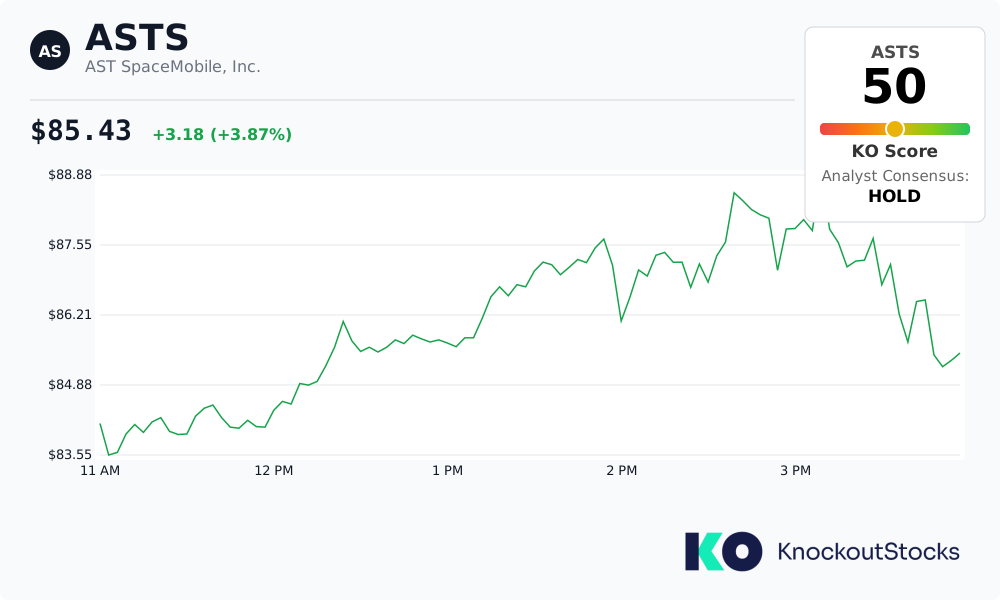 AST SpaceMobile, Inc., ASTS
The company’s Midland, Texas production hub shipped three additional BlueBird satellites this week. Designated as BlueBirds 14, 15, and 16, the spacecraft are currently traveling toward their Florida destination at Cape Canaveral.
AST SpaceMobile shared footage of the transport on social media platforms, showcasing the satellite containers making their journey. “Another convoy is on the move,” the company stated. “Next stop: orbit.”
The company has not disclosed a launch timeline for these three satellites. They represent the next wave following BlueBirds 11, 12, and 13, which lifted off via SpaceX Falcon 9 on August 5. Earlier deployments included BlueBirds 8, 9, and 10 in June.
Manufacturing Progress Continues
The Midland production line has now reached BlueBird 50 in its assembly sequence. Currently, more than 20 satellite structures are undergoing integration processes within the facility.
This production velocity carries strategic importance. AST’s capacity to manufacture and deploy satellites rapidly is fundamental to transitioning from limited coverage areas to a comprehensive operational constellation.
The company’s second-generation spacecraft feature phased-array antenna systems that extend across approximately 2,400 square feet. According to AST, these represent the most extensive commercial communications arrays currently operating in low Earth orbit.
Individual satellites are designed to deliver peak throughput exceeding 150 Mbps per coverage zone. This capability aims to provide cellular broadband connectivity directly to standard mobile devices without requiring specialized equipment.
AST has secured partnerships with approximately 60 mobile carriers globally. These collaborators, which include major operators like AT&T, Verizon, and Vodafone, maintain a combined subscriber base surpassing 3 billion users across the planet.
Executive Compensation and Defense Contracts
The company’s Compensation Committee established a Senior Management Change of Control Severance Policy on September 25. This framework standardizes compensation arrangements for key executives during acquisition scenarios.
Under qualifying termination conditions, the CEO would be entitled to a single payment equivalent to double their annual base compensation plus target incentive. Additionally, health insurance subsidies would extend for 24 months.
Executive Vice Presidents and Senior Vice Presidents falling under the policy would receive 1.5 times their combined salary and bonus figures. Their health benefit subsidies would continue for 18 months.
The framework covers terminations occurring within 12 months following a change of control event, or as early as 180 days prior. Eligible positions include the CEO, President, and all Executive and Senior Vice President roles.
Beyond commercial telecommunications, AST has diversified its revenue channels. The company has disclosed a contracted revenue pipeline totaling roughly $1.3 billion, incorporating expanding collaboration with the U.S. Space Development Agency.
This government contract portfolio provides AST with revenue diversification beyond carrier agreements. The constellation’s architecture, optimized for direct-to-device connectivity, presents clear advantages for classified or isolated communication applications.
Meanwhile, AT&T leadership publicly criticized SpaceX’s direct-to-consumer satellite approach this week. AT&T has endorsed AST’s collaborative framework, which works alongside existing carrier infrastructure rather than bypassing it.
AST SpaceMobile’s operational constellation now comprises 13 satellites following the August deployment. Company officials have affirmed their timeline to initiate beta testing of direct-to-device cellular connectivity throughout the United States by the end of 2026.
The post AST SpaceMobile (ASTS) Stock Surges as Three More Satellites Head to Florida Launch Site appeared first on Blockonomi.