Australia’s market regulator, the Australian Securities and Investments Commission (ASIC), has opened a consultation on draft requirements for crypto platforms covering capital adequacy, cust
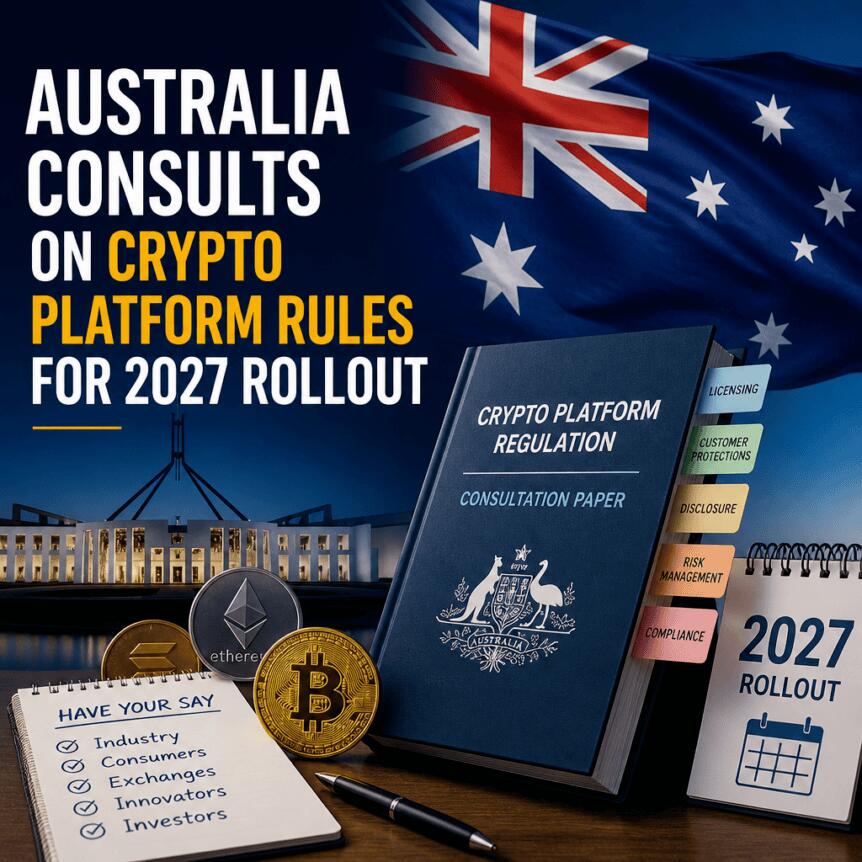
Australia’s market regulator, the Australian Securities and Investments Commission (ASIC), has opened a consultation on draft requirements for crypto platforms covering capital adequacy, custody arrangements, and trading conduct. The move comes as the regulator prepares to implement the Corporations Amendment (Digital Assets Framework) Act passed in April, which expands formal oversight of digital asset activities.
The consultation, issued as CP 392, lays out three alternative capital models, proposes quarterly reporting obligations tied to customer custody wallets, and includes restrictions designed to reduce conflicts of interest—particularly around whether platforms can trade for their own account. ASIC also floated the possibility of allowing offshore custody, while seeking feedback on what safeguards should apply if an overseas parent or related entity fails.
Key takeaways
- ASIC’s CP 392 proposes three different capital models for crypto operators, including a benchmark for firms without qualifying third-party custody arrangements.
- Platforms would face quarterly reporting to ASIC covering custody wallet structures and addresses, plus record retention requirements for seven years.
- Offshore custody would be permitted under the proposals, but ASIC is consulting on safeguards such as emergency access to private keys if an overseas related party fails.
- Draft trading rules target potential conflicts of interest, including restrictions on principal trading by certain order-matching structures.
- Feedback is due Nov. 27, with ASIC aiming to publish final standards and guidance in March 2027 ahead of a scheduled April 8, 2027 law start.
Consultation aims to translate the April digital assets law into operational rules
ASIC’s consultation is explicitly positioned as part of the regulator’s implementation work following Parliament’s passage of the Digital Assets Framework Act earlier this year. The draft guidance and standards are intended to “acknowledge the increasing role of digital assets and tokenization,” according to ASIC Commissioner Alan Kirkland.
In practice, the consultation focuses on how license applicants will demonstrate they can safeguard customers and meet ongoing financial and conduct requirements under the new framework. According to ASIC, the proposals are meant to provide clearer pathways for operators seeking authorization while setting expectations around asset custody and reporting.
Industry bodies and operators broadly welcomed the direction toward detailed implementation, while indicating the impact could be material for firms that have not yet built compliance, capital, and custody capabilities. Amy-Rose Goodey, CEO of the Digital Economy Council of Australia, said ASIC’s release is a “milestone” and that the shift toward practical implementation is encouraging after years of engagement on regulatory reform.
Capital models, custody reporting, and the push for tighter controls
A central part of the consultation is ASIC’s consideration of three alternative capital approaches. One proposal would require certain operators to hold at least 14 million Australian dollars (about $9.7 million) in net tangible assets or 10% of average revenue—whichever is greater—if they do not have qualifying third-party custody arrangements.
Goodey said industry participants would examine the three capital models closely, particularly how proportional they are for businesses of different sizes and what accommodations exist for third-party custody. For its part, OKX Australia’s CEO Shange Chandra characterized the proposals as “appropriately onerous,” arguing they would reward operators that have already invested in compliance and custody while challenging those that have delayed.
ASIC also proposes quarterly reporting to the regulator of custody wallet structures and the addresses involved. Operators would also have to maintain relevant records for seven years, reflecting a longer audit trail designed to support oversight of how customer assets are held and controlled over time.
Offshore custody permitted—safeguards still under debate
Digital asset markets are global, and ASIC’s draft guidance appears to accept that reality. The consultation includes a proposal to allow offshore custody, rather than requiring that customer assets be held domestically in every case.
Goodey highlighted the significance of not mandating domestic custody, noting that the approach recognizes the cross-border nature of digital asset trading and custody.
However, ASIC is also seeking input on what protections should apply if an offshore parent company or related entity experiences failure. One point discussed by ASIC is whether Australian operators should have emergency access to private keys in those circumstances.
Thomsons partner Liam Hennessy said the reporting proposal partly reflects Australia’s reliance on offshore infrastructure because competition and market structure often lead to assets being held offshore. Hennessy also pointed to the compliance challenge that could arise if custody arrangements are spread across jurisdictions but still need to meet Australian regulator expectations.
Beyond capital and custody, ASIC’s consultation addresses trading behavior. Draft provisions would restrict platforms from trading for their own account in ways that could create conflicts of interest, and would also target scenarios where platforms accept benefits linked to favoring particular tokens.
Hennessy suggested the rules could stress-test existing market structures, particularly for setups that rely on affiliated entities for liquidity provision. In his comments, he referenced ASIC’s approach to order matching models and said that under the proposal, an order-matching entity associated with a decentralized or platform-based process (described by him as DAP) could not trade as principal on its own platform, nor could its related bodies corporate trade as principal through it—though he noted that model-specific exceptions exist.
For firms that depend on an affiliated market maker, Hennessy said they should review how the restrictions apply before finalizing their operating and trading arrangements, since exceptions may not cover every operational design.
Implementation timeline: consultation ends in late November
ASIC’s CP 392 consultation is part of an 18-month implementation roadmap published after the Digital Assets Framework Act was passed in April. Public feedback is due Nov. 27. ASIC aims to publish final standards and guidance in March 2027.
The law is set to take effect on April 8, 2027. Operators would then have until Oct. 7, 2027 to apply for the relevant license, with the ability to continue operating while ASIC assesses applications.
For market participants, the key unknowns are how ASIC will reconcile offshore custody with practical safeguards (including emergency key access) and which capital model will become the final standard for different operator types. Observers will also be watching how the final trading restrictions and any exceptions map onto real-world platform and market-making structures ahead of the 2027 start date.
This article was originally published as Australia Consults on Crypto Platform Rules for 2027 Rollout on Crypto Breaking News – your trusted source for crypto news, Bitcoin news, and blockchain updates.