VIENNA — Once a year the FMA’s FinTech Day fills the Kassensaal of the Austrian National Bank with supervisors, fintech executives, bankers and academics, and the panels tend to stay abstract

VIENNA — Once a year the FMA’s FinTech Day fills the Kassensaal of the Austrian National Bank with supervisors, fintech executives, bankers and academics, and the panels tend to stay abstract. On Friday the authority put a number on the room. The crypto-asset service providers it supervises reported 111 million exchange transactions in the first half of 2026, worth €20.4 billion, according to the press release the FMA published at 10:43 UTC on 27 November.
The release draws on the reporting returns that licensed providers file with the authority, which makes it one of the few hard counts of what MiCA-regulated crypto business looks like inside a single EU member state. The distribution of that business is the part that matters. At the end of June, roughly 74% of the 7.72 million user accounts registered with the reporting providers belonged to clients living in other European Economic Area states, with Germany and France at the top of the list.
For a country of about nine million people, that is an unusual position to hold. Austria has become a licensing address for firms that sell across the bloc, and the FMA’s own data now shows the shape of it: a small domestic client base sitting underneath a much larger European one.
Where the Average Trade Lands at €184
Twenty billion euros is difficult to picture, so break it down. €20.4 billion across 111 million transactions averages €183.78 per trade. Spread over the 181 days from 1 January to 30 June, the flow works out to roughly 613,000 trades a day and about €112.7 million of turnover every 24 hours.
An average ticket under €200 points towards retail-sized orders rather than block business. An average is a blunt instrument, though. A market of mostly €50 trades punctuated by a handful of seven-figure orders produces the same headline figure, and the FMA does not publish a size distribution in this release, so the mean cannot settle the question on its own.
What the number does establish is the pace. Roughly 613,000 supervised trades a day is the kind of volume that depends on automated surveillance rather than manual review, which may explain why the FinTech Day programme put artificial intelligence, cybersecurity and post-quantum technology alongside MiCA and stablecoins.
These are reporting figures from supervised providers, not a census of every Austrian crypto trade. A German client of a Vienna-licensed platform is inside this dataset even though no Austrian counterparty is involved, and a Vienna resident trading on an unlicensed offshore venue is outside it entirely.
A Licence Issued in Vienna, a Client in Berlin
The mechanism behind those flows is the passport that MiCA created. Once a crypto-asset service provider is authorised in one member state, it can offer its services across the European Economic Area, which is why the Austrian authorisation is worth more than the domestic market alone.
Apply that to the FMA’s account data. If 74% of 7.72 million accounts belong to clients elsewhere in the EEA, that leaves about 5.7 million accounts outside Austria and at most around two million for domestic clients and customers outside the bloc combined. The authority itself frames the shift this way: cross-border business models have shaped the European crypto market since MiCA took effect, and that changes what supervision has to do.
Growth over the half-year is steady rather than explosive. Registered accounts rose from 6.7 million at the end of 2025 to 7.72 million at the end of June, an increase of 1.02 million, or 15.2%, in six months. That averages out to roughly 170,000 new accounts a month.
The licensing pipeline keeps feeding it. Transak’s Vienna-based entity received FMA authorisation under MiCA on 25 November, two days before the FinTech Day release, and began offering regulated on- and off-ramps across the EEA from 26 November. Each new licence of that kind adds another book of EEA clients to the reporting pool that produced Friday’s numbers.
Accounts Grew 15%, Client Assets Fell 23%
The custody side of the same return moved the other way. At the end of June, the reporting providers held crypto assets worth about €3.4 billion for their clients, against €4.4 billion at the end of 2025. That is a fall of roughly €1 billion, or 22.7%.
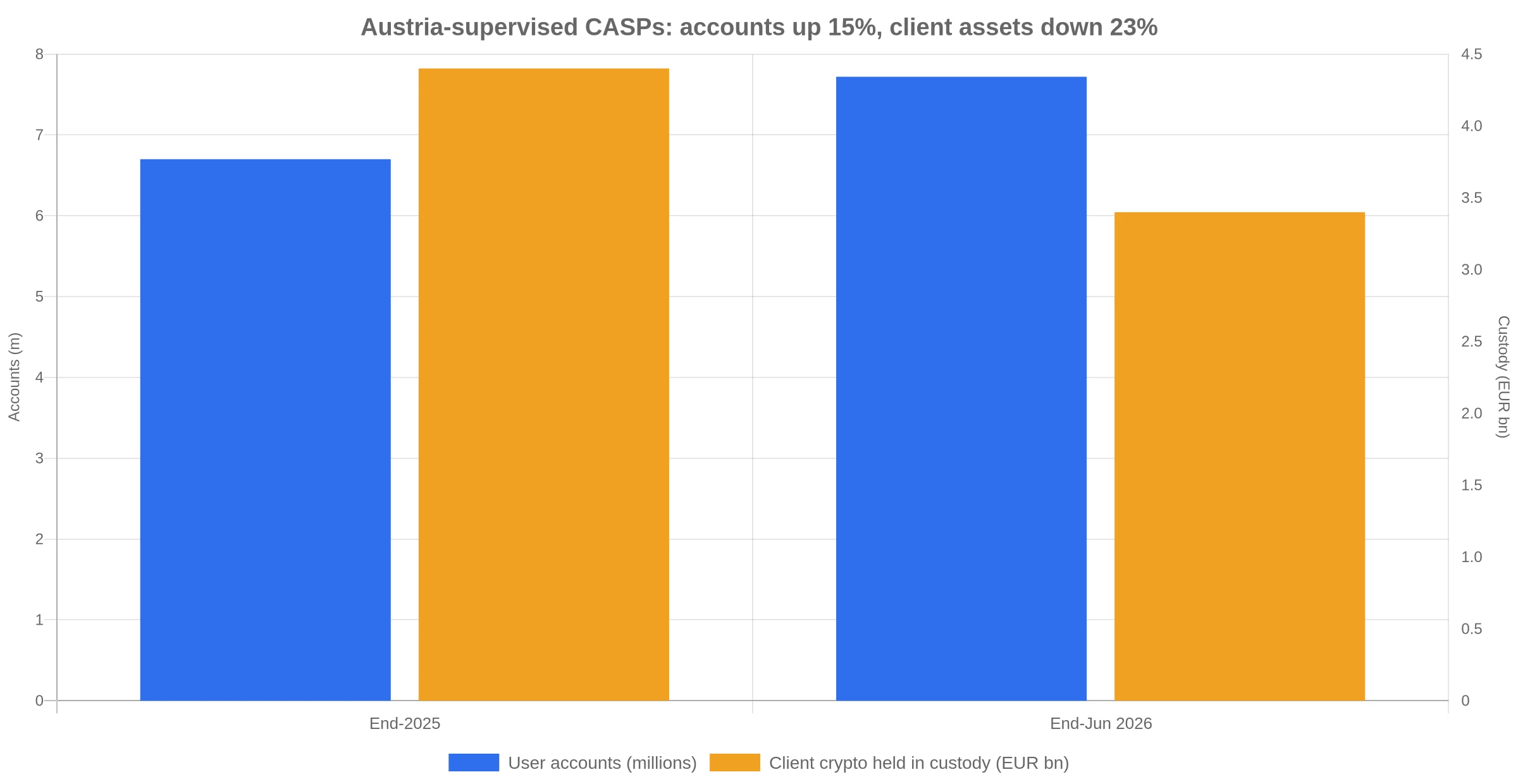
Registered accounts and client crypto assets at FMA-supervised providers, end-2025 versus end-June 2026. Source: FMA reporting data, 27 November 2026.
The FMA offers a valuation explanation of its own. The release says the lower figure reflects the price of bitcoin and other crypto assets on the reporting date, since a custody book is marked at market. A falling reference price reduces that book without a single coin leaving the platform.
The per-account arithmetic sharpens the point. €3.4 billion spread across 7.72 million accounts works out to about €440 per account, against €657 at the end of 2025. That is a drop of roughly 33%, larger than the headline 22.7%, because the number of accounts kept rising while the value they held fell.
What the release does not provide is a deposit or withdrawal series, so it cannot separate coins that were sold and taken off platforms from coins that simply became worth less. Both would produce the same custody figure. The account growth and the custody decline are consistent with new, small-balance accounts joining while existing balances lost value, but the FMA data does not prove that composition, and no one should read it as a net outflow.
The Supervision Question Kühnel Answered Carefully
The European character of that client base has pushed a different question to the front: who should supervise it. At EU level there is discussion of centralising oversight of crypto-asset service providers and giving ESMA a larger role, and the FMA used the release to set out its position without endorsing either side.
„Innovation, Wettbewerbsfähigkeit und wirksame Aufsicht gehen Hand in Hand, wenn wir einen zukunftsfähigen europäischen Finanzmarkt schaffen wollen“, sagte FMA-Vorständin Mariana Kühnel.
Translated: innovation, competitiveness and effective supervision go hand in hand if Europe wants a financial market fit for the future. Kühnel then tied the argument to the regulation that produced Friday’s dataset:
„Mit MiCAR haben wir erstmals einen gemeinsamen regulatorischen Rahmen für Kryptowerte in der Europäischen Union. Nun muss sich in der praktischen Umsetzung zeigen, dass daraus ein integrierter, innovativer und wettbewerbsfähiger europäischer Kryptomarkt entsteht – bei gleichzeitig hohem Anlegerschutz und hoher Marktintegrität.“
In English: with MiCA, the EU has a common regulatory framework for crypto assets for the first time, and implementation now has to show that an integrated, competitive European market emerges from it while investor protection and market integrity stay high.
On the institutional question the FMA is more guarded than either camp in the debate. The release states that institutional changes are not an end in themselves, and that the yardstick is whether they deliver more effective supervision, greater consistency and fair competitive conditions in the single market. It does not say whether the authority wants ESMA to take over CASP supervision, and readers should not infer a preference that the text does not state.
Stablecoins and the Euro’s Own Argument
Stablecoins got their own paragraph, framed as the point where crypto meets payments and market infrastructure, and where Europe’s competitive position is at stake. Kühnel’s line was the sharpest in the release:
„Europa muss bei Stablecoins seinen eigenen Weg finden: offen für Innovation und Wettbewerb, aber mit klaren Regeln, die Finanzstabilität, Verbraucher:innen und die Integrität unserer Märkte schützen“.
Europe has to find its own path on stablecoins, in other words: open to innovation and competition, but with rules that protect financial stability, consumers and market integrity. The release does not attach a legislative proposal to that sentence, and it does not address the enforcement questions that sit underneath the stablecoin market. Those are live: the European Banking Authority has found stablecoins acting as the settlement rail for tens of billions in DeFi lending while yield-bearing arrangements sit inside a MiCA prohibition that supervisors struggle to reach, as BlockchainReporter reported.
What the Reporting Returns Leave Out
The dataset is narrower than the headline suggests. It contains no revenue figures, no per-provider breakdown, no asset-level split of what traded, and no count of how many providers filed. It also gives no full-year 2025 volume comparison, so the six-month total cannot be set against last year’s market on the strength of this document alone.
Registered accounts are not active users. A 7.72 million total counts accounts that exist, including dormant ones, and the FMA does not publish a monthly-active measure. The 15.2% growth is therefore a measure of onboarding, not of engagement.
Nor is €20.4 billion the size of Austrian crypto trading. It is the turnover reported by providers the FMA supervises. Activity that runs through unlicensed platforms, offshore venues or peer-to-peer channels sits outside the frame, and so does business booked by providers licensed in other member states but serving Austrian clients under the same passport.
The next reporting window covers July to December, and it will answer two questions the half-year data cannot. The first is whether account growth holds near 170,000 a month as the first wave of Vienna MiCA authorisations moves from licence to live clients. The second is whether the custody base recovers with asset prices, or whether the €3.4 billion mark reflects a client base that is growing in number and shrinking in size. Both outcomes fit the first-half numbers. Only the second half will separate them.
The post Austria’s Licensed Crypto Market Traded €20.4 Billion in Six Months. Three in Four Accounts Sit Abroad appeared first on BlockchainReporter.