Avalanche News: Aave Brings Institutional RWA Lending To The Chain Big Avalanche News just dropped from one of DeFi's largest lending protocols. Aave confirmed it's building a dedicated real-
Avalanche News: Aave Brings Institutional RWA Lending To The Chain
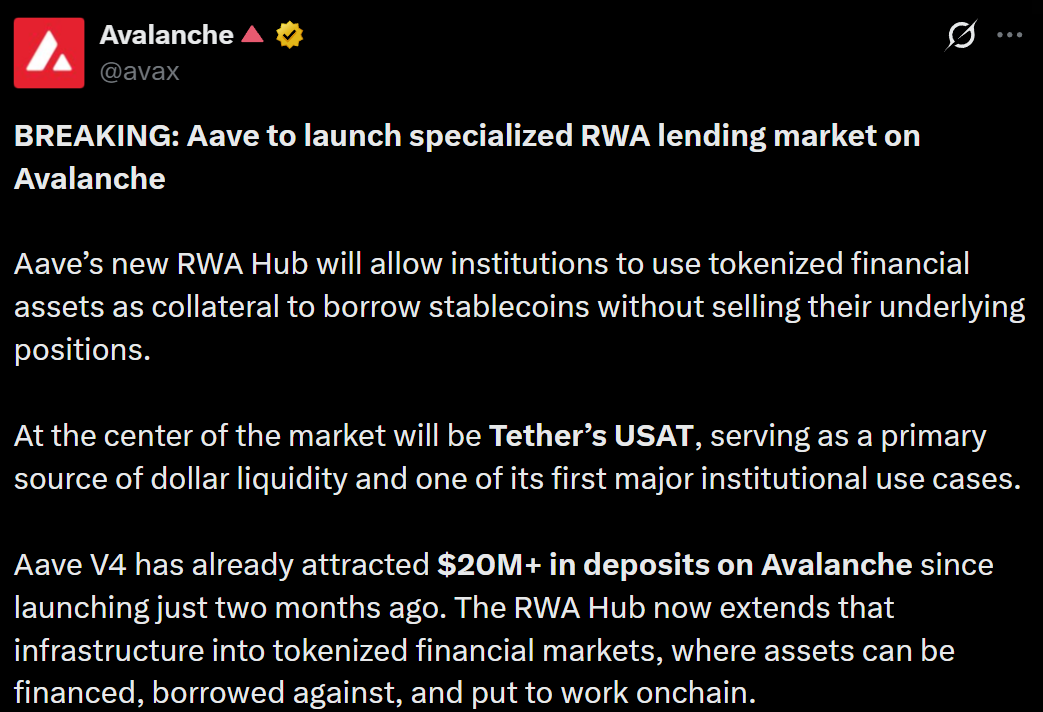
Big Avalanche News just dropped from one of DeFi's largest lending protocols. Aave confirmed it's building a dedicated real-world asset lending market on the network, letting institutions borrow stablecoins against tokenized holdings without selling what they own.
What Got Announced
Per an official post, the new RWA Hub runs through Aave V4's existing deployment, creating a credit market built specifically for institutional borrowers.
The setup lets eligible tokenized financial assets serve as collateral, while borrowers draw stablecoin liquidity without liquidating those underlying positions.
Source:Avalanche on X
Institutions pledge tokenized assets as collateral
Borrowing happens in stablecoins, primarily USA₮
Underlying positions stay intact, nothing gets sold
The market runs on Aave's existing Hub and Spoke structure
Tether's USA Takes Center Stage
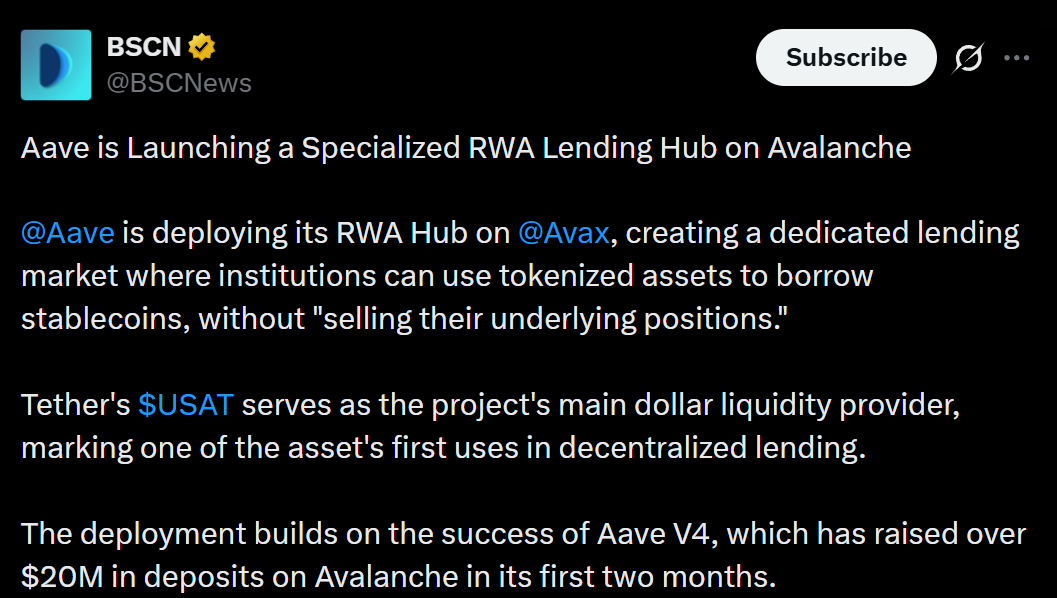
This piece of Avalanche News carries weight beyond one protocol alone. USA₮, Tether's dollar-backed stablecoin issued through Anchorage Digital Bank, will serve as the primary source of dollar liquidity for the new market, marking one of its first real deployments inside decentralized lending.
Institutional-grade stablecoin liquidity rarely anchors a lending product this early, which is what makes the pairing notable.
Source:BSCNews on X
Detail
Information
Protocol
Aave V4
Network
Avalanche
Primary Liquidity Asset
USA₮ (Tether)
Architecture
Hub and Spoke
Existing Deposits
$20M+ in the first 2 months
Collateral Type
Tokenized financial holdings
Why This Fits Where Real-World Assets Are Heading
Institutional lending built around real holdings rather than pure crypto collateral is its own category entirely.
The Hub and Spoke design lets the new market run its own collateral rules and risk settings while still tapping into shared liquidity elsewhere, rather than sitting as an isolated, walled-off product.
That matters because it lets one network host a specialized institutional product without pulling liquidity away from existing markets, a balance most decentralized platforms have historically struggled to strike.
It also arrives as real-world holdings brought on-chain have grown roughly 40% over the past year, now topping $51 billion industry-wide, a scale that finally justifies dedicated credit infrastructure rather than treating tokenized holdings as a side feature.
Building On Two Months Of Momentum
None of this started from zero, and that momentum is central to today's Avalanche News.
The V4 deployment went live just two months ago and had already pulled in more than $20 million in deposits, per the same announcement.
This new market extends that existing base into a fresh category, tokenized financial holdings, rather than starting growth over from scratch.
That early traction likely explains why the network got picked for the expansion over rivals, betting existing momentum carries straight into institutional territory too.
The move also lines up with where the broader industry keeps pointing: analysts have flagged the chain as already holding several billion dollars worth of tokenized real-world holdings, positioning it among the more credible venues for exactly that kind of product.
Conclusion
This round of Avalanche News marks a real step toward tokenized holdings functioning as working collateral, not just tradeable tokens sitting untouched in a wallet.
Specific collateral types haven't been locked in yet, and neither has an exact launch date, so the next real test lands once those details go public.
For now, pairing established lending infrastructure with a fast-growing network and dollar liquidity from a major stablecoin issuer sets up one of the more concrete institutional DeFi products worth watching for the rest of the year.
Disclaimer
This article is for educational and informational purposes only and should not be considered financial or investment advice. Always conduct your own research before making investment decisions.