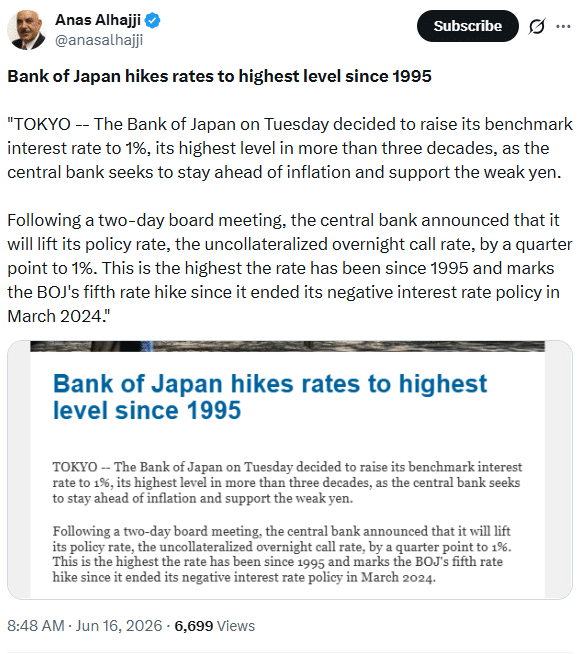
On Tuesday, June 16, 2026 the Bank of Japan rate hike lifted Japan’s policy interest rate from 0% to 1%. That was the highest level since 1995. The move came as Japan’s ultra-loose policy era
On Tuesday, June 16, 2026 the Bank of Japan rate hike lifted Japan’s policy interest rate from 0% to 1%. That was the highest level since 1995. The move came as Japan’s ultra-loose policy era that defined the country for decades further splintered.
The central bank increased its short-term rate from 0.75% to 1%. After a two-day meeting, the decision was approved in a 7-1 vote. This was the first move higher since December.
Bank of Japan Rate Hike Signals a Shift in Perception
Bank of Japan rate hike was taken to beat inflation risk Rising power charges, a delicate yen and surging wholesale costs additionally piled the stress on policymakers.
Japan continued low rates near zero to aid growth and combat deflation. As prices went up, and wage trends improved, that began to change.
This latest ruling marks a definitive realignment in policy. The BOJ now views inflation as a bigger threat than weak consumption. Nonetheless, officials cannot afford to slow growth too much.
Source:
XWhy the Rate Move Matters
The BOJ rate hike is significant into Japan. It is a major world economy. Its decisions may move currencies, bond yields, banks and cross-border investment.
We have higher rates which can increase the cost of borrowing households and companies. US savers will also benefit from these higher returns, which are available domestically only after years of near-zero yields.
Yen Weakness Keeps Pressure on BOJ
The yen has faced pressure from wide interest rate gaps with other major economies. A weak yen makes imports more costly because Japan relies heavily on imported fuel and raw materials.
The Bank of Japan rate hike may support the yen by making Japanese assets more attractive. Still, currency moves will also depend on global risk sentiment and U.S. rate policy.
Energy Costs Complicate Inflation Outlook
The Middle East conflict has added pressure to Japan’s inflation outlook. Higher oil costs can raise transport, utility, and factory expenses. Those costs can then move into consumer prices.
A U.S.-Iran peace deal eased some market fears. Yet energy risks remain important for Japan because the economy depends on global fuel markets.
Wholesale Inflation Raises Fresh Concerns
Wholesale inflation rose to 6.3% in May. That was the highest level in three years. The data showed that companies were facing higher input costs.
Those costs may reach consumers if firms raise prices. Analysts also expect core consumer inflation to move back above the BOJ’s 2% target later this year.
Global Markets Assess Capital Flows
The Bank of Japan rate hike could change global capital flows. Japanese investors have long bought overseas assets because domestic yields were low. Higher local rates may reduce that need.
Any shift could affect foreign bond demand and currency markets. Investors will watch Japanese government bonds, the yen, and overseas debt markets.
Fed Policy Adds Wider Market Context
The decision came during a busy week for central banks. The U.S. Federal Reserve was expected to keep its benchmark rate steady. However, inflation concerns have kept markets alert.
A tighter BOJ and a cautious Fed could narrow the rate gap between Japan and the United States. That may keep the yen and bond markets active.
Conclusion
The BOJ rate hike is a big step in the normalization of Japan’s policy. The rate of 1% demonstrates that officials are now more serious about the risk of inflation.
The forthcoming decisions will depend on inflation, wages, oil prices, and the yen. The BOJ will also have to defend yields as borrowing cost higher.
Appendix Glossary of Key Terms
Policy interest rate: It is a central bank’s main benchmark for borrowing costs.
Inflation: An increase in prices that decreases the value of the currency.
Core consumer price index (CPI): A measure of inflation that strips out volatile ingredients like fresh food
Wholesale inflation: Price increases faced by companies before goods reach consumers.
Weak yen: A decline in the yen’s value against other major currencies.
Monetary policy: Central bank actions used to manage inflation and economic growth.
Capital flows: Movement of money between countries for investment purposes.
Frequently Asked Questions About Bank of Japan Rate Hike
1- What did the Bank of Japan decide?
The BOJ raised its short-term policy interest rate to 1% from 0.75%.
2- Why is the Bank of Japan rate hike important?
It pushed Japan’s policy rate to its highest level since 1995.
3- How could the move affect the yen?
Higher rates may support the yen by improving returns on Japanese assets.
4- Why is inflation still a concern?
Energy costs, import prices, and wholesale inflation remain under pressure.
References
Coinomedia
WSJ