Banks are accelerating their push into Europe’s regulated crypto market, and the shift is showing up clearly in ESMA’s MiCA (Markets in Crypto-Assets) provider register. According to Cointele
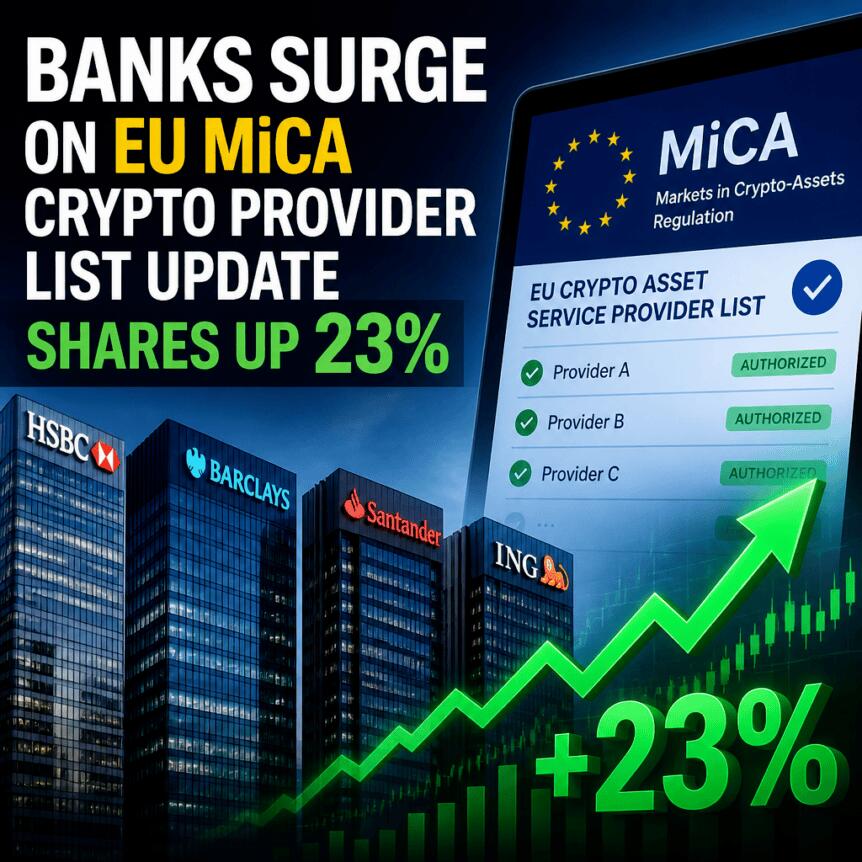
Banks are accelerating their push into Europe’s regulated crypto market, and the shift is showing up clearly in ESMA’s MiCA (Markets in Crypto-Assets) provider register. According to Cointelegraph’s analysis of ESMA data, banks expanded much faster than non-bank crypto-asset service providers over a roughly three-month window in 2026—changing the balance of who is listed under the EU’s MiCA framework.
Between June 26 and Sept. 16, the number of banks appearing on the MiCA register doubled to about 80 from roughly 40. Over the same period, the total count of listed crypto-asset service providers (CASPs) climbed from 243 to 349, but banks gained share as non-bank providers’ relative presence fell.
Key takeaways
- ESMA register data analyzed by Cointelegraph shows banks’ MiCA-listed footprint doubled to about 80 providers between June 26 and Sept. 16.
- Total CASPs rose to 349, but non-bank providers’ share slipped from around 84% to 77%—indicating faster bank growth.
- Banks increased from roughly 17% of the register in late June to nearly 23% by September.
- Germany is a major driver, with both large lenders and regional cooperative banks adding MiCA-covered capabilities.
MiCA register shows banks gaining share faster
The MiCA framework is designed to bring consistent rules to crypto-asset activities across the EU. In practice, the provider register offers a real-world view of which types of institutions are moving into compliance workflows.
Cointelegraph’s review of ESMA’s MiCA register shows that while the overall number of CASPs increased steadily—from 243 to 349—the change in composition matters. Non-bank providers still represent the majority of entries, but their dominance narrowed as banks expanded at a faster pace.
In late June, banks accounted for about 17% of the listed providers. By Sept. 16, that proportion was approaching 23%, even as non-bank providers remained the larger group in absolute terms. The implication for market participants is straightforward: regulated crypto services are no longer confined to crypto-native firms and fintech operators—incumbent financial institutions are increasingly participating.
Germany leads the banking expansion
Germany has been central to the acceleration. The additions include both major commercial institutions and a wave of cooperative and regional banks—suggesting the trend is spreading through established banking networks rather than remaining a large-bank niche.
Among the high-profile names is Deutsche Bank, Germany’s largest lender. It announced plans to launch digital asset custody services for institutional and corporate clients in Europe. In comments to Cointelegraph, a Deutsche Bank spokesperson said the bank expects to obtain regulatory approval for the offering under MiCA in October.
Beyond large institutions, Cointelegraph notes that Germany’s new entries also include numerous Volksbank, Raiffeisenbank, and VR Bank entities. That pattern matters because it points to a broader distribution of regulated crypto capabilities across the country’s regional cooperative banking base—potentially expanding access and competitive pressure well beyond the biggest banking groups.
Why banks can enter under MiCA’s Article 60 route
A key factor behind the speed of the bank listings is how MiCA treats credit institutions differently from standard crypto companies. While crypto firms that want to offer services typically must apply for authorization as CASPs, banks can provide certain crypto-asset services using a separate notification mechanism.
MiCA’s Article 60 allows a credit institution to provide crypto-asset services after it submits required information to its home regulator at least 40 working days before offering those services for the first time. In other words, banks can enter the market under a “notify and proceed” approach rather than running the full CASP authorization process that applies to many non-bank providers.
This procedural difference helps explain why the register’s composition can change quickly: banks have a pathway to start offering services sooner once their notification requirements are satisfied. For investors and other market users, it also means that more traditional institutions may show up on the compliance register—and potentially in real custody, trading, settlement, or other crypto-related workflows—before the market has time to fully price in their long-term scale.
At the same time, the notification route does not eliminate regulatory oversight; it changes the entry mechanics. The details of how each bank’s specific activities are scoped and how regulators review the notifications can vary in practice, so market watchers should focus not just on listings, but on what services are actually being launched and at what operational depth.
What to watch next as the register evolves
As banks keep growing their presence on ESMA’s MiCA register, the main question is whether this is a temporary surge driven by notification mechanics—or the beginning of a sustained reordering of Europe’s regulated crypto landscape. With Germany leading and large institutions like Deutsche Bank signaling custody plans, traders, institutional allocators, and crypto service users will likely want to monitor which banks move from listing to rollout, and how quickly non-bank providers adapt to the changing competitive environment.
This article was originally published as Banks Surge on EU MiCA Crypto Provider List Update, Shares Up 23% on Crypto Breaking News – your trusted source for crypto news, Bitcoin news, and blockchain updates.