Base Mainnet Launch Date: B20 Activation Registry Postponed After Halt Base mainnet ground to a halt — twice — within a single 48-hour window, forcing an immediate delay to its B20 Activation
Base Mainnet Launch Date: B20 Activation Registry Postponed After Halt
Base mainnet ground to a halt — twice — within a single 48-hour window, forcing an immediate delay to its B20 Activation Registry rollout.
For traders and developers building on Base, this isn't just a technical hiccup — it raises real questions about timing, reliability, and what this means for assets dependent on the B20 standard like stablecoins and RWAs.
No new Base launch date has been confirmed yet — and what's happening on Sepolia and Vibenet tells a very different story.
What Happened: Base Delays B20 Mainnet Activation
Base, Coinbase Layer 2 network, has officially postponed the mainnet enablement of its B20 Activation Registry following two separate block production stoppages within 48 hours. The announcement came directly from the official account:
"With the recent network stability issues, we're pushing back the B20 Activation Registry mainnet enablement to ensure a smooth rollout. Sepolia and Vibenet remain on track. We'll share a revised date shortly."
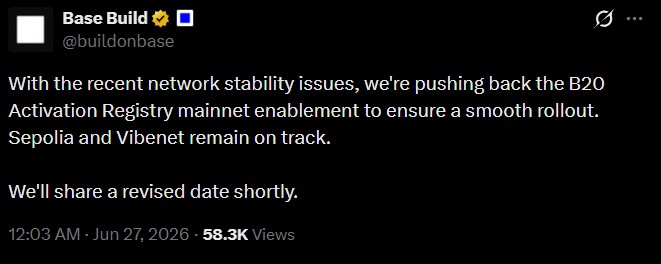
Source: Official X
Why the Base Mainnet Launch Delay Actually Matters
This isn't a minor scheduling shift. Two block production halts in under two days signal deeper stability concerns and that's exactly why Base chose to pump the brakes.
B20 is not a small upgrade. It is Base's native ERC-20 superset token standard, introduced through the Beryl hard fork. It enables:
Optimized on-chain token operations for stablecoins
Support for Real World Assets (RWAs)
Advanced features through precompiles and activation controls
Deploying a faulty B20 Registry— where real funds and live protocols operate — could have cascading consequences across the Base ecosystem.
Testnet Activity: Sepolia and Vibenet Stay on Schedule
Despite the mainnet delay, Base confirmed that Sepolia and Vibenet testnet deployments remain fully on track. This is a meaningful signal. Testnets passing while mainnet stalls typically suggests the issue is environment-specific — likely tied to the heavier load or a configuration gap between test and production environments. Developers can continue building and testing B20 integrations on testnet without interruption.
What Is the B20 Standard and Why Is It Important?
B20 is Base's answer to limitations in the standard ERC-20 token model. Introduced via the Beryl hard fork, it enables:
Precompiles: Faster, cheaper token operations
Activation Controls: Modular deployment flexibility
Superset Compatibility: Backwards compatible with ERC-20
For stablecoin issuers, RWA protocols, and DeFi projects building, B20 is a foundational upgrade, which makes a stable launch non-negotiable.
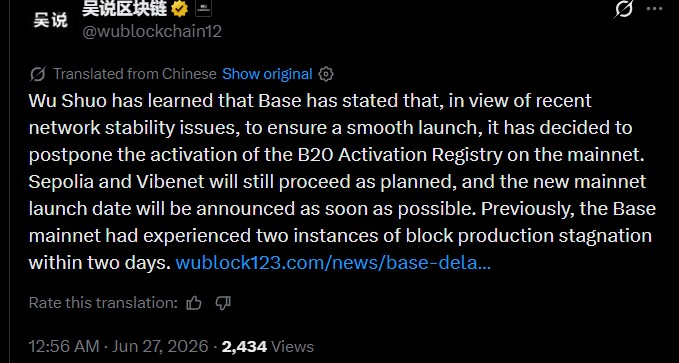
Source: Wu Blockchain X
What to Watch Next: The Revised Date
It has not confirmed a new mainnet activation date. Here's what to monitor:
Official announcements on X (formerly Twitter) for the revised schedule
Sepolia and Vibenet test results — successful testnet runs will likely precede any further attempts
Block production stability metrics over the coming days
Any developer communication around the Beryl hard fork rollout timelines
The speed of the revised announcement will itself signal how confident the team is in identifying the root cause.
The Bigger Picture: Trust Takes Time to Build
Two stoppages in under two days is the kind of record no Layer 2 network wants heading into a major protocol upgrade. Developers and stablecoin issuers watching the B20 rollout will now demand visible proof of stability — not just a new date. One clean, uninterrupted week of block production may matter more than any announcement.
Conclusion
The has made the right call by delaying the B20 Activation Registry launch — two block halts in 48 hours left no other responsible option. Testnet deployments on Sepolia and Vibenet continue unaffected, keeping developer momentum alive.
The critical question now is not if the Base launch date happens, but when — and whether the stability fix holds under real network load. Watch the official channel closely for the revised date.
Disclaimer: This article is for informational purposes only and does not constitute financial or investment advice. Cryptocurrency markets are highly volatile. Always conduct your own research before making any investment decisions. CoinGabbar is not responsible for any financial losses incurred.