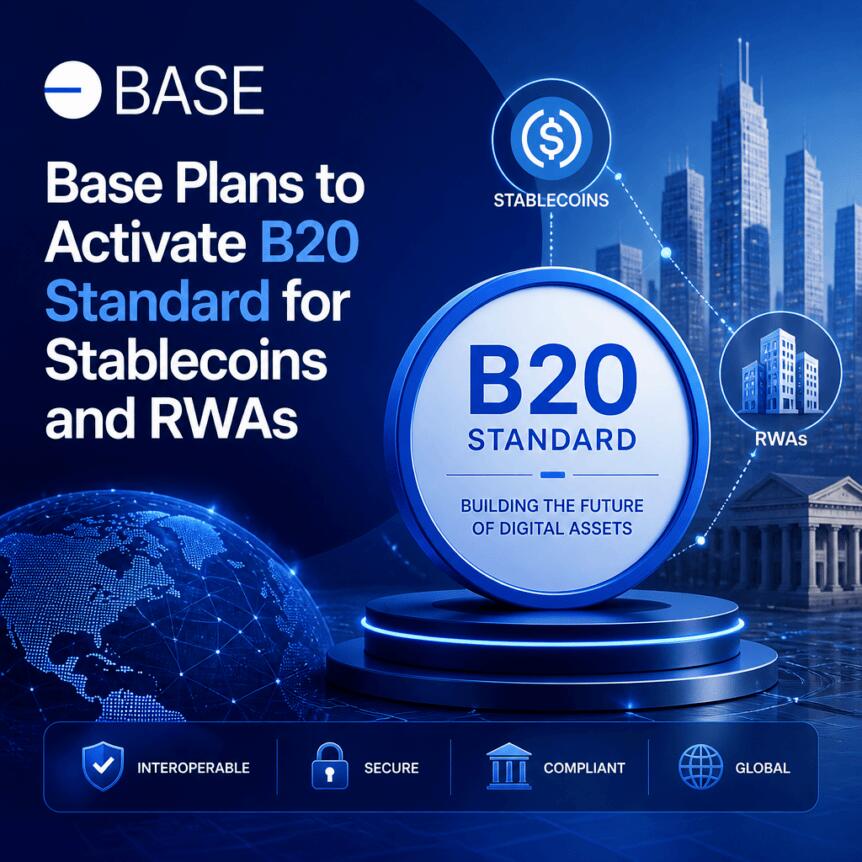
Coinbase-backed Layer-2 network Base is preparing to launch its new B20 token standard on mainnet, aiming to give developers a native way to issue stablecoins and other fungible assets such a
Coinbase-backed Layer-2 network Base is preparing to launch its new B20 token standard on mainnet, aiming to give developers a native way to issue stablecoins and other fungible assets such as tokenized real-world assets (RWAs). Base says the standard will be activated at 6 pm UTC, with developers able to start creating tokens under B20 once it goes live.
The rollout is positioned as a shift away from building and auditing custom token contracts. Instead, B20 provides an on-chain framework that supports issuer-side controls—features Base says are designed to simplify creation of both stablecoin- and asset-style tokens without developers having to implement their own token logic from scratch.
Key takeaways
- Base will enable the B20 token standard on mainnet at 6 pm UTC, according to Base documentation.
- B20 includes two variants—an asset format with configurable decimals and a stablecoin format with fixed six-decimal precision.
- The standard is intended to reduce developer workload by avoiding the need to build and audit custom ERC-20 contracts for common token functions.
- Base says B20 tokens remain compatible with ERC-20 while adding issuer controls such as supply limits and minting/burning permissions.
- The launch comes after recent Base outages tied to sequencer infrastructure issues, including incidents on June 25 and June 26.
What B20 changes for token issuance on Base
Base’s B20 standard introduces a built-in token framework meant to standardize how fungible assets are created and governed on the network. In Base’s documentation for the “launch B20 token” process, the network describes B20 as a native mechanism that developers can use to issue tokens for use cases such as stablecoins, RWAs, and tokenized equities.
Base also outlines how B20 supports two variants:
- Asset variant: allows decimals to be configured from six to 18.
- Stablecoin variant: requires a fixed six-decimal format and asks issuers to specify a fiat currency denomination (for example, US dollar or euro).
Base says developers can begin creating B20 tokens once the standard is activated. The goal is not just convenience, but operational consistency: rather than each project writing its own token contract and testing it, B20 is designed to bundle common token behavior into a standardized structure.
Built-in controls designed to replace custom ERC-20 logic
Beyond simple compatibility, Base says B20 tokens are designed with issuer controls that typically require custom contract logic in many token deployments. According to Base, B20 tokens are compatible with standard ERC-20 tokens, but they include additional mechanisms that issuers can configure and manage.
Base lists features under its issuer controls framework, including:
- Supply limits
- Transfer rules
- Minting and burning
- Pausing
- Transaction notes
For builders, the practical implication is that B20 could streamline token deployments for use cases where permissions and operational safeguards matter—especially for stablecoin-style issuances and regulated or semi-regulated asset tokenization models. For users, standardized issuer control behavior can also make it easier to reason about how tokens are administered, though the exact implementation details will still depend on each issuer’s chosen parameters.
B20 ties back to the Beryl upgrade
B20 was introduced as part of Base’s Beryl upgrade, which Base says went live on June 26. Base’s documentation attributes B20’s introduction to this upgrade cycle and frames it as part of broader network changes.
In addition to enabling B20 functionality, the Beryl upgrade also reportedly shortened withdrawal waiting periods from seven days to five days. Base also pointed to technical changes intended to improve network performance as part of the same upgrade.
That context matters because B20 is not an isolated feature drop—it arrives alongside changes designed to affect both user experience (withdrawals) and developer/building conditions (network behavior and token standard availability). In other words, the B20 launch is tied to a larger upgrade narrative rather than a standalone deployment.
Launch sequence after Base sequencer incidents
The timing of B20’s mainnet activation follows a period of operational disruption for Base, including outages linked to sequencer infrastructure.
On June 25, Base reported an outage caused by a consensus issue. At the time, the network said an invalid block had been sequenced, which prevented new blocks from being created. Base resumed block production on the same day after a nearly two-hour halt, as previously covered by Cointelegraph (Coinbase’s blockchain Base back online after 2-hour outage).
In a post-mortem, Base attributed back-to-back outages on June 25 and June 26 to a sequencer bug that triggered the first outage and then a second interruption following a reset-related race condition. The first incident reportedly lasted about 116 minutes, while the second lasted about 20 minutes after sequencers were unable to catch up following the reset.
Cointelegraph also reported on the post-mortem findings (Base post-mortem reveals sequencer bug behind back-to-back outages).
These incidents also intersected with upgrade timing. Base said the first outage occurred hours before the scheduled Beryl upgrade. The Beryl upgrade was later delayed by one day due to a B20 activation registry timing issue, showing that B20-related coordination was already present during this rollout window.
For participants monitoring Base’s ecosystem, the key question is how token-standard activation and network reliability interplay during upgrade periods. The B20 launch signals a push to expand functionality, but recent outages highlight that the underlying sequencer infrastructure—and the operational processes around upgrades—remains a critical factor for stability.
With B20 now set to activate at 6 pm UTC, developers and token issuers will be watching to see how quickly real stablecoin and RWA-related products adopt the standard, and whether Base’s recent sequencer incidents remain isolated as more activity moves onto the new framework.
This article was originally published as Base Plans to Activate B20 Standard for Stablecoins and RWAs on Crypto Breaking News – your trusted source for crypto news, Bitcoin news, and blockchain updates.