Automated crypto strategies have moved well past simple price alerts. A bot in 2026 reads wallet positions, screens a contract before touching it, converts assets on a schedule, and reports b
Automated crypto strategies have moved well past simple price alerts. A bot in 2026 reads wallet positions, screens a contract before touching it, converts assets on a schedule, and reports back to whoever deployed it. AI agents do the same work through natural language rather than hardcoded logic.
All of it runs on APIs. And no single API covers the whole job.
The choice matters more than it used to. An agent that can query prices but cannot see wallet holdings is blind to its own position. A bot that reads perfect market data but has no way to convert assets is a dashboard, not a strategy. This guide covers five providers, each built for a different layer of an automated stack.
Why API Choice Decides What an Automated System Can Do
A trading bot is only as capable as the data it can reach and the actions it can take. Raw node access does not solve this. An autonomous system needs enriched, structured responses it can parse without building a pipeline first.
Model Context Protocol has become the dividing line for the AI half of this. MCP turns API endpoints into callable tools for language models, so an agent queries data conversationally instead of through custom integration code. Providers that ship native MCP servers remove an entire adapter layer.
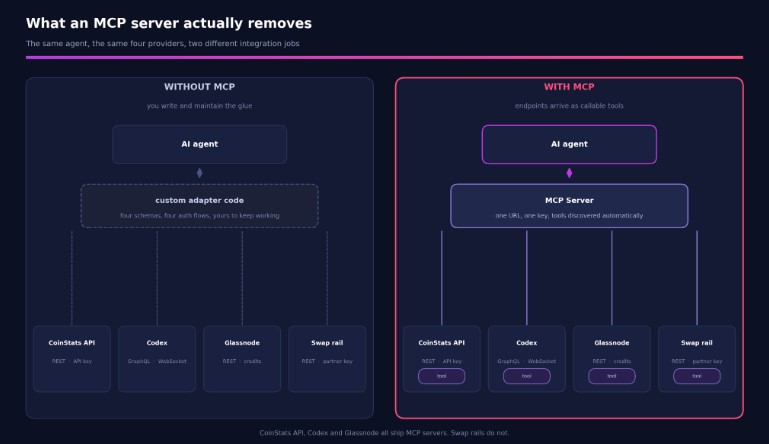
The following automated systems dominate crypto API usage in 2026, and each pulls on a different part of the stack:
- Signal and momentum bots watch price action across venues and fire on threshold breaks. They need low-latency aggregated pricing and consistent response schemas.
- Portfolio rebalancing bots compare live holdings against target weights, then convert assets to close the gap. They need wallet balances, DeFi position data, and a swap rail in the same loop.
- Arbitrage and routing bots hunt price gaps between centralized and decentralized venues. They depend on fresh quotes and fast settlement more than on historical depth.
- Contract screening bots check a token before buying it. They need risk flags on contract behavior, not just price and volume.
- Research and analyst agents ingest onchain metrics alongside market data to produce reports or adjust risk parameters. They need long metric history and reproducible definitions.
- Conversational portfolio assistants answer questions about holdings, performance, and market conditions in plain language. They need a data interface a language model can call directly.
- Treasury automation scripts convert revenue to stablecoins on a schedule without a human at the keyboard. They need a swap rail with predictable settlement and no account friction.
These workloads share one requirement: clean, structured, reliable API access. They differ completely in which part of the stack they lean on. The five providers below map to those different parts.
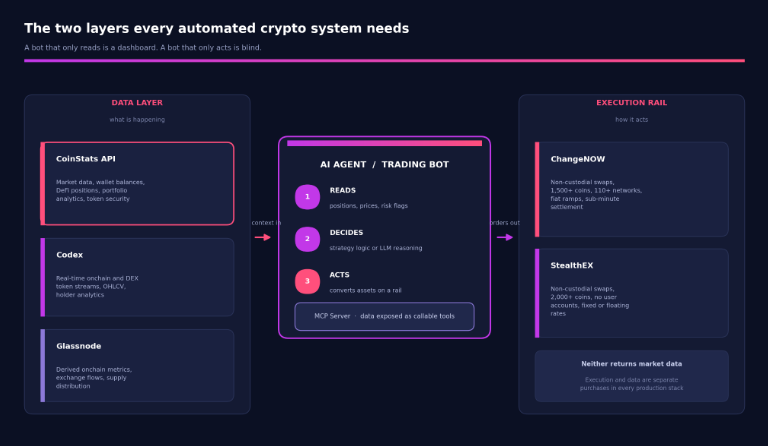
The split matters commercially as well as technically. Data and execution are separate purchases, and a provider strong on one side rarely covers the other.
1. CoinStats API
CoinStats Crypto API covers the data half of an automated system through one key. It returns market data, wallet balances, DeFi positions, portfolio analytics, and token security, already structured for an application.
Coverage and Portfolio Context
The API tracks 100,000+ coins aggregated from 200+ exchanges. Wallet and DeFi data spans 120+ blockchains, including Ethereum and EVM networks, Solana, and Bitcoin. DeFi positions resolve across 10,000+ protocols per wallet automatically. Historical pricing reaches back roughly ten years for backtesting. Portfolio endpoints return profit and loss and allocation, the input a rebalancing bot acts on. This breakdown of thebest aggregated exchange APIs covers the tradeoffs against single-venue feeds.
Token Security and MCP Server
Token Risks endpoint screens EVM contracts before a trade executes. Built on Hexens Glider engine, it flags honeypots, hidden fees, mint and burn, blacklists, and upgradeable proxies. CoinStats MCP Server exposes 20+ data tools to language models over a single OAuth URL, connecting to Claude, Cursor, VS Code, and n8n. An x402 option lets agents pay per request in USDC on Base with no account at all.
Pricing and Access
Pricing is credit based. The free tier includes 20,000 credits per month at 2 requests per second, and paid plans start at $49 per month. Basic market-data calls consume 1 to 2 credits, so continuous polling stays inexpensive.
Best for: Most crypto bot and agent use cases. Teams that want market data, wallets, DeFi, portfolio analytics, and contract screening behind one key. It is a data API, so pair it with a swap rail for execution.
2. ChangeNOW
ChangeNOW handles the conversion step that data APIs deliberately leave alone. The non-custodial swap API lets a platform embed instant exchanges, with liquidity routing and settlement handled on ChangeNOW’s side. Wallets, payment flows, and DEX aggregators use it to add swap functionality without building an exchange.
Coverage extends to 1,500+ coins and 2.25M+ trading pairs across 110+ networks, with liquidity aggregated from both centralized and decentralized venues. The API is REST only, authenticated with a single key issued through the Partner Program. A fiat on and off-ramp supporting 50+ currencies sits alongside the crypto pairs, useful for products taking card payments.
Reliability is the strong point for anything moving real user funds. ChangeNOW reports 99.99% uptime, a 350ms response time, and a 10-minute incident warning window, backed by 24/7 support and free post-integration maintenance. Certifications include SOC 2 Type II and ISO 27001:2022. Swaps typically settle in under a minute. Integration extends to a widget and white-label deployments for teams that want the flow without the frontend work.
Commercially, integration costs nothing and carries no rate caps or monthly fees. Partners earn a commission starting at 0.4% per transaction, configurable by asset, pair, or swap size. That suits products where swap volume is revenue rather than a cost line. Minimum swap amounts apply, and UK users are not supported.
Best for: High-throughput conversion bots, treasury automation, wallet integrations, and embedded swap products that need certified infrastructure. Market data requires a separate provider.
3. StealthEX
StealthEX takes the same execution role with a privacy-first posture. The instant exchange API is fully non-custodial, and end users never create StealthEX accounts to complete a swap. Standard volumes carry no mandatory KYC, with risk-based screening applied only to flagged transactions.
For an automated system, removing the account step removes a whole class of failure. A bot never handles a signup flow, never stores user credentials, and never blocks on verification mid-strategy. Coverage spans 2,000+ coins and tokens across a wide network range, broader than most swap rails at this friction level.
The REST API supports both fixed and floating rates through dedicated endpoints. Floating rates settle at market price on execution. Fixed rates lock the receive amount in advance, the safer choice when a bot needs a deterministic output to feed the next step in a strategy. A bot that needs certainty on the output amount should default to fixed rates, accepting a slightly worse rate for a predictable balance. Settlement typically completes in 5 to 30 minutes, so this is a rail for scheduled conversion rather than latency-sensitive arbitrage.
The commercial model suits independent builders more than enterprise teams. Integration is free with no monthly commitment, and partners set their own commission between 0 and 0.5% on routed volume. That flexibility is why the API appears frequently behind Telegram bots and wallet swap features.
Best for: Telegram bots, wallet integrations, DEX aggregators, and conversion flows where avoiding user accounts is a design requirement. There are no market data or analytics endpoints.
4. Codex
Codex serves automated traders that need onchain token data faster than a general aggregator delivers it. The API streams real-time prices, trades, and OHLCV candles for 90M+ tokens across 80+ networks spanning EVM chains, Solana, and others. Wallet coverage reaches 700M+ addresses, with holder analytics and token metadata enriched in the response.
Data freshness is the headline number at one second, which puts Codex in a different category from providers built around periodic snapshots. Delivery runs over a GraphQL API with WebSocket subscriptions at a 99.9% uptime record, plus webhooks for event-driven systems. Enrichment comes built in, so USD prices, aggregated volume, and candles arrive without an indexing pipeline to maintain. Teams that would otherwise run their own indexer save that engineering cost outright.
Agent support is well developed. Builders connect through a TypeScript SDK published as @codex-data/sdk, an MCP server for language model access, and agentic payments through MPP. TradingView, Coinbase, MoonPay, Uniswap, and Pump.fun run on the platform, which is a reasonable proxy for production reliability at serious volume.
The free tier includes 10K requests per month, with full query access included. The Growth plan starts at $350 per month for 1M requests, WebSockets, and webhooks. That entry price sits well above the others here, so Codex earns its place on streaming depth rather than on cost.
Best for: Streaming-first trading bots, long-tail token scanners and monitors, and DEX-focused agents needing tick-level onchain data. It does not cover centralized exchange balances or decode DeFi positions.
5. Glassnode
Glassnode occupies the analytical end of the stack. Where the other providers return prices or move assets, Glassnode returns derived onchain metrics: exchange flows, supply distribution, entity-adjusted activity, and valuation ratios computed across long histories. For strategies built on macro onchain conditions rather than tick data, that is precisely the input.
The platform covers 1,700+ assets and 800+ metrics, reachable through Glassnode Studio for visual work, a REST API for systems, a CLI, and an Excel add-in. Glassnode recommends the CLI specifically for agentic use cases. Bulk endpoints let one request pull a metric across many assets or parameter combinations at once, which cuts call volume sharply when scanning broadly.
Glassnode MCP Server is currently in beta with free access during the beta period. It ships six tools spanning asset discovery, metric discovery, metadata retrieval, and single or bulk data fetching. Installation runs across Claude Code, Cursor, VS Code, and other clients through one command. Public access caps history at 30 days per request, while adding an API key removes the cap and draws on account credits.
Access is the main consideration. Full API access sits with Professional subscriptions, Advanced subscribers get a more limited Light API, and every request consumes data credits. Account rate limits run to 600 requests per minute, with metadata calls exempt from that count.
Best for: Research agents, analyst tooling, and strategies driven by onchain regime signals rather than execution speed. Full API access requires a paid Studio plan, though MCP beta allows exploration first.
Choosing the Right API
These five providers are not interchangeable, and comparing them on a single axis produces the wrong answer. The useful question is which layer a system is missing.
For the data layer, CoinStats API covers the widest surface through one integration. Market data, wallet balances, DeFi positions, portfolio analytics, and token security sit behind a single key. That handles most bot and agent requirements without a second provider, and MCP Server makes the same data callable from an AI agent. Most builds can start there and add depth later.
Codex adds streaming depth where a general aggregator is not fast enough, particularly for long-tail tokens and DEX activity at one-second freshness. The two pair well: one supplies portfolio and account context, the other supplies tick-level onchain streams.
Execution is a separate decision entirely. ChangeNOW and StealthEX both provide non-custodial swap rails, and the choice comes down to priorities. ChangeNOW brings certifications, sub-minute settlement, and fiat ramps for products moving volume. StealthEX brings a no-accounts model and partner-set commissions for builders who want privacy and flexibility.
Glassnode sits apart from all four. It will not price a trade or execute one, but for strategies keyed to onchain conditions, no amount of market data replaces the metrics it computes.
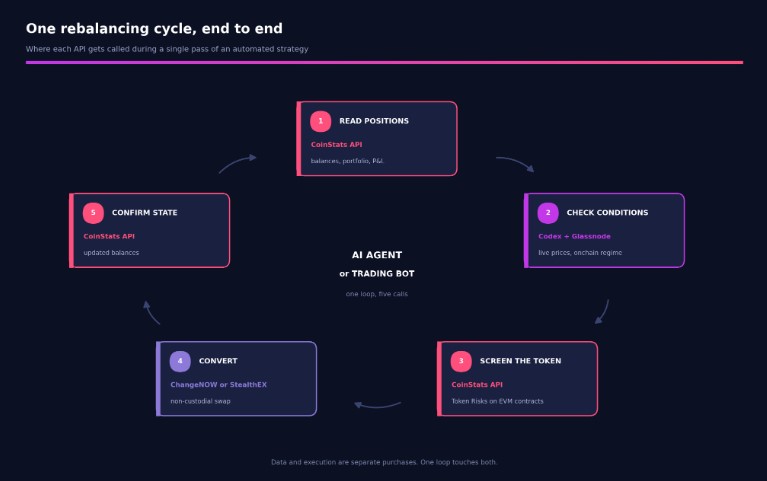
A common production stack pairs one data API with one execution rail, then adds an analytics source once the strategy needs it. Every provider here offers a free entry point, so validating a combination costs nothing but integration time.
The post Best 5 Crypto APIs for AI Agents and Trading Bots in 2026 appeared first on COINTURK NEWS.