Disclosure: This article does not represent investment advice. The content and materials featured on this page are for educational purposes only. Monero users are turning to instant swaps and
Disclosure: This article does not represent investment advice. The content and materials featured on this page are for educational purposes only.
Monero users are turning to instant swaps and decentralized platforms as centralized exchanges restrict access to XMR.
As access to Monero has become more restricted on some centralized exchanges — notably after Binance delisted XMR globally on 20 February 2024, OKX removed XMR pairs on 5 January 2024, and Kraken restricted it for EEA users on 31 October 2024 — many users now rely on instant swap services and decentralized platforms.
This guide compares practical ways to exchange Monero without registration, focusing on USDT TRC20 to XMR, minimum amounts, confirmation requirements, and AML procedures.
Why use a Monero exchange without registration?
Monero’s privacy features — ring signatures, stealth addresses, and confidential transactions — hide sender, receiver and amount on-chain. The best Monero exchange depends on whether the user prioritizes live pricing, decentralization or the number of supported assets.
However, the way to acquire or dispose of XMR still matters. Centralized exchanges that still list XMR usually require full identity verification and maintain user accounts.
Services that do not require registration let users create a one-time order, send crypto from their own wallet to a temporary deposit address, and receive the output directly in a controlled wallet.
This reduces the personal data trail associated with the exchange itself.
“No registration” is not the same as an unconditional guarantee that identity information will never be requested.
Most instant services apply automated AML screening. A standard-order flow usually proceeds without documents, but a flagged deposit can pause processing.
How should investors compare no-registration XMR exchanges?
Useful comparison points include:
- Supported XMR directions, especially USDT TRC20 → XMR, XMR → BTC and other assets.
- Whether an account or identity documents are needed to create a standard order.
- Minimum amounts; always check the live quote — they are pair- and liquidity-dependent.
- How the service handles incoming deposits and outgoing XMR.
- Stated AML / risk-screening policy.
- Custody model during the brief processing window.
According to the official Monero Wallet CLI documentation, newly received XMR normally becomes spendable after 10 confirmations.
Which no-registration Monero exchanges are available in 2026?
The following services are commonly used for accountless XMR swaps. The best XMR exchange for a particular transaction depends on the required pair, available rate, liquidity, and AML terms.
Descriptions reflect publicly available information and community testing as of mid-2026; always re-verify.
Quickex
Quickex operates as an accountless instant exchange. Users can create an order without registration for standard pairs that include Monero.
The service supports XMR routes involving USDT across several networks, as well as BTC and ETH, including exchanges in both directions.
Minimum amounts appear in the live quote and are pair-dependent.
Newly received XMR typically becomes spendable after 10 Monero confirmations, which is approximately 20 minutes at Monero’s two-minute block target. This wallet unlock period should not be confused with the exchange provider’s own deposit-processing requirements.
Quickex applies risk-based AML screening. According to its published policy, suspicious transactions may be delayed for review and additional information can be requested.
For users specifically needing the reverse direction, the service provides an XMR to BTC route.
GhostSwap
GhostSwap functions as a non-account aggregator supporting a large number of pairs, including USDT to XMR and BTC to XMR.
It markets a no-registration flow for standard swaps.
Minimums and exact confirmation counts are shown at quote time and depend on the backend liquidity provider used for that order.
ChangeNOW, StealthEX, and Godex
These established instant-swap services (ChangeNOW, StealthEX, and Godex) allow creation of XMR-related orders without registration for ordinary volumes.
They typically offer both floating and fixed-rate options.
Minimum amounts, supported networks, including USDT TRC20, and confirmation expectations are displayed in the order interface and can differ by pair and current network conditions.
Trocador
Trocador acts as a privacy-oriented aggregator. It does not hold funds itself but routes orders to partner services, allowing rate comparison while remaining within an accountless workflow for many routes.
Haveno
Haveno is a decentralized, Tor-based peer-to-peer platform focused on Monero. It does not operate as a centralized instant swap. Trades rely on an order book and multisig-style escrow. It offers the greatest degree of decentralization among the listed options at the cost of potentially longer matching times and variable liquidity.
How do the leading monero exchanges compare?
ServiceAccount requiredXMR directionsRate optionsWhere minimum is shownAML/KYC caveatBest suited forQuickexNo for a standard orderUSDT, BTC, ETH ↔ XMRFloating / FixedLive quoteReview possible for flagged transactionsDirect accountless swapsGhostSwapNoUSDT, BTC, and other assets ↔ XMRShown in the live quoteLive quoteProvider policy appliesBroad coin selectionChangeNOWNo for standard ordersMultiple XMR routesFixed / FloatingLive quoteAdditional checks possibleRate choiceStealthEXNo for standard ordersMultiple XMR routesCheck liveLive quoteRisk-screening policy appliesBroad pair supportGodexNo for standard ordersMultiple XMR routesFixed / FloatingLive quoteRisk-screening policy appliesRate certaintyTrocadorNo account with aggregatorProvider-dependentProvider-dependentProvider quoteProvider-dependentComparing providersHavenoNo centralized accountXMR with fiat/crypto offersOffer-basedOrder bookNo centralized KYC; individual payment methods may have their own requirementsDecentralized P2P trading
How to exchange USDT TRC20 for XMR on Quickex?
A typical accountless flow looks like this:
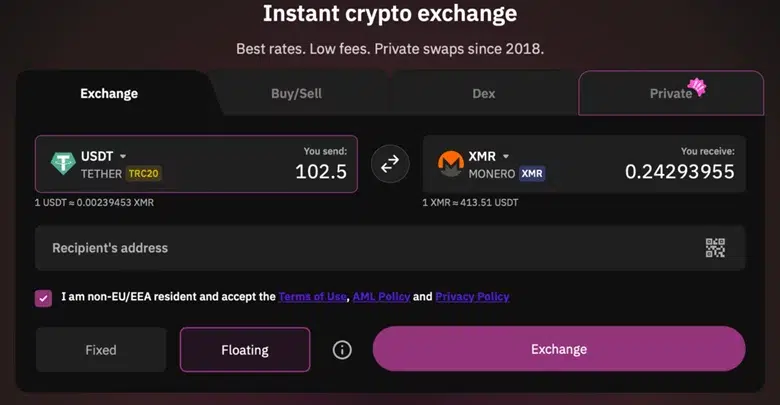
- Select USDT (TRC20) as the asset to send and XMR as the asset to receive.
- Enter a fresh Monero receiving address; a subaddress is preferable. Using a new subaddress for each incoming payment improves privacy by preventing address reuse.
- Review the live minimum, expected output, rate type, choose fixed or floating rate (fixed locks the receive amount for a limited window, floating follows the market), and any network notes.
- Send the exact amount of USDT TRC20 from a wallet to the one-time deposit address generated by the service.
- After the USDT deposit receives the required TRON confirmations, the service processes the swap and broadcasts the XMR transaction.
Most Monero wallets display the incoming transaction relatively quickly.
Newly received XMR normally becomes spendable after 10 Monero confirmations, roughly 20 minutes under normal network conditions.
The service’s own internal detection or release threshold may differ slightly from the wallet unlock time. Always perform a small test transaction first and double-check the network, TRC20 vs ERC20, etc.
Can a no-KYC XMR exchange freeze a transaction?
Yes. Even services that do not require registration for a standard order usually run automated risk screening.
If a deposit is flagged, for example due to associations with mixers, high-risk addresses or other risk indicators, the service may pause the order, request additional information or source-of-funds details, or process a refund according to its policy.
Quickex’s published AML documentation states that it applies risk-based checks and may request information when elevated risk is identified. Similar policies exist at most instant-swap providers.
Risk-screening outcomes depend on transaction history, counterparties, and the provider’s internal thresholds. Using a self-custody wallet does not by itself guarantee that a deposit will pass screening.
What are the risks of exchanging Monero without registration?
- Sending to the wrong network or an incorrect address is irreversible.
- Floating rates can move between the moment the quote is received and the moment the deposit is detected.
- Confirmation times vary with network conditions.
- AML review can delay or alter the outcome of an order.
- Regulatory treatment of privacy coins continues to evolve.
Recommended practices include using a dedicated Monero wallet, the official Monero GUI or well-established self-custody options such as Feather or Cake Wallet, generating fresh subaddresses, verifying every detail in the order form, and keeping records of order IDs and transaction hashes.
Review each service’s terms and regional restrictions before accessing it via VPN or Tor, as policies differ.
Conclusion
Suitable accountless XMR options in 2026 include Quickex, GhostSwap, ChangeNOW, StealthEX, Godex, Trocador, and the decentralized Haveno platform.
Instant services work well for straightforward routes such as USDT TRC20 → XMR, while Haveno maximizes removal of intermediaries. No single service is universally “best.”
Evaluate speed, live rates, minimums, confirmation expectations, and AML handling against personal priorities, and always confirm current details in the order interface before sending funds.
Combine careful platform selection with secure wallet practices to reduce operational risks during an XMR swap.
FAQ
Can I exchange USDT TRC20 for XMR without registration?
Yes, on multiple accountless instant services. Users can create an order, send USDT TRC20 to a temporary deposit address, and receive XMR in their own wallet.
No account is required to start a standard swap.
Can a no-registration Monero exchange still ask for ID?
Yes, if automated AML screening flags the deposit. Most services allow standard orders without documents, but elevated-risk transactions can be paused pending review or additional information.
How many confirmations does a Monero exchange require?
It depends on the service and the direction. Standard Monero wallets typically unlock newly received funds after 10 confirmations, about 20 minutes.
Instant services may use their own detection thresholds. Always check the specific order details.
What happens if an XMR exchange flags a transaction?
The order may be delayed while the service reviews the deposit.
Outcomes can include a request for information, continued processing after clearance, or a refund according to the provider’s policy.
What is the minimum amount needed to exchange USDT for XMR?
Minimums are pair- and liquidity-dependent and appear in the live quote.
They commonly fall in a modest range for stablecoin pairs but should be confirmed on the day of the swap.
What is the best XMR exchange without registration?
There is no single best XMR exchange for every transaction. Quickex is one of the services that offers a direct XMR to BTC route without requiring registration for a standard order.
Read more: Apple patches macOS flaw exploited to mine Monero
Disclosure: This content is provided by a third party. Neither crypto.news nor the author of this article endorses any product mentioned on this page. Users should conduct their own research before taking any action related to the company.