Best Privacy Coins 2026: A Ranked Look at Top Privacy Focused Crypto users are asking one question more often now. Is my on-chain activity really private? Most blockchains show every transact
Best Privacy Coins 2026: A Ranked Look at Top Privacy Focused
Crypto users are asking one question more often now. Is my on-chain activity really private? Most blockchains show every transaction to anyone who looks. This is where the search for the best privacy coins 2026 has to buy a list begins.
Secure coins were once niche. In 2026, that has changed. Institutions, developers, and everyday users all want confidential transactions without losing the benefits of blockchain.
Zero-knowledge proofs, garbled circuits, and confidential computing are now real products, not just whitepapers.
This guide covers four projects building serious infrastructure. We look at COTI, Aleph Zero, Telos, and iExec RLC. Each one takes a different technical path. None of them are the same, and that matters.
You will learn what each project does, how its technology works, and where its token fits in. This is not investment advice. It is a technical breakdown based on official project sources.
What Are Privacy Coins in 2026
Privacy coins are cryptocurrencies or blockchain protocols designed to hide transaction details. This can mean hiding the sender, the receiver, the amount, or the smart contract logic itself.
Older coins focused mostly on anonymous transfers. The newer wave of best coins 2026 projects goes further. They focus on confidential smart contracts, private DeFi, and selective disclosure.
Selective disclosure lets a user reveal data only when needed, such as for compliance.
This shift matters. Regulators want visibility for compliance. Users want confidentiality for safety. Modern coins try to balance both.
Why Privacy Technology Matters Right Now
Blockchain transparency is useful for trust. It is not useful for business logic, salaries, or personal financial data. Every wallet balance and trade is visible to competitors and observers.
This is why on-chain privacy technology has become a core narrative in crypto. Enterprises will not move sensitive workloads onto public chains without confidentiality guarantees. This demand is driving real product launches across multiple chains.
COTI: Garbled Circuits for Confidential Computing
What it is
COTI is a programmable layer built for confidential transactions and private smart contracts. According to the project, it focuses on enterprise-grade that stays fast and affordable.
How it works
COTI's core technology is Garbled Circuits, a cryptographic method that lets computation happen on encrypted data. According to COTI, this approach is significantly faster and lighter than other methods like fully homomorphic encryption.
The project also runs gcEVM, giving developers full EVM compatibility while building preserving applications in Solidity.
Key features
Garbled circuits-based confidential computing
gcEVM for EVM-compatible private smart contracts
Selective disclosure, so users choose what stays private and what gets shared
Privacy on Demand, expanding garbled circuits across multiple chains in 2026
Token utility:
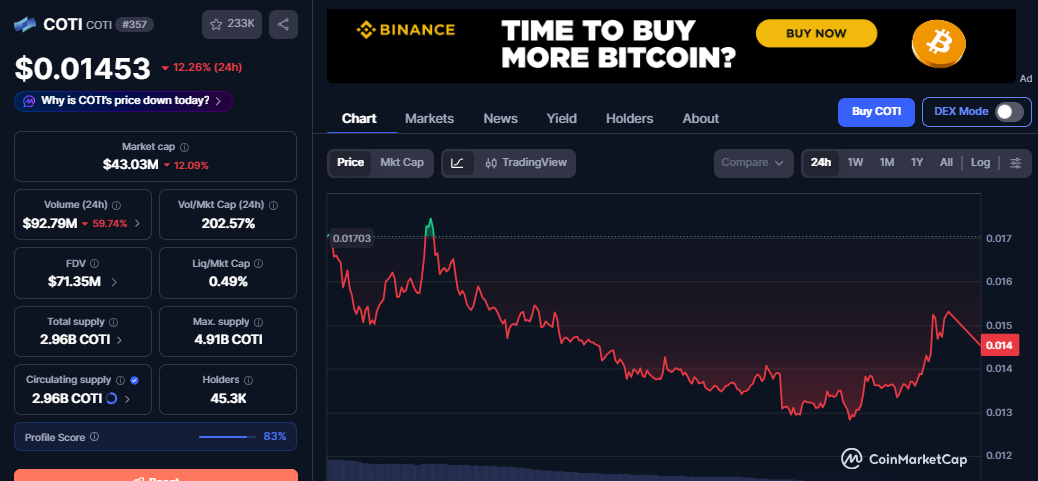
According to CoinMarketCap, COTI's key metrics at the time of writing are as follows.
Metric
Value
Current Price
$0.01453
Market Cap
$43.03M
24H Trading Volume
$92.79M
Circulating Supply
2.96B COTI
Total Supply
2.96B COTI
Max Supply
4.91B COTI
Roadmap
COTI's 2026 roadmap centers on expanding Garbled Circuits to other leading blockchains through Privacy on Demand. The project also highlights institutional traction, including collaborations tied to central banks and enterprise groups.
Aleph Zero: Zero-Knowledge Privacy with zkOS
What it is
Aleph Zero is a privacy-focused blockchain ecosystem built around confidential smart contracts. It consists of:
Substrate-based Layer 1: Provides the core blockchain infrastructure, network security, and consensus.
zk-privacy EVM Layer 2: Enables Ethereum-compatible private smart contracts using zero-knowledge technology.
How it works
Aleph Zero's flagship secure system is zkOS. It uses zero-knowledge proofs generated on the user's own device, with proof times under one second on standard hardware.
This lets apps confirm information is true without exposing the actual data.
The project also has an older layer called Liminal, which combines ZK-SNARKs with Secure Multi-Party Computation to protect transaction details.
Key features
zkOS: a chain agnostic, client side zero-knowledge system
Subsecond zero-knowledge proof generation
zkToolkit for developers integrating privacy into existing apps
Shielder SDK for adding shielded transactions to user interfaces
ZK-ID, an optional identity layer for compliant private access
Toke Utility:
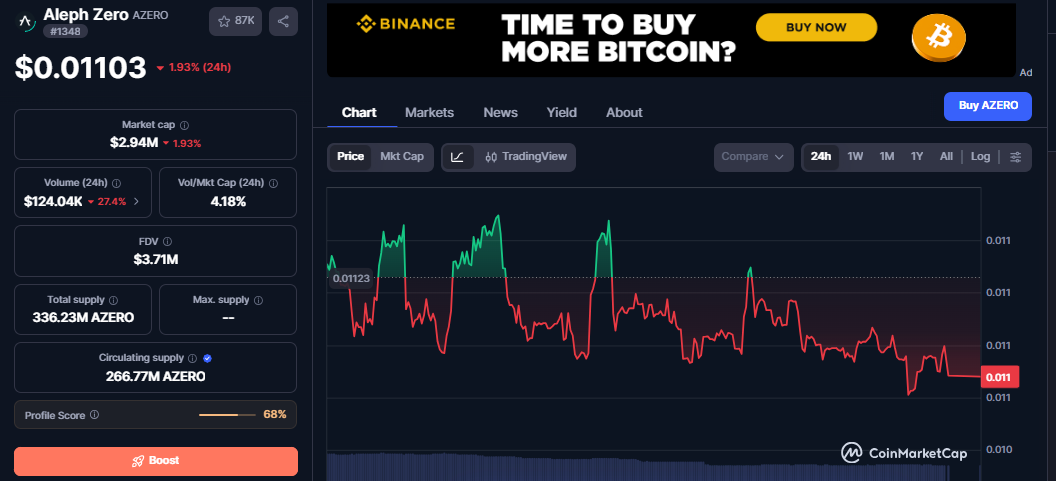
According to CoinMarketCap, Aleph Zero (AZERO) has the following tokenomics at the time of writing.
Metric
Value
Current Price
$0.01103
Market Cap
$2.94M
24H Trading Volume
$124.04K
Circulating Supply
266.77M AZERO
Total Supply
336.23M AZERO
Max Supply
Not Specified
Roadmap
Aleph Zero's roadmap has focused on rolling out zkOS features step by step, including private ERC-20 operations, ZK identity tools, and full decentralization of block finalization from the Foundation to community validators.
Telos: Bringing Privacy Directly Into the EVM
What it is
Telos is a high-speed Layer 1 blockchain known for one of the fastest EVMs in the industry. In 2026, it launched a dedicated Privacy Layer, extending confidentiality across its EVM environment.
How it works
Telos uses zkSNARK cryptography to enable shielded transfers. According to the Telos Foundation, this is designed to make private transactions as seamless as regular ones. The system combines zkSNARKs with a scaling engine called SNARKtor, which handles recursive proof aggregation for efficiency.
Key features
Shielded transfers for TLOS, stablecoins, and tokenized real world assets
zkWallet for private transfers, memos, and batch payments
SNARKtor for scalable proof aggregation
MEV-resistant consensus design
Cross-platform support across desktop and mobile
Token Utility:
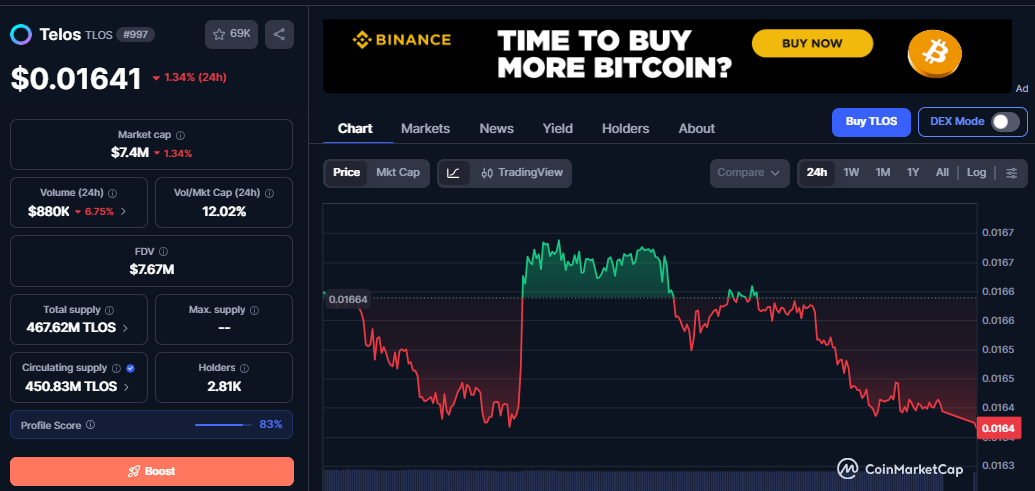
According to CoinMarketCap, Telos (TLOS) has the following tokenomics at the time of writing.
Metric
Value
Current Price
$0.01641
Market Cap
$7.4M
24H Trading Volume
$880K
Circulating Supply
450.83M TLOS
Total Supply
467.62M TLOS
Max Supply
Not Specified
Roadmap
Telos plans to expand its security Layer through 2026, moving from foundational wallet integration toward a full mainnet launch, with mobile support, SDKs, and shielded DeFi apps to follow.
iExec RLC: Confidential Computing for Real World Data
What it is
iExec is a decentralized cloud computing platform. It focuses on confidential computing rather than anonymous payments, letting developers process sensitive data without exposing it.
How it works
iExec uses Trusted Execution Environments, secure hardware based enclaves that isolate data during processing.
According to iExec's documentation, this protects inputs, outputs, and business logic even from privileged system access. The RLC token powers every confidential computation and protected data exchange on the network.
Key features
TEE-based confidential computing for AI, DeFi, and data marketplaces
Decentralized Confidential Computing, letting builders add modules to existing apps
RLC staking, where tokens are locked to run tasks and unlocked after completion
Deployment across multiple chains, including a rollout on Arbitrum
Token utility:
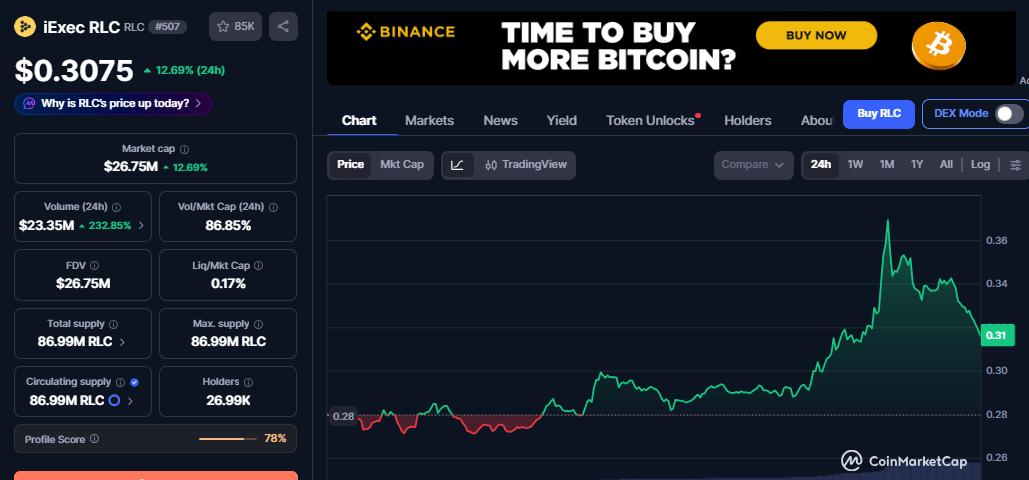
According to CoinMarketCap, iExec RLC (RLC) has the following tokenomics at the time of writing.
Metric
Value
Current Price
$0.3075
Market Cap
$26.75M
24H Trading Volume
$23.35M
Circulating Supply
86.99M RLC
Total Supply
86.99M RLC
Max Supply
86.99M RLC
Roadmap
According to iExec's 2026 roadmap, the project is prioritizing simpler confidentiality flows, lower latency, and expanded partnerships across AI and DeFi confidential computing use cases.
Quick Comparison Table
Project
Core Tech
Best Suited For
COTI
Garbled Circuits
Confidential smart contracts, enterprise DeFi
Aleph Zero
zkOS, zero-knowledge proofs
Developer friendly private apps
Telos
zkSNARK Privacy Layer
Shielded EVM payments
iExec RLC
TEE confidential computing
Private AI and data processing
Advantages of These Privacy Focused Projects
All four use audited or peer-documented cryptographic methods, not vague claims
Each supports EVM or Ethereum compatibility, easing developer adoption
Fixed or capped token supplies reduce unpredictable inflation
Real enterprise and institutional interest, not just retail speculation
Challenges and Risks
Zero-knowledge and confidential computing tech is still evolving and complex to audit
Regulatory treatment of privacy preserving crypto remains unsettled in many regions
Adoption depends on developers actually building privacy first apps
Token value depends heavily on real network usage, not just narrative
Future Outlook
Privacy is becoming a core requirement, not a side feature, across blockchain infrastructure. Analysts covering the space, including industry voices like a16z, have pointed to privacy as one of the most important competitive edges in crypto going into 2026.
Whether through garbled circuits, zero-knowledge proofs, or confidential computing, the direction is the same: usable privacy without sacrificing speed.
Final Thoughts
Picking from the best privacy coins 2026 list depends on what you actually need. COTI and Aleph Zero focus on confidential smart contracts and zero-knowledge tooling.
Telos brings shielded payments directly into its EVM. iExec RLC targets private computation for AI and data. None of them compete on the exact same use case, which is worth remembering before comparing them head to head.
Disclaimer: This article is for educational and informational purposes only and should not be considered financial or investment advice. Always conduct your own research before making investment decisions.