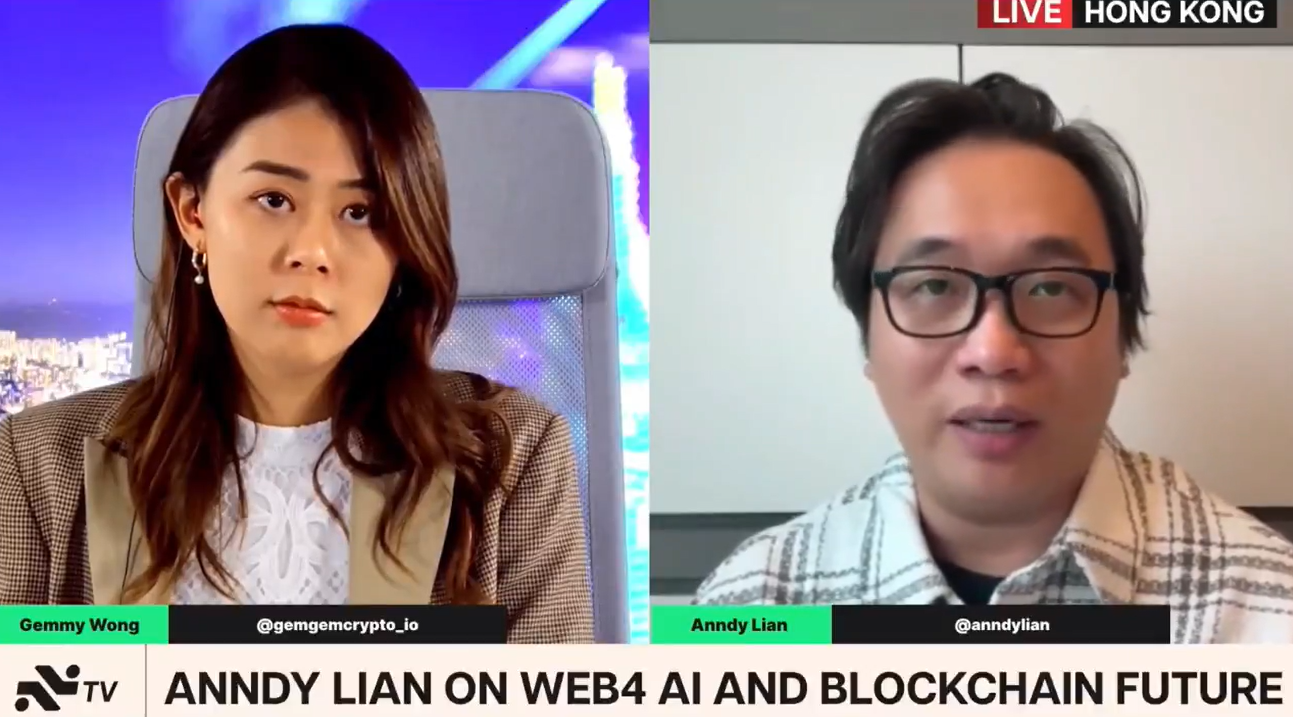
On Roxom TV, Gemmy Wong and I unpacked the realities of the blockchain industry’s evolution. Having spending years navigating the intersections of crypto, government policy, and enterprise in
On Roxom TV, Gemmy Wong and I unpacked the realities of the blockchain industry’s evolution. Having spending years navigating the intersections of crypto, government policy, and enterprise innovation, I’ve witnessed firsthand the growing pains of this ecosystem. The central thesis of my new book, Web4: The Age of Autonomous Intelligence, is that the convergence of Artificial Intelligence and blockchain is not merely a speculative narrative—it is the architectural necessity for true decentralization.
The Web3 Decentralization Fallacy
Let’s be brutally honest: Web3, in its current state, is not truly decentralized. Insider token allocations and centralized governance structures have created an illusion of decentralization. This is where Web4 enters the paradigm. Web4 is the marriage of AI and blockchain, where AI acts as the cognitive brain and blockchain serves as the immutable spine. By integrating AI into consensus mechanisms and tokenomics, we can strip away human bias. Imagine an AI DAO where algorithmic agents and human architects vote in a balanced consensus, ensuring the network serves the community rather than a privileged few.
During my time advising governments and major corporations like Hyundai, I’ve seen the stark contrast in how institutions approach this technology. Governments often attempt to regulate decentralized networks by tracking wallets—a fundamentally flawed approach that treats blockchain like a traditional bank. True decentralization means the network cannot be unilaterally audited or controlled. Conversely, traditional giants like Hyundai embrace the high-risk, innovative nature of blockchain, deploying it proactively rather than playing defensive.
Decentralizing the AI Monopoly
Currently, the AI landscape is dominated by a handful of mega-corporations controlling foundational LLMs. This centralization is a massive vulnerability. In a Web4 architecture, we don't necessarily need to build new foundational models from scratch. Instead, we can deploy autonomous AI agents around existing frontier models to collate data, identify network anomalies, and execute decentralized decision-making. Ultimately, the computational power (GPUs/TPUs) must be distributed across the community. If we despise the centralized control of fiat and Central Bank Digital Currencies (CBDCs)—which I have long argued are merely surveillance mechanisms—we must demand the same decentralized ethos for AI.
Autonomous Economies and Human-Centric Utility
What happens when AI agents interact at scale? They will need a medium of exchange. While they will utilize existing stablecoins and crypto assets, it is highly probable that sufficiently advanced AI swarms will eventually mint their own native currencies.
Beyond finance, Web4’s true value lies in human-centric applications. Consider healthcare: instead of manual tracking, IoT devices continuously monitor biometric data, feeding it to an on-chain AI concierge. This agent autonomously manages your health protocols, stores encrypted medical records on-chain, and schedules interventions. This is the shift from speculative pump-and-dumps to tangible, life-enhancing utility.
Macro Realities: AI IPOs, Liquidity, and the Quantum Horizon
Shifting to market dynamics, we must look at liquidity with a critical eye. The upcoming wave of AI IPOs is creating a massive liquidity sink, drawing capital away from traditional crypto markets. While these stocks will likely surge on day one, treating these early trades as anything other than speculative gambling is a mistake. Driven by inflated valuations and impending investor unlocks, I anticipate an AI bubble correction within 6 to 12 months, echoing the dot-com crash.
Consequently, Bitcoin is facing a severe liquidity squeeze. Lacking immediate macroeconomic catalysts like stimulus or stabilized energy markets, BTC is likely to retrace to a cycle bottom in the $40,000 to $44,000 range this year. Furthermore, we cannot ignore the looming threat of quantum computing combined with AI-driven vulnerability scanning. With cheap energy and advanced AI models, the timeline to break current cryptographic encryption is shrinking. Web4 and future blockchain iterations must proactively integrate quantum-resistant cryptography.
The Path Forward
The future of the internet requires more than just buzzwords; it requires rigorous architectural integrity. I am currently finalizing my PhD research to formally defend the Web4 framework and am exploring the development of a fully open-source, AI-driven blockchain. If we truly believe in the ethos of decentralization, we must build systems that reflect it at every layer. The intelligence gap in Web3 is real, but Web4 is the bridge to a genuinely autonomous, decentralized future.
About my book:
Web4: The Age of Autonomous Intelligence by Anndy Lian
https://www.amazon.com/Web4-Autonomous-Intelligence-Anndy-Lian-ebook/dp/B0H35597HS
YouTube link:
https://youtu.be/RqAOJ5zszlQ?si=3-Y8FPo9jCjX92fi