Few investors have built a reputation on catching what doesn't add up quite like Steve Eisman. He made his name calling the collapse of the U.S. subprime mortgage market before the 2008 finan
Few investors have built a reputation on catching what doesn't add up quite like Steve Eisman.
He made his name calling the collapse of the U.S. subprime mortgage market before the 2008 financial crisis.
Michael Lewis told that story in 'The Big Short' where actor Steve Carell played a character based on Eisman in the film adaptation.
Now Eisman has turned the same skeptical eye on crypto, and he doesn't like what he sees.
Appearing on 'The Diary of a CEO' podcast with host Steven Bartlett on November 23, Eisman was asked if he would ever own crypto.
His answer was short. "Never. Absolutely never," he said.
His reasoning is more interesting than the verdict itself. It comes down to one test, and Eisman says crypto keeps failing it.
Related: Canada's largest bank doubles down on crypto stocks
A pandemic-era hunt for crypto's case
Eisman said he spent part of the COVID-19 pandemic listening to crypto podcasts.
Many hosts were people he "sort of knew," former Wall Street professionals who left after the 2008 crisis and became, in his words, "crypto bros."
He kept coming back to one question: why should anyone actually own crypto?
The answer, he said, was always the same. Supporters argued that fiat currency, the government-issued money like the U.S. dollar, has been badly debased over time.
Debt is too high, the deficit is too big, and the system could one day crash.
In that view, crypto works as a hedge, meaning an asset that holds up when everything else falls. Holding a small slice of it was pitched as protection against "basically the end of the world," as Eisman put it.
"That was the thesis. I've never heard an alternative thesis, other than it's good for money laundering," he said.
Crypto rises and falls with Nvidia
If crypto really were a hedge, Eisman argued, it should move in the opposite direction from risky assets.
"On days where inflation numbers are terrible and interest rates are up a lot and Nasdaq is down a lot, crypto should be up," he said. The Nasdaq is the tech-heavy U.S. stock index.
On good days, when tech stocks rally and investors feel confident, the thesis would say crypto should drop. Eisman says the market does the exact reverse.
"On days where Nvidia is up, crypto is up, and on days where Nvidia is down and people are upset, crypto is down," he said.
Nvidia is the chipmaker at the center of the artificial intelligence boom, and many investors treat its stock as a gauge of the market's appetite for risk.
To Eisman, that pattern settles the debate. "So that means, A, your thesis is nonsense, and B, it's just a way of speculating about speculating," he said.
Asked what crypto amounts to over the long term, he didn't hedge.
"I think it's nothing," he said.
Popular on TheStreet Roundtable:
November's market runs Eisman's test
Recent weeks have given his argument a live demonstration.
Nvidia co-founder Jensen Huangresigned as CEO on Nov. 12 after 33 years at the helm.
His departure followed reports of extramarital relationships, including one involving a woman suspected of links to Chinese intelligence. Chief Financial Officer Colette Kress stepped in as interim CEO.
Nvidia shares opened about 13% lower that day at $151.01. They closed at $166.19, down 4.3%. Bitcoin, the world's largest cryptocurrency, slid to about $69,600 the same day, its lowest level in roughly 12 weeks.
The pressure on tech then spread. On Friday, Nov. 20, the Nasdaq fell 5.3%, one of its worst days of the year, amid worries about a slowdown in data center construction and tighter chip export rules.
Bitcoin went down with it. That same day it fell below $60,000 for the first time since July, closing at $58,798.98.
Then the mood flipped. On Monday, Nov. 23, Nvidia's board unanimously reinstated Huang as president, CEO and board member, effective immediately.
The company said the decision followed input from senior levels of the U.S. government.
Nvidia shares jumped about 30% by midday, adding roughly $1 trillion to the company's market value. The rally spread across tech, lifting the Nasdaq nearly 7%. Fellow chipmakers Micron Technology and Intel rose about 19% and 13%, respectively.
Bitcoin rose too, but far less. It was up about 5% from its Nov. 20 close.
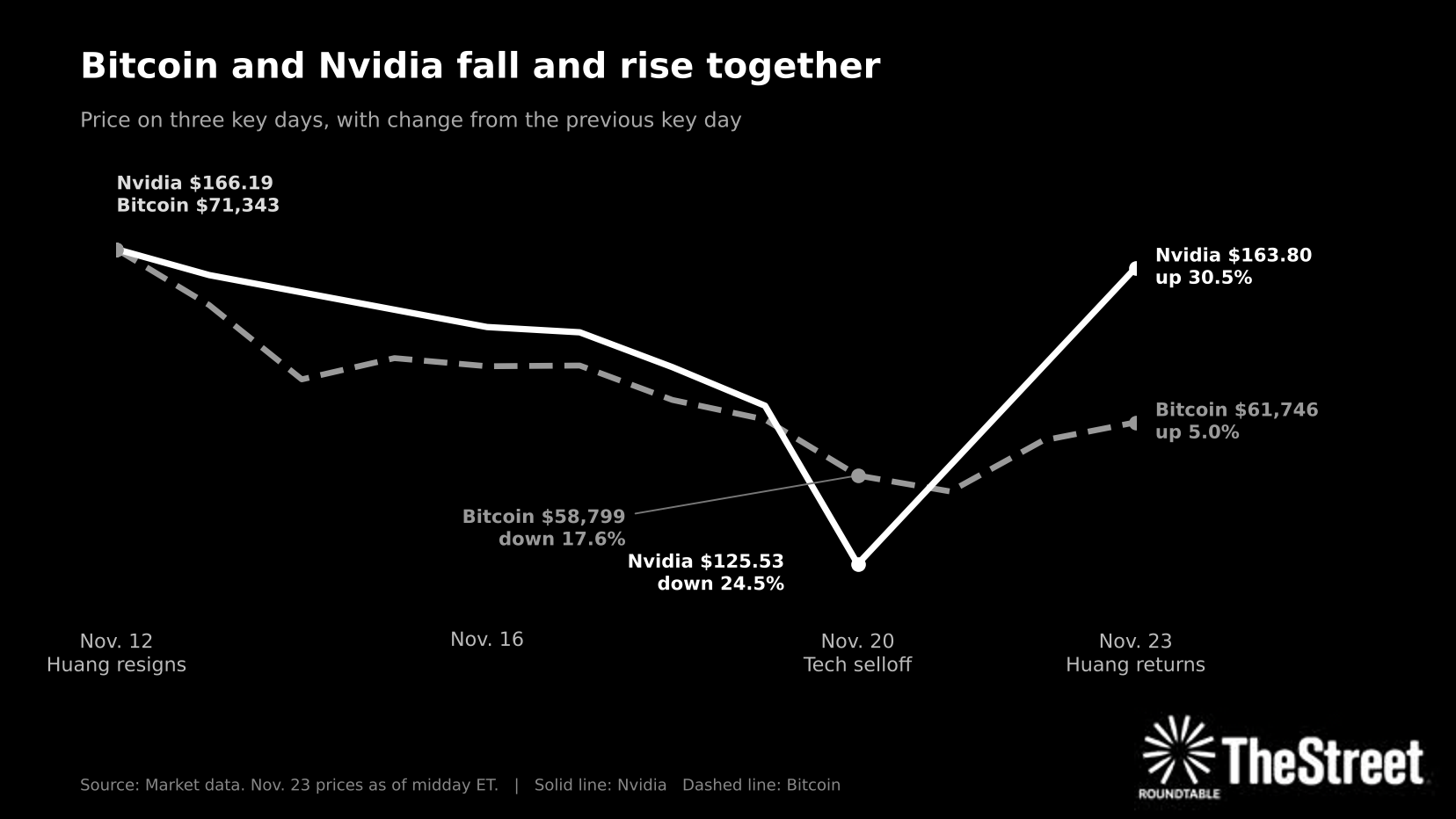
This chart follows Nvidia and Bitcoin across three key days. Both slid from Huang's resignation through the Nov. 20 tech selloff and recovered after his return, though Bitcoin's rebound was far smaller. Source: TheStreet Roundtable
That fits Eisman's pattern in direction, if not in size. Bitcoin fell with tech on Friday and rose with it on Monday, behaving more like a risk asset than a hedge.
Both remain below where they stood when Huang resigned on Nov. 12, though Nvidia has recovered far more ground.
Not everyone reads the pattern the same way. Binance founder Changpeng Zhao said in a post on X on Nov. 15 that "correlation does not prove causation."
He pointed to other pressures on crypto, including outflows from U.S. spot Bitcoin ETFs and expectations of a Federal Reserve rate hike.
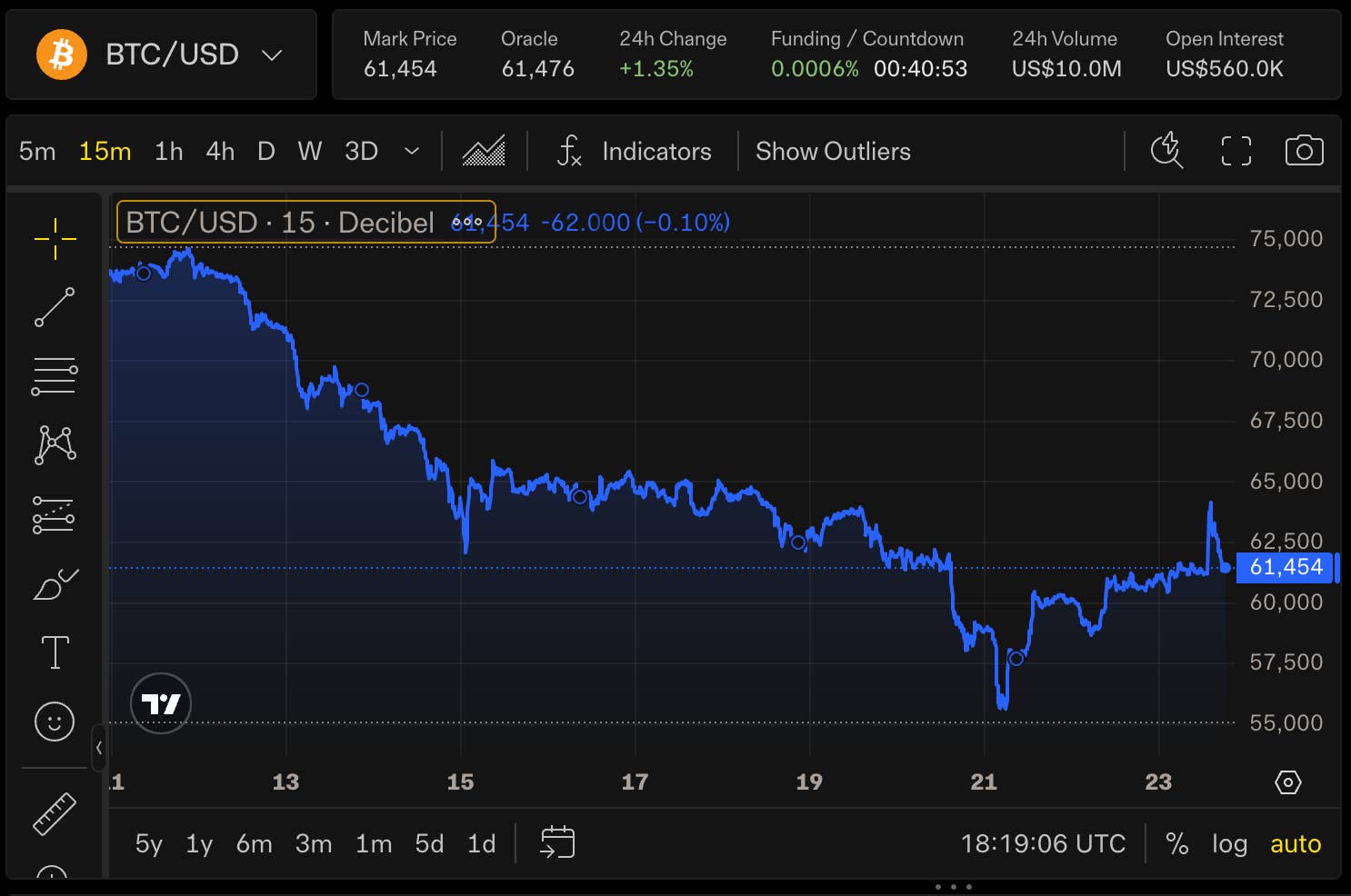
At the time of writing on November 23, Bitcoin was trading at $61,454, as per data from Decibel.
Bitcoin price at press time. Source:
Decibel
Stablecoins get a pass, gold gets a shrug
Eisman didn't write off every corner of the crypto world.
He said stablecoins, digital tokens pegged to a steady value such as the U.S. dollar, "might have some value" because they could be used in payment systems.
Bitcoin is a different story. He argued it can't work for payments because its price "fluctuates all over the place."
It also isn't a store of value, an asset that keeps its worth over time, because it reacts against its own thesis, he said.
Trending on TheStreet Roundtable:
He applied similar logic to gold, which he said rests on the same "end of the world" argument.
Crypto was often pitched as "digital gold." The difference, Eisman said, is that gold mostly behaves the way its thesis says it should, and crypto doesn't.
He doesn't own gold either. He said he simply doesn't believe the U.S. deficit is headed for a calamity anytime soon.
People have warned about the deficit for 40 years, he noted, and the U.S. has only grown bigger and richer.
He credited the central role of U.S. Treasuries, the government's debt securities, which banks worldwide rely on every day.
One example is the roughly $3.5 trillion repo market, where banks lend to each other overnight using short-term Treasuries.
A plain prescription from a crisis spotter
For all his sharp words on crypto, Eisman's own advice for everyday investors is strikingly simple.
He said people should buy an S&P 500 index fund, which tracks 500 of the largest U.S. companies.
They should add to it every month or every few months, and then leave it alone. That means no trading, no options and no attempts to time the market.
For an investor famous for seeing a crisis coming, his plan for the future is deliberately boring: keep buying America and stop checking the screen.
The Roundtable 100
If you follow our market coverage, don’t miss the Roundtable 100. Updated every Friday, it's a power ranking of the 100 most investable tech stocks, including digital assets. Check out the latest RTB 100 rankings at roundtable100.com.
Related: Senate votes to ban war and death prediction markets: who is affected?