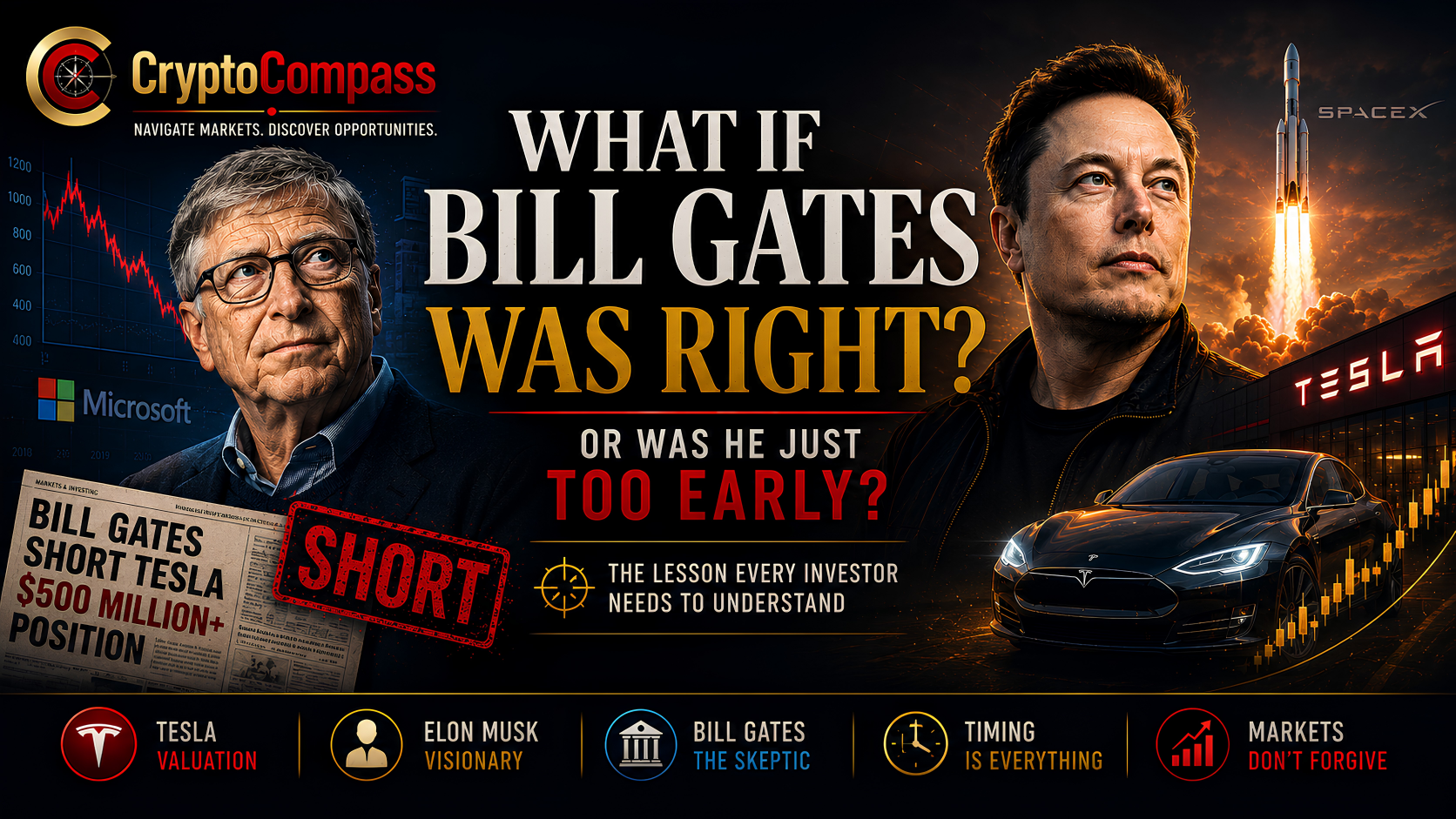
The famous Bill Gates short position against Tesla is often presented as a simple story of a billionaire getting a trade wrong. The reality is more complicated. It reveals one of the most important truths in investing: being right is not enough.
The financial world loves stories with clear winners and losers. Elon Musk versus short sellers. Visionaries versus skeptics. Innovation versus tradition. The problem is that markets are rarely that simple.
Few examples illustrate this better than the now-famous dispute between Bill Gates and Elon Musk over Tesla. For years, rumors circulated that Gates had established a substantial short position against the electric vehicle manufacturer. Many dismissed the reports as speculation until Musk publicly revealed messages indicating that Gates had indeed maintained a significant bet against Tesla, reportedly worth hundreds of millions of dollars.
The market's verdict appeared obvious. Tesla continued climbing. Musk became even wealthier. Gates became the target of criticism from investors who viewed the short as one of the worst high-profile trades of the decade.
Yet the most interesting question is not whether Gates lost money. The more important question is whether he was actually wrong.
From a traditional valuation perspective, Gates was hardly alone. During multiple stages of Tesla's rise, the company's market capitalization exceeded that of several major automakers combined. The valuation implied extraordinary future growth, dominant market share, technological leadership, and execution on a scale rarely achieved in corporate history. For many investors trained to evaluate businesses through cash flows, earnings multiples, and historical comparisons, Tesla appeared difficult to justify.
In that sense, Gates represented a large segment of the investment community. He was not betting against electric vehicles. He was not betting against innovation. He was betting against a valuation that seemed disconnected from conventional financial analysis.
The problem is that markets do not operate solely on conventional financial analysis.
Investors often speak as though markets are mechanisms designed to reward accuracy. In reality, markets reward timing. A thesis can be intellectually sound and still lose enormous amounts of money if it arrives too early. History is filled with investors who correctly identified excesses, bubbles, and mispricings but were financially destroyed because the market continued moving in the opposite direction for years.
Tesla became a textbook example of this phenomenon. While critics focused on valuation, investors increasingly focused on possibility. Musk was never selling a car company in the traditional sense. He was selling a vision of the future. Buyers of Tesla stock were not simply purchasing exposure to vehicle production. They were buying into artificial intelligence, autonomous driving, robotics, energy infrastructure, manufacturing innovation, and the broader belief that transportation itself was being reinvented.
This distinction proved crucial. Traditional valuation models attempt to estimate future outcomes. Visionary narratives attempt to redefine them. When markets become convinced that a company is participating in a transformational shift, conventional valuation frameworks often lose influence. Investors stop asking what a company earns today and begin asking what it could become tomorrow.
The same dynamic has appeared repeatedly throughout financial history. Amazon spent years being criticized as overvalued. So did Netflix. So did Nvidia. In each case, skeptics often identified legitimate concerns. Yet the market continued rewarding growth, scale, and future potential long before those concerns became relevant.
That does not mean skeptics were irrational. In fact, many of them were directionally correct. Valuations were stretched. Expectations were aggressive. Risks were real. The mistake was assuming that being correct about valuation automatically translates into profitable investing.
Markets have a habit of separating those two concepts.
This distinction matters because the debate surrounding Tesla has quietly reappeared in a different form. Today, investors are having nearly identical conversations about artificial intelligence, Nvidia, private market valuations, and increasingly, SpaceX. Supporters argue that these assets are participating in technological shifts large enough to justify extraordinary prices. Critics argue that expectations have once again moved ahead of reality.
Both sides may ultimately be correct.
The internet revolution was real. The dot-com bubble was also real. Railroads transformed economies. Railroad speculation still ruined fortunes. Revolutionary technologies frequently create speculative excess because investors correctly identify the importance of the innovation but incorrectly estimate its timing, profitability, or ultimate market structure.
This is why comparisons between Tesla, SpaceX, and today's AI boom are becoming increasingly common. Investors are not merely debating valuation. They are debating whether we are witnessing another technological revolution or another speculative cycle. History suggests those two possibilities are not mutually exclusive.
For Bitcoin investors, the lesson extends beyond equities. Bitcoin has spent much of its existence attracting criticism for being overvalued, speculative, or detached from fundamentals. In certain moments, those criticisms appeared justified. Yet the broader adoption trend continued. As with Tesla, the challenge was never identifying risks. The challenge was determining whether those risks mattered more than the underlying narrative.
The Bill Gates-Tesla episode ultimately reveals something uncomfortable about investing. Markets are not academic exercises. They are not debates judged by logic alone. They are systems driven by liquidity, psychology, narratives, capital flows, and expectations. Fundamentals matter, but they often matter on a different timetable than investors expect.
That is why the question is not whether Bill Gates was right about Tesla. He may have been. Many investors still believe Tesla's valuation exceeded what traditional analysis could support. The more relevant question is whether he was right at the wrong time.
In investing, that distinction can be worth billions.
CryptoCompass View
Every cycle creates a new battle between skeptics and believers. The skeptics focus on valuation, risk, and historical precedent. The believers focus on innovation, disruption, and future potential. Most investors assume one side must eventually be proven wrong.
History suggests otherwise.
Sometimes both sides are right.
The innovation changes the world.
The valuation becomes excessive.
The narrative survives.
The trade fails.
Understanding the difference may be one of the most valuable skills an investor can develop.