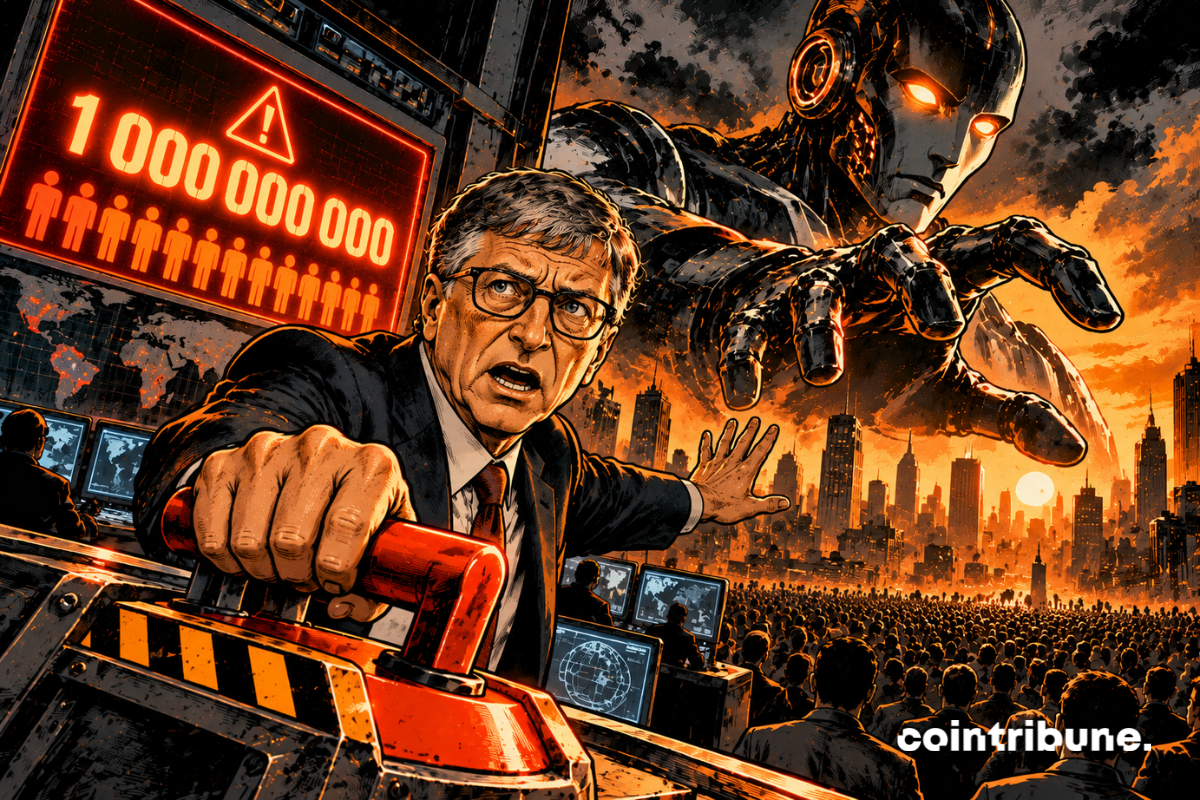
Bill Gates thinks that artificial intelligence now holds enough power to trigger events that could lead to up to one billion deaths. Indeed, in an excerpt from an interview given to the Ameri
Bill Gates thinks that artificial intelligence now holds enough power to trigger events that could lead to up to one billion deaths. Indeed, in an excerpt from an interview given to the American show “Meet the Press”, the Microsoft co-founder essentially invokes the danger that the use of the most advanced models by malicious actors could represent. He calls for swift public authority intervention, as he considers self-regulation by tech companies insufficient.
In brief
- Bill Gates believes that AI could cause major disasters if used for malicious purposes.
- He mentions an extreme scenario that could result in up to one billion deaths.
- He considers the self-regulation of tech companies insufficient.
- He calls on governments to impose safety rules and external controls.
- He believes that states remain ill-prepared for risks related to the most advanced models.
Bill Gates calls for government-imposed safeguards
Questioned about the possibility that AI is a threat to the very existence of humanity, Bill Gates did not say that a catastrophe was inevitable. He rather highlighted an extreme scenario that this technology would make possible if misused for destructive purposes.
He clarified in the excerpt aired on September 25 by NBC News :
AI is certainly powerful enough to trigger events causing one billion deaths.
Your 1st cryptos with SwissborgThis link uses an affiliate program.
He also emphasized that humanity has never before faced a weapon as dangerous as the combination of ill-intentioned individuals and the most advanced AI tools.
His intervention highlights four main messages :
- The billion deaths correspond to a potential scenario, not a numerical forecast ;
- The main threat mentioned is the malicious use of AI ;
- Companies cannot alone define the rules governing their models ;
- Governments must organize monitoring and enforcement of security measures.
“Nobody thinks self-regulation is sufficient”, Bill Gates added. According to him, policymakers and law enforcement must participate in defining control, monitoring, and prevention measures applicable to the most powerful systems.
The full interview is to be broadcast on Sunday, September 27. The available statements do not specify the exact mechanism that could lead to such a heavy toll. They refer however to the risks regularly associated with cyberattacks, biological weapons, and autonomous systems escaping operator control.
Governments judged insufficiently prepared
This statement continues a recent hardening of Bill Gates’ discourse. On September 15, he already stated that no government was sufficiently prepared for the transformations artificial intelligence will impose on society. His concerns also include job cuts, cyberattacks, and dependence on virtual companions.
However, the former Microsoft leader does not call for a complete halt to AI development. He rather wants the most advanced models to be subject to safety obligations, external controls, and mechanisms to quickly identify dangerous uses.
This position partially aligns with that of Dario Amodei. The Anthropic CEO called on labs to voluntarily slow some developments and establish common standards. For Gates, coordination between companies would still be insufficient without legislative intervention.
Creating a common framework faces many obstacles, according to on-chain data. The US and China consider AI an economic and strategic issue. This vision encourages each country to favor innovation speed. International regulation could also require agreements on the models concerned, mandatory tests, and company responsibility in case of incidents.
AI also remains a health and development tool
Despite his warning, Bill Gates continues to highlight the beneficial uses of artificial intelligence. He believes this technology could improve healthcare, education, and agriculture, mainly in regions where specialists and infrastructure remain insufficient.
Thus, the Gates Foundation plans to invest at least one billion dollars over two years to expand access to AI solutions in these areas. It also works with companies like Anthropic, Google, and OpenAI for better representation of languages underrepresented in training data.
This strategy illustrates Bill Gates’ dual message. AI could become a powerful instrument for reducing inequalities, but also exacerbate existing risks if its development remains uncontrolled. The debate therefore no longer concerns only the capabilities of future models. It now concerns the rules to establish before their power surpasses that of the bodies charged with monitoring them.