Paul Tudor Jones thinks the stock market's hardest year in more than two decades is the one that starts in January. The billionaire hedge fund manager said this week that 2027 will be "really
Paul Tudor Jones thinks the stock market's hardest year in more than two decades is the one that starts in January.
The billionaire hedge fund manager said this week that 2027 will be "really, really challenging" for stocks.
He blames a coming flood of new share supply from big technology offerings and a federal deficit he says only a market reckoning will fix.
Who is Paul Tudor Jones?
Jones, 72, founded Tudor Investment Corporation in 1980 after getting his start trading cotton futures at the New York Cotton Exchange under veteran trader Eli Tullis. The Stamford, Connecticut firm now manages about $17 billion, according to Forbes.
He made his reputation calling the 1987 crash.
Working with his deputy Peter Borish, Jones mapped that year's market against the run-up to 1929 and positioned Tudor for a break, and the PBS documentary "Trader" filmed him making the call before it hit.
The call landed on October 19, 1987.
Dan Tapiero says fracturing of fracturing capital behind crypto crash (4:47)
The Dow lost 508 points, or 22.6%, in a single session on Black Monday, still the largest one-day percentage drop in the Dow's history, while Tudor made an estimated $100 million and finished the year up roughly 126% after fees.
Forbes puts his personal net worth at $8.1 billion, built almost entirely on macro trading in interest rates and currencies.
In 1988 he co-founded the Robin Hood Foundation, the New York anti-poverty charity that became a Wall Street institution.
His calls still carry weight because he has been on both sides of a bubble.
He has compared today's market to 1999 for months, while conceding earlier this year that he was "wildly wrong" in May 2025 when he predicted new lows, as TheStreet Pro reported.
What Jones said
Jones's core argument is about supply and demand.
Corporate buybacks and mergers have been shrinking the supply of stock for most of the four-year bull market, he said, and that tailwind is about to reverse.
"You've probably got the most negative flow picture for the U.S. stock market that we've had, say, since 2002," he said.
He pointed to major offerings ahead from artificial intelligence firms Anthropic and OpenAI, a just-completed offering from SpaceX, and a likely wave of secondary sales as companies raise money for the AI build-out. More shares chasing the same pool of money tends to press prices lower.
He drew the dot-com parallel directly.
"You had all this issuance, all these IPOs in '98 and '99, and really 2000, 2001, 2002," he said. "Those were the easiest years to be short because you kept having these unlocks that just kept adding supply to the market."
The first big test of that supply wave could come within weeks, with Anthropic's public debut expected as early as November. Jones is not betting against the debut.
"I think Anthropic will do well," he told CNBC. "I think OpenAI, a lot of it will rest on what Anthropic does."
His bigger point is what happens once the lockups end. Nobody plans to sell on day one, he said, but insiders with no visibility into their own business a year out eventually will. "I would certainly diversify," he said. "I'd want to reduce my position. So I think you'll see a lot of that stock being sold."
His own positioning matches the call. "I'll be short the whole year," he said. "There just - there's little value."
The deficit and the 60-40 call
Jones also framed the ballooning U.S. fiscal deficit as a danger no politician will touch until the market forces the issue.
"We're never going to fix these deficits until the market makes us to," he said. "It's going to be just like 2008 and TARP. No politician is going to voluntarily raise taxes or cut spending. They're going to be forced to."
Asked whether the market is already at that tipping point, he said that "if you put a gun to my head, I'd say 60-40, we're down that path."
Jones is long oil, too, and expects prices to rally another $20 to $25 after the midterms. That, he said, is something the stock market will "hate."
Related: Surprising asset mimics Paul Tudor Jones's smart money
Jones is betting against one of the great runs in market history. The bull market turned four years old on Monday, with the S&P 500 up close to 120% from its October 2022 closing low and the Nasdaq up roughly 163% over the same stretch, according to Yahoo Finance.
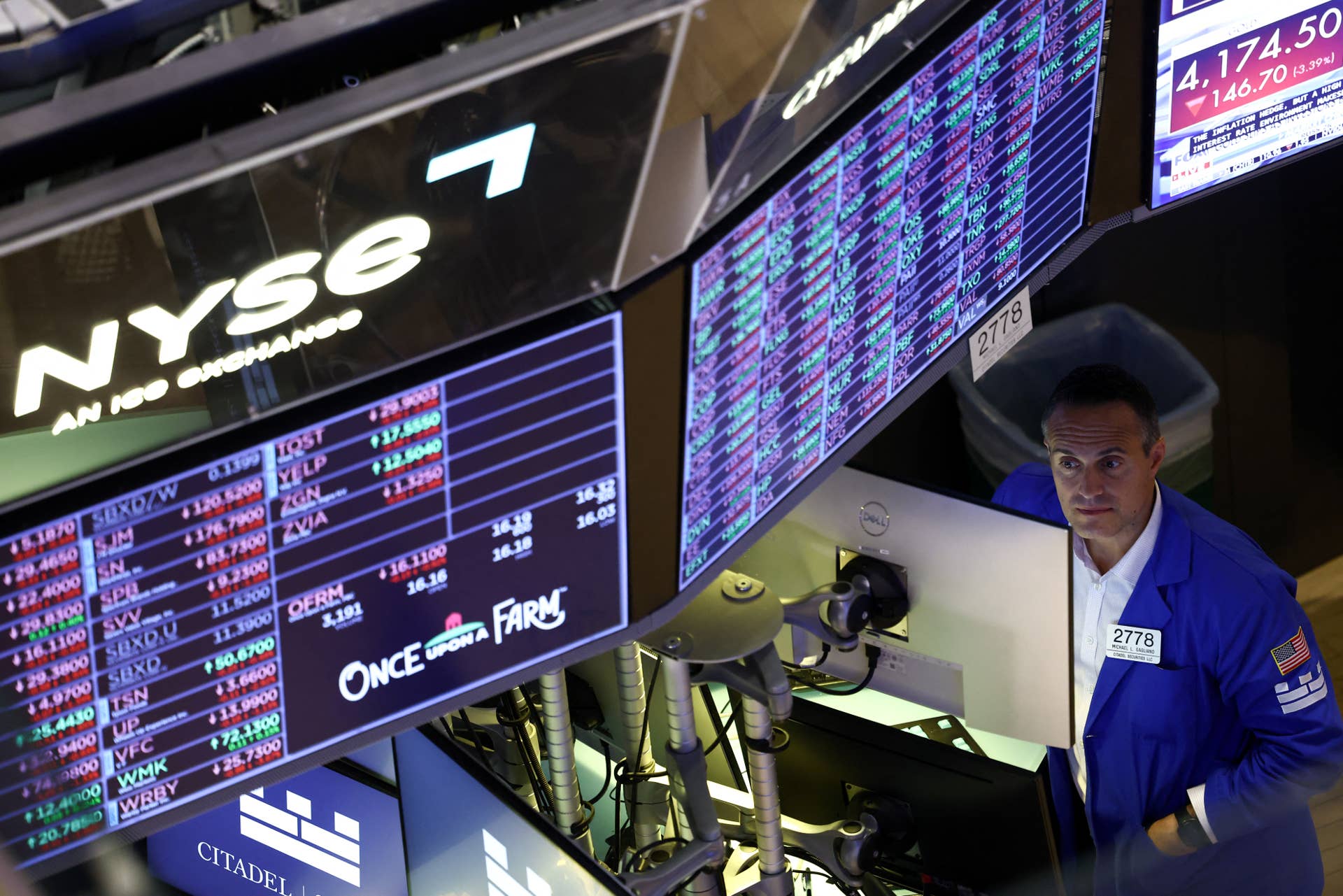
A trader works on the floor of the New York Stock Exchange at the opening bell, in New York City on September 28, 2026. Photo: Getty Images
Getty Images
The gains have not been shared evenly. The Dow has climbed far less over those four years, and technology stocks alone now make up about 40% of the S&P 500, leaving the whole index exposed to the AI trade Jones is shorting.
Both indexes were still setting records this month. On October 6 the S&P 500 closed at an all-time high of 7,818.95 and the Nasdaq at 27,599.79, Reuters reported.
Then this week happened. On Friday the Nasdaq fell 2.1% to 26,140.03, the S&P 500 lost 1.1% to 7,659.44 and the Dow slipped 0.3% to 52,002.41 as an extended tech sell-off dragged the market lower, the Associated Press reported.
The weekly scoreboard shows the split. The Nasdaq dropped 4.5%, its worst week since late June, while the S&P 500 gave up about 2% and the Dow actually finished the week 0.7% higher, according to Yahoo Finance. The Nasdaq now sits about 5.3% below its record close. The S&P 500 is only about 2% off its own.
That split is the story inside the numbers. Money is leaking out of the AI trade that carried the rally for four years, with investors increasingly nervous about the debt some AI infrastructure companies have taken on, while steadier corners of the market hold up better, as TheStreet's markets coverage has tracked through the week.
Even after the pullback, the indexes are up solidly for 2026. Through Friday's close the S&P 500 is ahead 11.9% for the year, the Nasdaq 12.5% and the Dow 8.2%.
History also offers a gentler read than Jones's. Research from Truist co-chief investment officer Keith Lerner counts this as the 11th bull market since the 1950s, and among those that reached a fifth year, the average gain was 12% and the median 15%, according to Yahoo Finance. Even if Jones is right about 2027, the final leg of a bull market has tended to pay investors who stayed.
Michael Saylor doubles down as market crash fears grow (2:39)
Not everyone is buying it
Investor Dave Ellison, asked about Jones's call on TheStreet this week, made the counterargument. The companies raising capital in this cycle are far stronger and more profitable than the dot-com class of 1999, he said, and the sheer level of worry already in the market is itself a reason for optimism.
Everyone is already worried about prices, rising rates and the federal deficit, Ellison said. That kind of wall of worry is exactly what bull markets climb.
Analyst warns Bitcoin is heading towards 1929-style crash (2:19)
What the warning means for Bitcoin and crypto
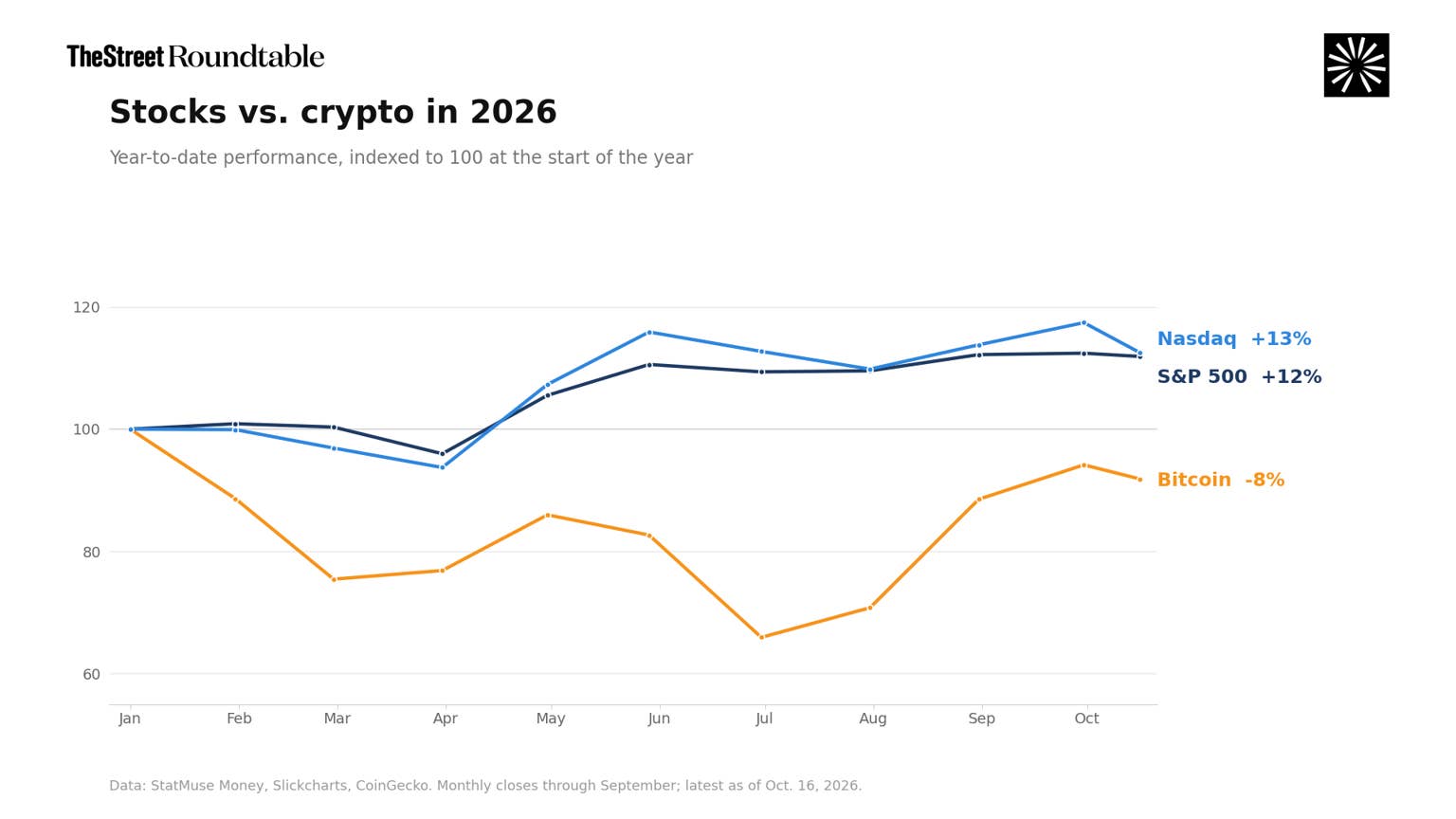
Crypto investors have not had the year stock investors have. Bitcoin changed hands near $81,500 on Friday, down about 8% for 2026 and roughly 35% below the record high it set last October, while the S&P 500 is up nearly 12% and the Nasdaq 12.5% over the same stretch, according to CoinGecko data.
The gap has been wide all year. Bitcoin crashed from about $126,000 last October to below $59,000 in June, climbed back above $86,000 earlier this month, and slid again alongside stocks this week.
Bitcoin versus the S&P 500 and the Nasdaq Composite this year, indexed to Jan. 1. (Data: StatMuse Money, Slickcharts, CoinGecko)
Jones himself is no crypto skeptic. He called Bitcoin "unequivocally the best inflation hedge that there is" on the Invest Like the Best podcast in April, arguing its fixed supply of 21 million coins beats gold, and his firm raised its stake in BlackRock's spot Bitcoin ETF in the second quarter.
Jones's argument is that a flood of new share supply is about to swamp stocks, and a hard-capped asset is the opposite of that problem. But crypto has traded like a risk asset all year, falling when tech falls, and a brutal 2027 for equities would likely drag Bitcoin down with it before any scarcity bid shows up.
The Roundtable 100
If you follow our market coverage every day, this one is built for you. We just launched the Roundtable 100, a weekly ranking of the 100 most investable tech stocks, digital assets included. The latest rankings publish every week at roundtable100.com.
Related: Roundtable 100 analyst sees a hidden opportunity in PayPal