Binance Hack 2026: How $6.3B Changed Crypto Security Crypto security damage was already rising in 2026, and then one announcement changed the scale of the whole year. The Binance Hack 2026 st
Binance Hack 2026: How $6.3B Changed Crypto Security
Crypto security damage was already rising in 2026, and then one announcement changed the scale of the whole year.
The Binance Hack 2026 story began when the exchange published an estimated impact of around $6.3 billion, a number larger than all of the recorded losses for the third quarter combined.
This article uses the exchange’s own update and data to show how big the event is, how 2026 looked before it, and what to watch next.
Key Points
The exchange estimates the total impact at around $6.3 billion, with about $3 billion frozen on-chain.
It says user funds are safe and that losses will be covered from the SAFU fund and company funds.
CertiK recorded $1.28 billion for all of Q3 2026, so the estimate is almost five times larger.
Incident counts have climbed through the year, but October’s jump comes from one event.
What the Exchange Has Confirmed
According to the official Security Incident Update published on October 30, 2026, an initial investigation suggests a compromised DevOps engineer’s laptop let an attacker reach a service container and submit unauthorized withdrawal transactions.
The company found no evidence of a wallet private key leak. The same text appears in an official post on X.
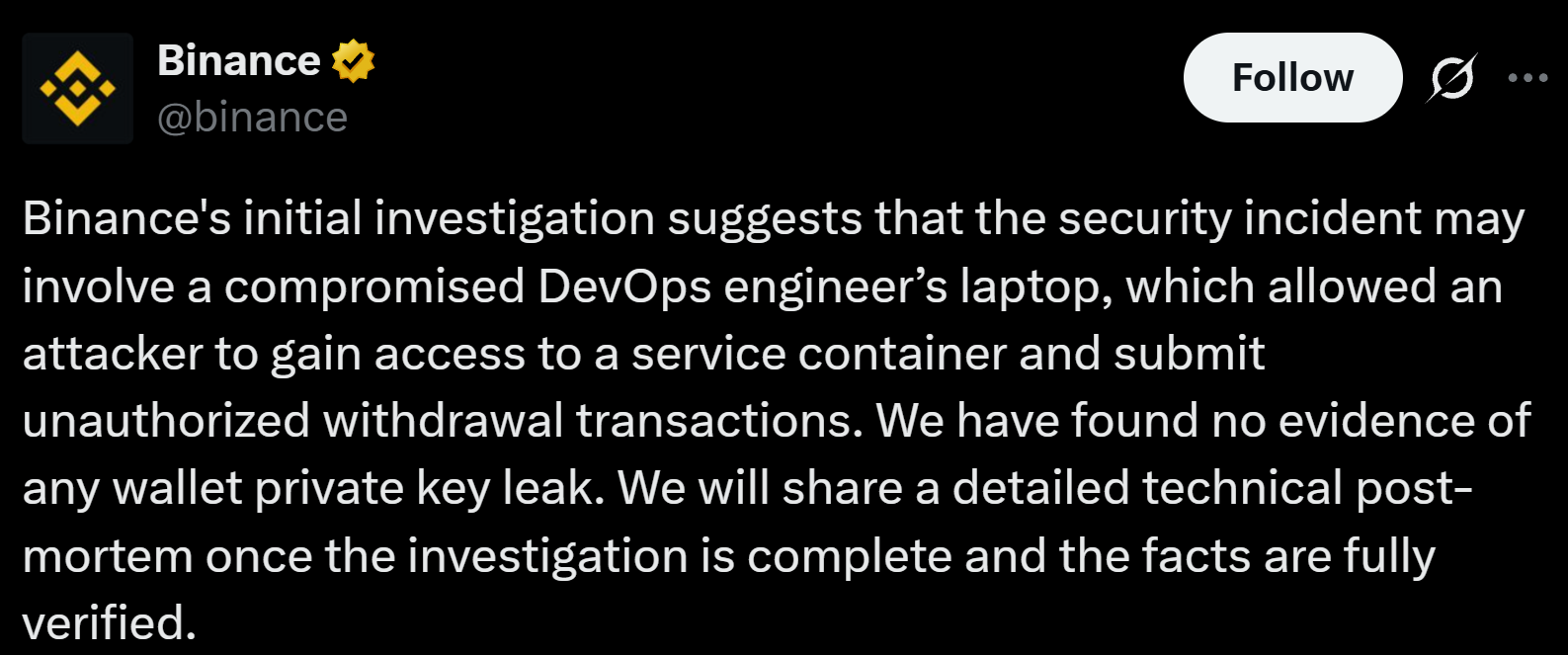
Note that the exchange calls this a “security incident,” not a hack, although many people use the second word. Here is what the update says:
Topic
Status
Estimated total impact
Around $6.3B
Frozen on-chain
About $3B so far
Who covers losses
SAFU fund and company funds
User funds
Described as safe
Deposits and withdrawals
Temporarily suspended
Next steps
Technical post-mortem and updated Proof of Reserves
How Big Is $6.3 Billion?
Context makes the number clearer. The Binance Hack 2026 estimate is a company figure for “impact,” while The reports “losses,” so the comparisons below are only a rough guide. By our own arithmetic:
Comparison
Figure
Estimate is about
CertiK Q3 2026 total losses
$1.28B
4.9 times larger
CertiK Sept 2026 total losses
$771.5M
8.2 times larger
Bybit loss in 2025
$1.447B
4.4 times larger
CertiK full-year 2025 total
About $3.35B
1.9 times larger
The comparison shows scale, not a ranking, and the exchange itself has not called this the largest incident in history, so we avoid that claim.
The Q3 and September numbers come from CertiK’s security dashboard, and the 2025 numbers come fromCertiK’s 2025 report, which singles out Bybit for its outsized share of that year’s amounts lost.
The Year Before October
In H1 2026 report counted $1,315,676,432 in losses across 344 incidents, which looked 46.8% lower than H1 2025.
That gap comes mostly from the Bybit theft in the 2025 base, and it says H1 2026 was about 28% higher once that outlier is removed.
Wallet compromise was the most damaging attack type, with over $444 million lost across 33 incidents, mainly from the Kelp DAO and Drift Protocol cases in April.
The dashboard shows momentum building after that. Q3 total losses reached $1.28 billion against $822.3 million in Q2, a 55.7% rise, while incidents grew from 222 to 255.
In September, Bitget lost $387.5 million and Liquid Network lost $318.7 million, and exploits made up 95.7% of the month’s $771.5 million total.
What the Chart Shows: Fewer Incidents, Bigger Hits
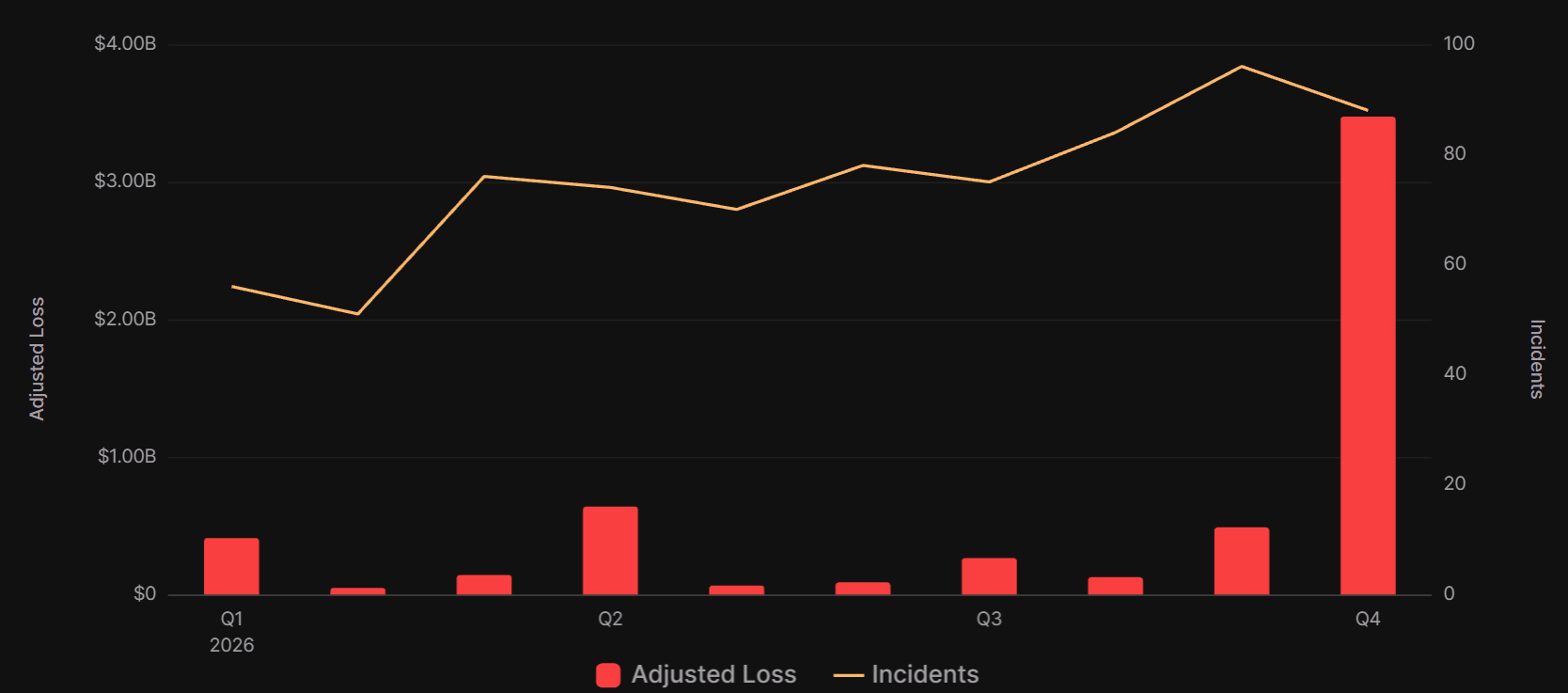
The chart tracks “adjusted loss,” which means the total after frozen and returned funds are subtracted.
In H1 2026, for example, $115.3 million was frozen or returned, which brought $1.316 billion down to about $1.2 billion.
The chart’s bars also line up with the dashboard’s adjusted figures of $793.6 million for Q2 and $878.7 million for Q3. Reading the bars by eye, the pattern is clear:
Period
Adjusted loss (approx.)
Incidents (approx.)
January
$0.4B
56
April
$0.6B
74
September
$0.5B
96
October
$3.5B
88
Incidents rose from about 56 in January to about 96 in September, then eased in October, yet adjusted loss jumped roughly sevenfold.
The incident counts across the ten bars add up to about 750, matching the headline in a post by The Kobeissi Letter, which says the industry has seen an estimated 750 incidents in 2026, with total potential losses of $9.0B.
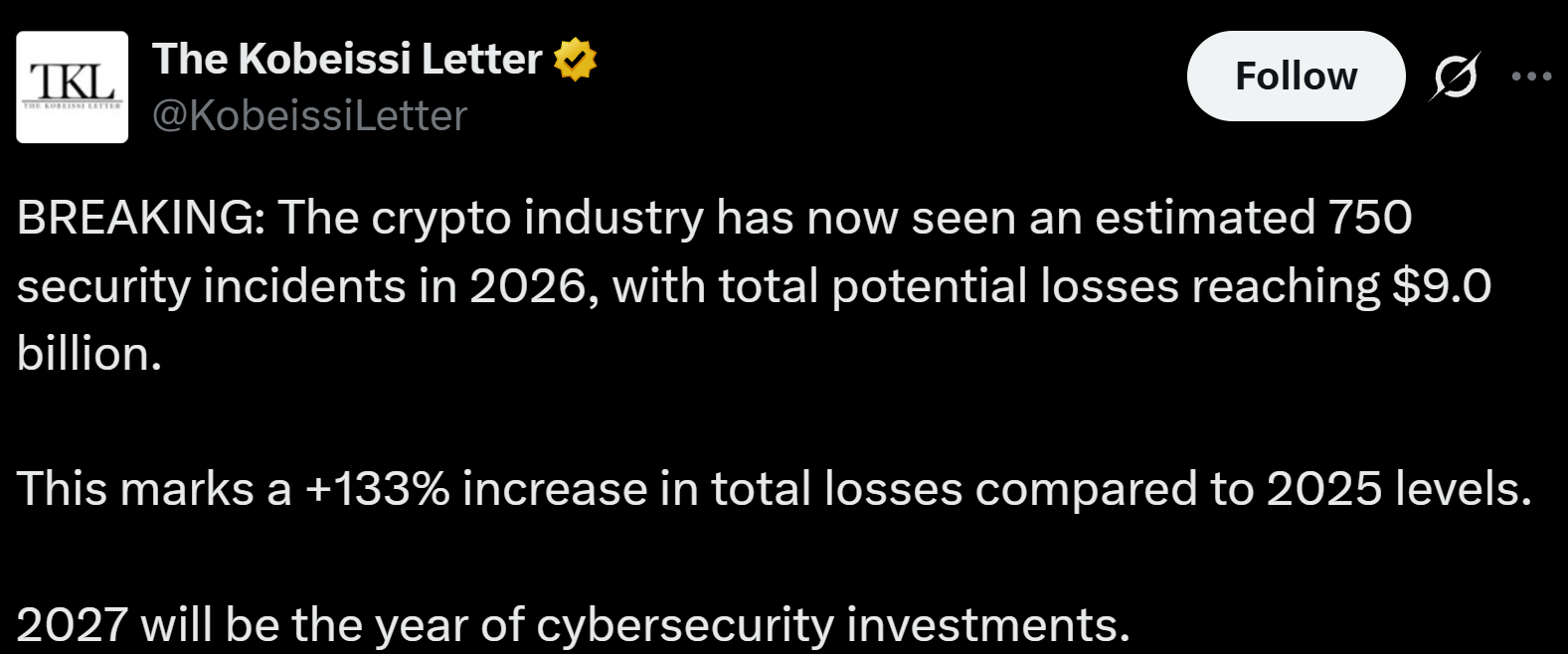
Our own sum supports that headline: In H1 total of $1.316B, plus its Q3 total of $1.28B, plus the exchange’s $6.3B estimate comes to about $8.9B.
The post also says losses are up 133% from 2025, but that percentage depends on the baseline.
In 2025 total was about $3.35B, and against it $9.0B would be about 2.7 times higher, so we cite the 133% as the post’s own figure.
The October bar appears to reflect the exchange’s case: $6.3 billion estimated impact minus about $3 billion frozen leaves roughly $3.3 billion, close to the bar’s height. That match is our own inference, not a statement from either source.
What to Watch Next
The Binance Hack 2026 story is still developing, and several official steps remain:
The detailed technical post-mortem
The updated Proof of Reserves
When deposits and withdrawals resume
Updates on frozen assets and recovery
Official statements, since the update asks users to rely only on official channels
Because adjusted loss subtracts frozen and returned funds, recovery progress could change how this case is counted later, though that is our inference.
The post also predicts that 2027 will be a year of heavy cybersecurity investment. That is a forecast, not a fact, but this year’s numbers explain why many expect it.
Conclusion
The Binance Hack 2026 story shows how one event can reshape a year of statistics.
Before October, Data showed steady growth in incidents and moderate amounts lost. After it, the picture is dominated by one very large, still-developing case.
Readers should rely on official updates, especially the promised technical report, and treat every figure as preliminary.
Disclaimer
This article is for educational and informational purposes only and is not financial or investment advice. Crypto assets are high risk, their prices can be very volatile, and you can lose some or all of your money. Always do your own research and consider speaking with a licensed financial advisor before making investment decisions.