Binance has reportedly shared customer transaction data and personal identifying information with Russian authorities in a case involving an IT specialist accused of financing terrorism throu
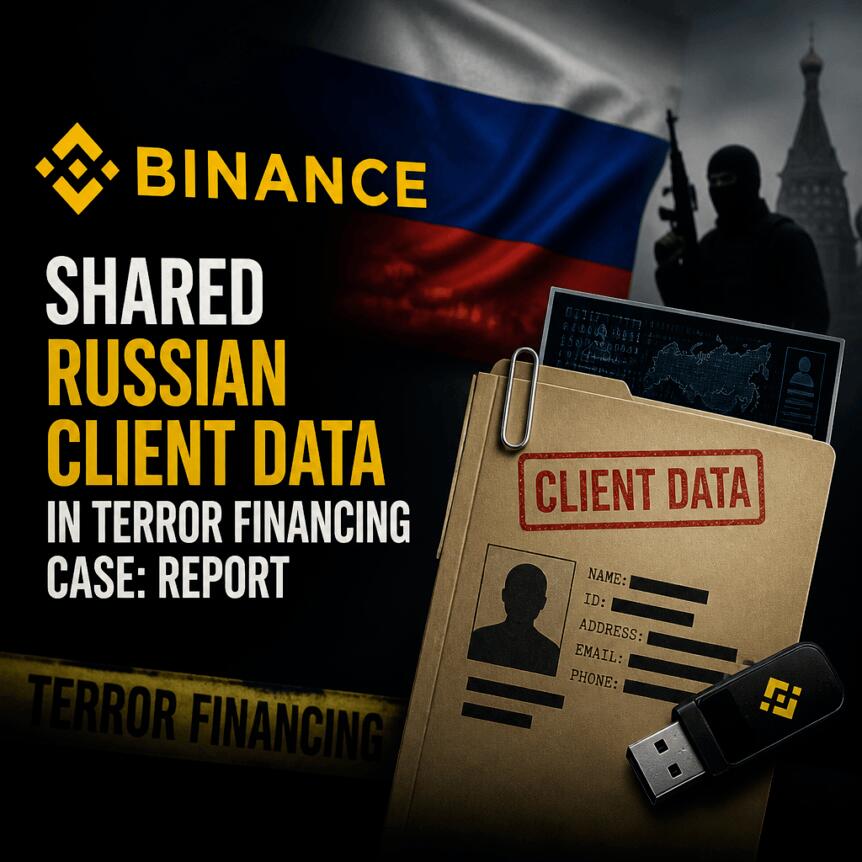
Binance has reportedly shared customer transaction data and personal identifying information with Russian authorities in a case involving an IT specialist accused of financing terrorism through cryptocurrency donations tied to Ukrainian fundraising campaigns, according to documents reviewed by Reuters.
Russian investigators say the information helped build the case against Yuri Belenkiy, who was detained in September 2025 and is currently awaiting trial in Russia. Reuters reports that law enforcement used Binance-supplied material as evidence supporting the charges.
Key takeaways
- Reuters reviewed law enforcement documents stating that Binance provided transaction history and personal details for Yuri Belenkiy.
- Russian authorities allege Belenkiy sent more than $700 in crypto between January 2023 and March 2024 to support the Ukrainian military and a banned group identified as Azov at different times.
- The data transfer included sensitive identifiers such as date of birth, address, phone number, and passport information.
- Binance says it cooperates with lawful information requests under applicable legal and privacy requirements, while declining to comment on the specifics of the case.
According to Reuters’ review, Russian authorities asked Binance for the transaction history of Yuri Belenkiy and received information linking him to cryptocurrency transfers. The response reportedly included not only transaction records but also personal identifiers used to connect the accused individual to the funds.
Reuters reports that the materials provided included Belenkiy’s date of birth, address, phone number, and passport number. The response also allegedly contained copies of his Russian passport and a Bulgarian residency permit.
The use of these records underscores a recurring pressure point for exchanges: even after exiting certain markets, platforms can still become a focal point for cross-border investigations when authorities request account and transaction data tied to specific users.
Allegations tied to crypto donations and a banned organization
Russia’s Investigative Committee alleges that Belenkiy sent more than $700 in cryptocurrency between January 2023 and March 2024. The alleged transfers were described as supporting the Ukrainian military as well as a group Reuters identified as the Azov Brigade or the Azov Regiment depending on the naming used at different times.
In the Russian case framing, the presence of a sanctioned or “banned” organization is central to the terrorism-related characterization. While the underlying activity described involves cryptocurrency donations connected to Ukrainian efforts, the legal outcome will depend on how prosecutors interpret intent, recipients, and the status of those recipients under Russian law.
For crypto users and compliance teams, the case illustrates how closely surveillance and enforcement can track on-chain value flows—especially when exchanges are able to connect addresses to real-world identities through account verification data.
Why the exchange’s earlier Russia exit matters
Binance announced it would fully exit Russia in September 2023, selling its local business to CommEX. Reuters’ reporting suggests that despite that earlier decision, Binance remained within the reach of Russian law enforcement requests for data tied to customers and past activity.
This detail matters for market participants because it challenges a common assumption that an exchange’s exit from a jurisdiction ends its role in later investigations. From an investor and compliance perspective, the key question is not only where a company currently operates, but also whether it retains or can access customer records and transaction logs that may be requested later.
Binance response and the compliance line
Reuters reports that a Binance spokesperson declined to comment on specific confidential law enforcement requests or the details of individual cases.
In comments shared with Cointelegraph, Binance stated that it does not make or enforce the laws of any jurisdiction, does not determine charges, and does not decide how governments use information in legal proceedings. The company said it cooperates with lawful information requests from law enforcement globally, subject to applicable legal, privacy, and regulatory requirements.
That response reflects a broad compliance position commonly used by major crypto exchanges: cooperation is framed as process-based rather than judgment-based. However, cases like this also highlight the practical risks for customers—particularly when authorities obtain both transaction records and personal identification data.
Earlier coverage from Cointelegraph noted that Binance planned to restrict transactions involving HTX and other crypto platforms, showing that the exchange continues to adjust operational policies as enforcement and regulatory pressures evolve. In parallel, user data requests remain a separate but highly consequential compliance channel.
As this case proceeds, the next developments to watch are how Russian courts treat the evidence derived from exchange records and whether legal proceedings clarify the standards used to link donations to specific recipients and to organizations classified as banned. For the broader crypto ecosystem, the outcome may influence how exchanges consider the scope and safeguards around information requests tied to historic activity.
This article was originally published as Binance Shared Russian Client Data in Terror Financing Case: Report on Crypto Breaking News – your trusted source for crypto news, Bitcoin news, and blockchain updates.