Binance Security Update Targets DeFi Phishing Attack After Bitget Hack The crypto industry woke up to fresh security concerns this week after Bitget confirmed a major breach affecting its hot
Binance Security Update Targets DeFi Phishing Attack After Bitget Hack
The crypto industry woke up to fresh security concerns this week after Bitget confirmed a major breach affecting its hot and warm wallets. Against that backdrop, it has rolled out new protective measures of its own.
This Binance security update, following the recent Bitget hack 2026 news cycle, centers on Wallet's decision to add real-time detection and risk-interception tools aimed at stopping phishing attacks that exploit DeFi authorization requests. The timing matters: these attacks often need no gas fee at all, making a single careless signature enough to drain a wallet.
At a Glance
Binance Wallet adds real-time detection for high-risk DeFi signatures.
Targets phishing and malicious authorization attacks.
Users are urged to verify domains, permissions, and addresses.
The move follows the Bitget hack and rising wallet security concerns.
Binance plans to expand risk protection coverage.
Binance Wallet Adds Real-Time Protection Against High-Risk Signatures
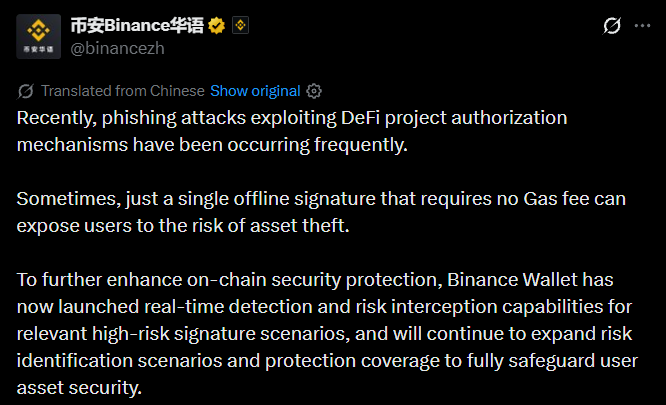
On September 25, 2026, the exchnage announced that its wallet product now actively screens for high-risk signing scenarios and can intercept suspicious approvals before they complete.
The company said the move responds directly to a recent wave of phishing schemes that abuse DeFi authorization mechanisms rather than traditional private-key theft.
Binance indicated this is only the starting point, with plans to keep broadening the range of risk patterns the system can recognize and block over time.
Source: Official X Post
How DeFi Phishing Attacks Can Steal Assets Without Gas Fees
Many crypto users assume danger only comes from transactions that cost gas, but offline signature requests can be just as damaging. These signatures grant permissions, sometimes full authorization over specific tokens, without ever touching the blockchain directly at the moment of signing.
Attackers disguise these requests inside cloned or lookalike interfaces, hoping victims sign without reading the fine print. Once approved, the transaction is generally irreversible, and funds can be moved out shortly after.
Binance Wallet Security Warnings: What Users Should Check Before Signing
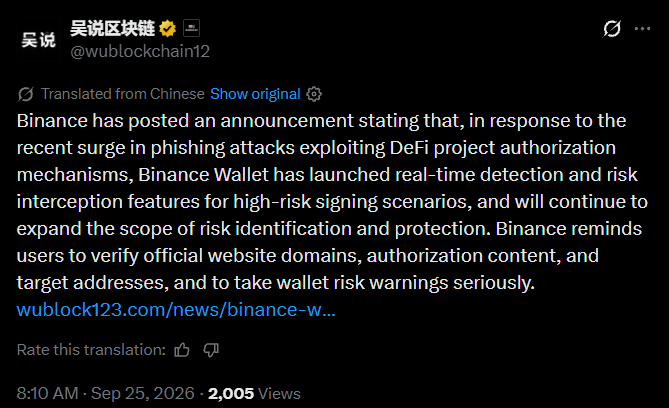
Binance's guidance to users is straightforward but easy to overlook in practice. Before approving anything, users should confirm the website domain matches the official platform exactly, since phishing sites frequently use near-identical URLs.
They should also read the specific authorization details rather than clicking through automatically, and verify the destination address tied to the request.
Wallet-generated pop-up warnings should never be dismissed casually, as they exist specifically to flag scenarios similar to recent attacks. The core message from Binance is that signatures cannot be undone once confirmed.
Source: Wu Blockchain
Bitget Hack 2026: Raises Fresh Questions About Crypto Exchange Security
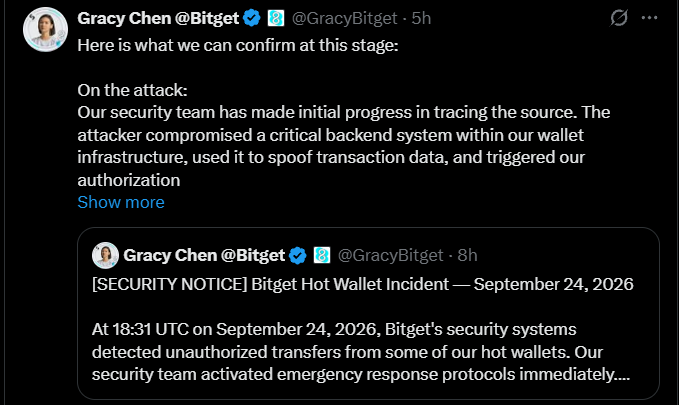
The latest Bitget crypto hack disclosed that it detected unauthorized transfers at 18:31 UTC on September 24, 2026, with an estimated impact of roughly $351.6 million.
According to the Bitget crypto exchange, only certain hot and warm wallets were affected, while cold storage remained untouched. Withdrawals were paused as a precaution, though deposits and trading continued normally.
CEO Gracy Chen said investigators traced the intrusion to a compromised backend system that was used to forge transfer data, and she stated that a private-key leak had been ruled out.
Some investigators have pointed to IP patterns associated with a North Korea-linked group, with blockchain researchers suggesting a possible connection to Lazarus Group, though this attribution remains unconfirmed pending Bitget's full report.
Source: Official Bitget X
Binance vs. Bitget: Different Security Risks, Different Attack Surfaces
The two developments highlight two very different weak points in crypto security.
Security Area
Bitget Incident
Binance Wallet Response
Main concern
Unauthorized transfers from hot/warm wallets
High-risk DeFi signature phishing
Attack surface
Exchange backend infrastructure
User-side signing and authorization
User action needed
Withdrawals temporarily paused
Review warnings before signing.
Protection focus
Exchange-level containment and fund reserves
Real-time detection and interception
Investigation status
Ongoing, report expected within 24 hours
Expanding risk-identification coverage
What Binance Wallet's New Protection Means for Crypto Users
The new detection layer gives users an added checkpoint before a risky approval goes through, which could meaningfully cut down on losses tied to authorization-based phishing.
That said, no wallet feature removes risk entirely. Scammers continually adapt their tactics, and tools like this work best alongside careful habits: checking URLs, reading authorization scopes, and treating every signature request as a real financial decision rather than a routine click.
What Happens Next for Binance Wallet and Exchange Security
Binance has committed to expanding its risk-detection scope beyond the current set of scenarios, though it hasn't detailed a specific timeline for future updates.
Bitget, meanwhile, has promised an incident report covering root cause analysis and remediation steps, with Bybit's CEO Ben Zhou offering tracking assistance through his firm's bounty platform.
Together, these stories point to two fronts crypto users and platforms need to watch: backend infrastructure resilience on the exchange side, and phishing-resistant signing on the wallet side.
Binance Wallet Security Timeline: From Phishing Threats to Real-Time Interception
Time
Development
Sep 24, 18:31 UTC
Bitget detects unauthorized transfers.
Sep 24-25
Security teams trace backend compromise and track outflows.
Sep 25
Bitget suspends withdrawals as a precaution.
Sep 25
Binance announces real-time signature detection and interception.
Ongoing
Binance exchange plans wider risk-identification coverage.
Conclusion
Coming so close together, Bitget crypto hack news and Binance's new wallet protections underscore how crypto security threats are evolving on multiple layers at once.
Neither development should be read as a guarantee against future incidents, but both reflect a broader industry push toward real-time transaction and signature scrutiny. Users are best served by pairing platform-level tools with their own diligence.
Disclaimer: This article is for informational purposes only and does not constitute financial, investment, or legal advice. Cryptocurrency markets are volatile and carry risk. Security features, investigation findings, and incident details discussed here may change as events develop. Readers should independently verify wallet alerts, domains, and official announcements, and consult a qualified professional before making any financial decisions.
