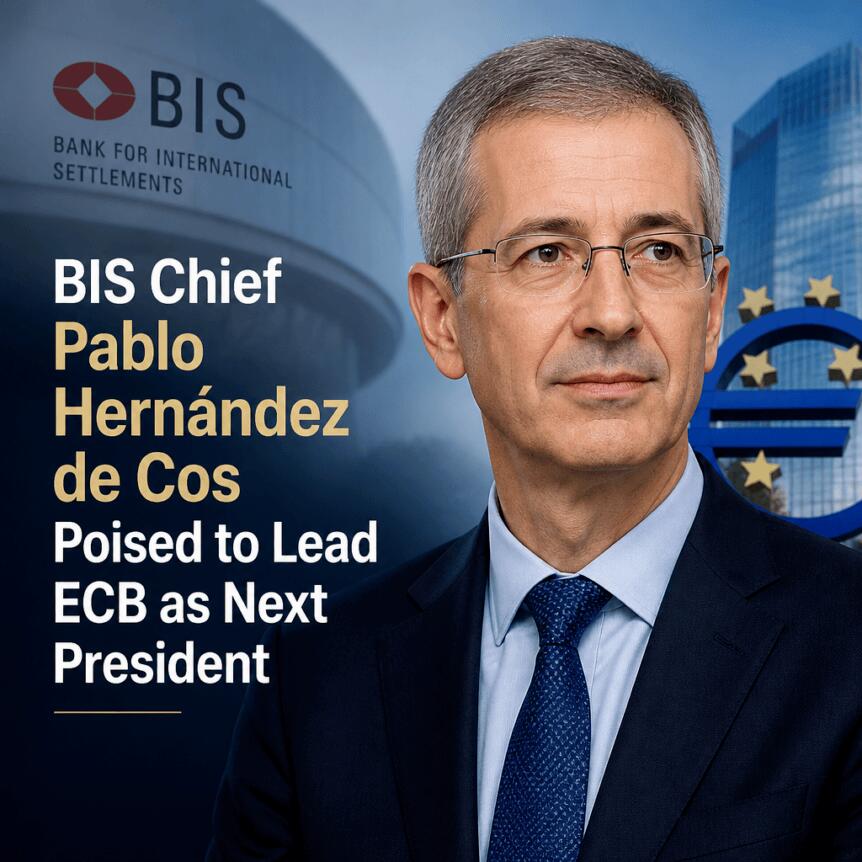
The European Central Bank is set to get a new president as the BIS’ general manager Pablo Hernández de Cos moves into pole position to succeed Christine Lagarde, according to the Financial Ti
The European Central Bank is set to get a new president as the BIS’ general manager Pablo Hernández de Cos moves into pole position to succeed Christine Lagarde, according to the Financial Times, citing people familiar with the matter. The report says Hernández de Cos has secured the backing of a majority of eurozone governments, with the appointment still subject to formal approval.
Hernández de Cos is expected to take over on Feb. 7, after the Dutch government withdrew its support for rival candidate Klaas Knot, a former governor of the Netherlands’ central bank. Investors watching Europe’s monetary agenda may see the change as more than personnel: it comes at a moment when the ECB is advancing its digital euro roadmap and intensifying its scrutiny of private stablecoins.
Key takeaways
- Pablo Hernández de Cos is reported to be backed by a majority of eurozone governments to succeed Christine Lagarde at the ECB, pending formal approval.
- Hernández de Cos is due to start on Feb. 7, after the Netherlands withdrew support for rival candidate Klaas Knot.
- He has argued stablecoins are not “credible” as large-scale payment systems, while endorsing tokenized bank deposits for day-to-day use.
- He warns that widespread use of US dollar-backed stablecoins abroad could weaken Europe’s monetary sovereignty and transmission of domestic policy.
- The leadership transition aligns with the digital euro effort, with a pilot planned for 2027 and a potential launch in 2029, subject to legislation.
Why the candidate matters for Europe’s stablecoin stance
Hernández de Cos has been one of the more vocal central bank figures critical of stablecoins as they are commonly implemented. Speaking at the Jackson Hole Economic Symposium in August, he argued that stablecoins in their current form are not a credible vehicle for payments at scale. Instead, he pointed toward tokenized bank deposits as a more suitable structure for everyday payment use and for wholesale settlement.
This distinction matters for the way European policymakers may approach the private stablecoin debate. A shift toward tokenized deposits would effectively keep the core of payment infrastructure closer to the traditional banking system, even as settlement technology modernizes. That approach can appeal to regulators seeking to reduce fragmentation and preserve established channels for liquidity and monetary policy transmission.
Concerns about dollar stablecoins and monetary sovereignty
While Hernández de Cos acknowledged that stablecoins could have specialized uses, he also issued a broader caution: the widespread adoption of US dollar-backed stablecoins outside their primary jurisdiction could undermine monetary sovereignty and weaken domestic policy transmission in Europe. He also noted a potential downside risk for banks if a broader payments ecosystem moved away from bank deposits—an outcome that could raise bank funding costs.
In practice, these arguments reflect a central tension in the European view of stablecoins. Even if stablecoins offer faster settlement and cross-border utility, policymakers may worry about where credit, liquidity, and confidence ultimately sit—particularly when the asset is tied to a different currency and the issuer or reserve mechanics are not under local control.
Digital euro continuity: a focus on public money rails
Hernández de Cos has, by contrast, shown more openness toward central bank digital currencies. In a 2023 speech, he said a digital euro could support payments innovation while safeguarding Europe’s monetary sovereignty.
The reported leadership change comes as the ECB advances its digital euro project. According to the project’s publicly stated timeline, a pilot is planned for 2027, with a potential launch in 2029—both dependent on legislative approval. If Hernández de Cos takes office as expected, his track record suggests he will likely continue to frame the digital euro not just as a technology experiment, but as a response to competition from private tokens and evolving payment demands.
For market participants, that continuity can influence expectations around how the ECB might balance innovation with regulatory control—especially regarding settlement options, interoperability, and the degree to which tokenized forms of deposits might coexist with a public digital euro.
What to watch after the report: approval and policy direction
Although the Financial Times report indicates Hernández de Cos has secured backing from a majority of eurozone governments, the appointment still requires formal approval. The Netherlands’ withdrawal of support for Klaas Knot underscores that eurozone leadership races can turn on national preferences and political calculations—so the final outcome should be treated as pending until official steps are completed.
Beyond the process, investors and builders should focus on the policy signals that often follow an ECB leadership transition. Hernández de Cos’ prior remarks suggest a likely emphasis on keeping large-scale payment functionality anchored to the banking system or to public-sector infrastructure like the digital euro, rather than relying on US dollar-backed stablecoins as a mainstream payment layer.
With the digital euro pilot and potential 2029 launch still subject to legislation, the immediate question for the market is whether the ECB under new leadership will tighten its stablecoin skepticism further—or broaden the room for experimentation through frameworks that keep monetary control and reserve accountability closer to European institutions.
This article was originally published as BIS Chief Pablo Hernández de Cos Poised to Lead ECB as Next President on Crypto Breaking News – your trusted source for crypto news, Bitcoin news, and blockchain updates.