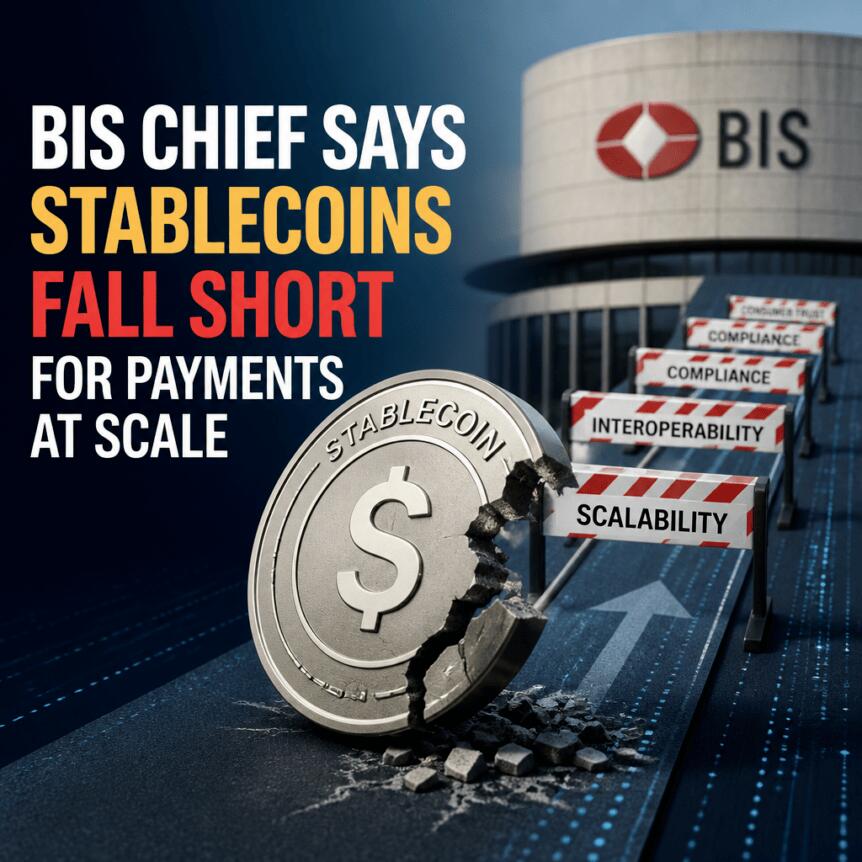
The Bank for International Settlements (BIS) has renewed its scepticism toward stablecoins, arguing that they have not proven credible as everyday payment instruments at scale—even as governm
The Bank for International Settlements (BIS) has renewed its scepticism toward stablecoins, arguing that they have not proven credible as everyday payment instruments at scale—even as governments push forward with regulatory regimes for tokenised cash.
In comments reported by Reuters, BIS General Manager Pablo Hernández de Cos said stablecoins struggle to function reliably as a means of payment. He contrasted them with tokenised bank deposits, which he described as a more direct way to bring tokenisation into finance while preserving the core foundations of the monetary system. Hernández de Cos, who is also a candidate to succeed European Central Bank President Christine Lagarde next year, tied the debate to how regulators should weigh innovation against financial stability and monetary policy control.
Key takeaways
- The BIS argues stablecoins are not credible for everyday payments at scale, while tokenised deposits are viewed as a more workable alternative.
- Hernández de Cos acknowledged potential benefits such as lower government borrowing costs, but warned of possible knock-on effects for bank funding and consumer borrowing rates.
- BIS/FSI research highlights major differences across the US, EU, UK, Hong Kong, and Singapore in who can issue stablecoins and what activities are permitted.
- Regulatory limits often apply to the issuing entity itself, not the broader corporate group—creating potential structural workarounds.
Why the BIS says stablecoins fall short as “money in practice”
Hernández de Cos’ central critique focuses on usability and reliability. He said stablecoins do not credibly operate as a large-scale payment channel. Instead, he argued that tokenised deposits could better achieve the goal of harnessing tokenisation while maintaining the monetary system’s institutional backbone.
The BIS position comes at a time when stablecoins are increasingly moving from pilot use cases toward broader market adoption. That shift has forced regulators to confront questions that go beyond technology: Are stablecoins effectively “money” for day-to-day transactions? Do they improve settlement efficiency without eroding oversight? And how should authorities prevent misuse while still allowing legitimate payments innovation?
Lower borrowing costs—who pays the trade-off?
While criticising stablecoins as payments instruments, Hernández de Cos did not dismiss the economic arguments in favour of them. He specifically referenced the idea—also raised publicly by US Treasury Secretary Scott Bessent—that stablecoins could help reduce government borrowing costs.
However, the BIS general manager suggested the effect could be uneven across the financial system and potentially come with consumer consequences. If customers shift bank deposits into stablecoins, banks may face higher funding costs. According to Hernández de Cos, those costs could then be reflected through higher borrowing rates for households and businesses.
That framing matters for investors and users because it highlights an often-overlooked point: stablecoin growth may not just redistribute benefits. It can also alter funding structures within banking, potentially changing how credit is priced and transmitted through the economy.
Regulatory friction: interoperability and anti-money laundering controls
Beyond payments effectiveness, Hernández de Cos pointed to operational and compliance challenges. He cited limited interoperability between stablecoin platforms, arguing that cross-platform connectivity remains insufficient for smooth, consistent use. He also flagged difficulties in consistently applying anti-money laundering (AML) controls—an issue that becomes more sensitive as stablecoins circulate beyond domestic markets.
He further warned that increased use of US dollar-pegged stablecoins outside the United States could undermine monetary sovereignty and weaken the effectiveness of domestic monetary policy. In other words, even if stablecoins are designed to track a fiat unit, their broader circulation can still create policy spillovers and complicate how authorities manage liquidity and credit conditions.
BIS-linked research finds uneven stablecoin rules worldwide
The BIS critique is accompanied by findings from a new study released by the Financial Stability Institute (FSI), a BIS-linked body. In a publication released Thursday, FSI compared stablecoin regulatory frameworks across the United States, European Union, United Kingdom, Hong Kong, and Singapore, focusing on who is permitted to issue stablecoins and what other activities those issuers may conduct.
According to the study, these jurisdictions differ substantially. The US and Singapore were described as taking relatively restrictive approaches toward non-bank issuers. Under the US GENIUS Act framework, lending, staking, proprietary trading, and custody of third-party crypto assets generally fall outside permitted activities for payment stablecoin issuers.
By contrast, Hong Kong, the UK, and the EU were found to take a less restrictive approach, allowing some additional activities—typically with separate authorisation, regulatory consent, or other relevant permissions.
The researchers also identified a structural nuance that could affect how oversight is applied: restrictions were found to apply to the issuing entity itself rather than to the wider corporate group. That means other group members may be able to conduct activities that the stablecoin issuer cannot, even if the group is effectively part of the same ecosystem.
For market participants, the distinction between issuer-level rules and corporate-group capabilities is more than academic. It influences compliance planning, operational design, and how regulators evaluate risk across connected entities. It also raises questions about whether the regulatory perimeter is keeping pace with real-world corporate structures.
What comes next for stablecoin policy
As the debate continues, regulators and firms will be watching whether tokenised deposits gain clearer momentum as a preferred “tokenisation with guardrails” pathway, and whether jurisdictions converge on issuer rules that are consistent enough to prevent regulatory gaps across corporate groups and platforms.
This article was originally published as BIS Chief Says Stablecoins Fall Short for Payments at Scale on Crypto Breaking News – your trusted source for crypto news, Bitcoin news, and blockchain updates.